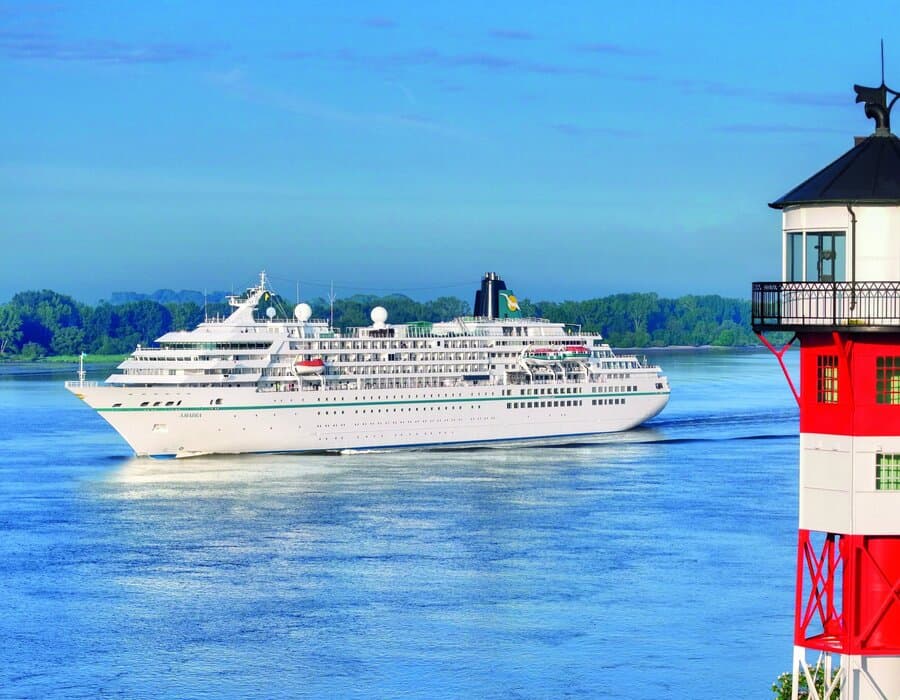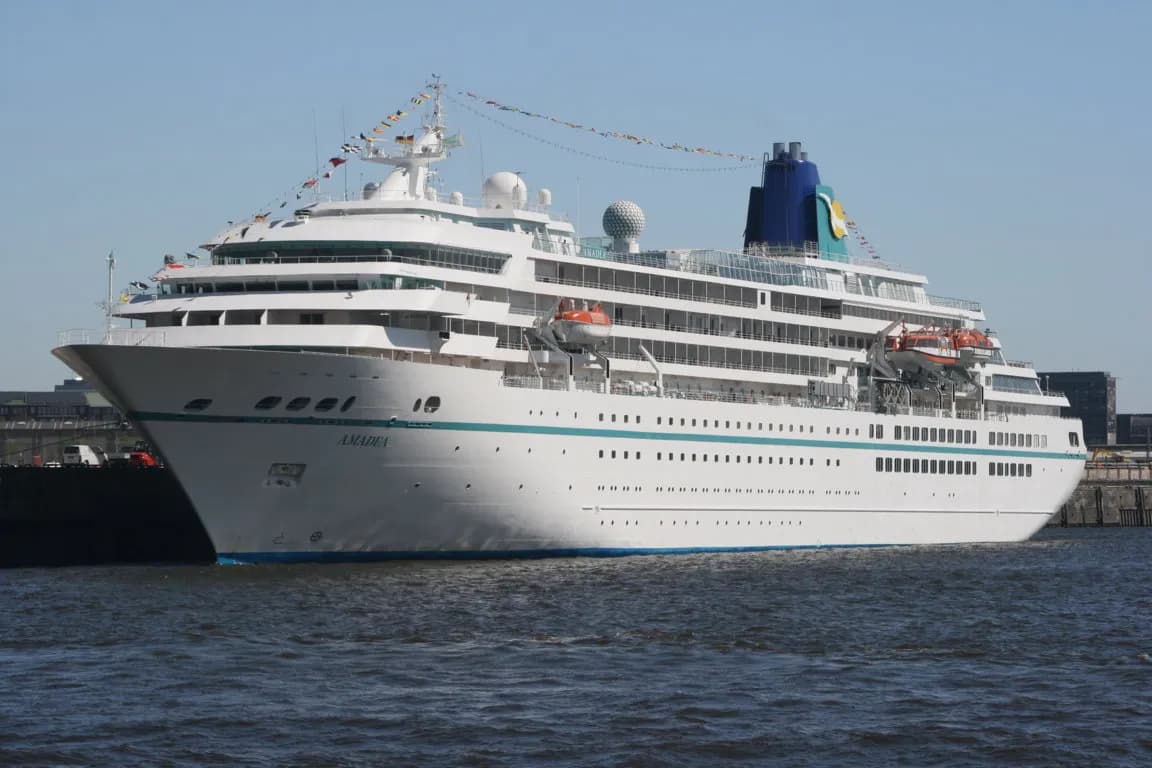
For 20 years, in 2026, the Amadea has been part of the Phoenix fleet, and for over 10 years it has been the dream ship of German television.
In the German cruise market, it holds a well-established position, and thanks to its compact size and Japanese origins, it has a charm all its own. We had the opportunity to get to know the ship, its crew, and its passengers during a brief two-day visit.
Anyone checking in at the Columbus Cruise Center in Bremerhaven for a Phoenix cruise can’t help but feel like they are attending a large reunion of former classmates. Passengers greet the Phoenix team, who return the greetings, while both new and experienced passengers exchange pleasantries with one another; the crew of 315 people already know each other naturally. The “Welcome aboard” quickly becomes “welcome home” — it’s more than just a slogan. Eighty percent of the guests on the upcoming cruise to Southern England and Northern France (“Westeuropäische Küstenhighlights”) are regulars, so most people are inevitably familiar with one another from previous cruises. In addition, the Amadea has just returned from a long North Atlantic and Greenland cruise, and many crew members and performers are arriving in Bremerhaven for the first time, while their predecessors either change ships, finish their contracts, or go on vacation.
Soon after, the familiar atmosphere is also felt on board the ship itself. The “First Lady of the Seas” (Phoenix Reisen) can accommodate a maximum of 570 passengers, less than a tenth of the Disney Adventure, which is currently docked in the harbor basin across for final outfitting. It’s a comparison of completely different worlds: here is ZDF’s dream ship, connecting its older passengers (average age on this cruise: 72) with Florian Silbereisen and the romantic stories of television; there, a floating amusement park for families, where even short cruises without port stops still feature a roller coaster on the sun deck.
Here we have an elegant ship from 1991, with three-digit cabin numbers, no casino, and no children’s playroom; there, a mega cruiser with 20 decks, where public areas are divided into seven themed sections to prevent confusion or getting lost. Even within the Phoenix fleet, many Amadea enthusiasts would struggle to confuse it with the Artania or the Amera, because the former ASUKA is closer in size to the old Albatros (retired in 2020) than to the “Grand Lady” or the former Royal Viking Sun.
Even the emergency drill shortly before departure takes place in a relatively intimate setting. No loudspeakers or megaphones are needed here: the cabin number is simply called, and if the guest is present, they respond with a firm “Yes.” Couples respond with “Yes, yes,” while cabins with multiple occupants are not available on the Amadea. Everything is checked off on a small board with slips of paper, and the linguistic chaos typical of other ships is absent. Ninety-six percent of Amadea passengers are German, Austrian, or Swiss (occasionally there’s a Luxembourger, Dutch, or Dane), so there are no announcements in English on board. On a Phoenix ship, you are among like-minded people — both demographically and linguistically.
A Cruise Ship the Old-Fashioned Way
Punctually at 6:00 p.m., the Amadea sets sail from Bremerhaven, where during the day it had taken on an additional 40 tons of provisions for the departing cruise. The Weser metropolis serves as its secret home port: seven months a year, cruises begin and end here, interrupted “only” by a world cruise that, during the remaining five months, takes the ship to all continents. And so it goes, year after year. After 35 years on the seven seas, there are very few ports this seasoned ship hasn’t visited. The forward staircase on board is adorned with plaques from ports around the world, a testament to its voyages — a true gallery that grows year after year.
For departure, there is no shortage of a Sailaway Party on the sun deck, with complimentary champagne and the first meetings (or reunions) with the ever-present Phoenix team on board. The evening sun disappears behind windmills and dikes as the Amadea leaves behind the MSC, Maersk & Co. container ships, exchanging the calm Weser for the rougher waters of the North Sea.
At dinner in the aft “Vier Jahreszeiten” restaurant, the gentle movement of the waves makes the meal a little wobbly, but no one minds: after all, we’re on a ship, and on vacation, no one needs to constantly check the clock for fear of losing their food. In the two equivalent restaurants, “Vier Jahreszeiten” (Deck 5) and “Amadea” (Deck 8), dinner is served in a single long seating period with free choice of tables from 6:30 p.m. to 9:00 p.m. Those who don’t want to miss the departure or prefer a relaxed shower after a late excursion can take their time. Phoenix had already introduced this concept of “Freestyle Cruising” long before other companies marketed it extensively.
The first evening’s menu includes duck breast, mixed salad, beef meatballs, and apple pie — all very good, though perhaps not enough to fully satisfy, especially if breakfast and lunch were skipped on embarkation day. No problem, however: snacks are available until late at Harry’s Bar and Kopernikus Bar, respectively until 11:00 p.m. and even 1:00 a.m., with the famous “Kopernikus-Würstchen.” On the Amadea, no one goes hungry, and no one suffers from seasickness: thanks to a minor adaptation, even the famous “Schnapsi Taxi” — an invention from colleagues at AIDA Cruises — has now found its way onto Phoenix ships.
A perfect opportunity to get to know the ship comes after dinner with a guided tour on board, attended not only by new guests but also by regular Amadea passengers. It’s a simple moment to chat with the Phoenix team or share anecdotes and curiosities about the ship.
It’s immediately noticeable that the Amadea, like the other ships in the Phoenix fleet, is a vessel from another era, with its classic — if now somewhat dated — layout of cabins in the forward section (all cabins on board are exterior) and common areas, including the aft show lounge. This ensures quiet cabin corridors but requires a bit of up-and-down movement on the stairs: the reception is on Deck 5, bars and lounges on Decks 6 and 9, and everything else somewhere in between.
What might seem complicated actually has many advantages: there’s no need to walk 250 meters along a promenade to get from one point to another, you frequently encounter other passengers on the stairs or in the elevators, and at the same time you can enjoy a truly nautical atmosphere within the ship. Where other vessels have purely functional staircases without any detail, the Amadea features in its mini-atrium a kind of “interior railing”: a wooden handrail with white metal posts, similar to the one on the sun deck. The archway along the shop on Deck 6, with its deck-plank effect, is also excellent.
In other areas, the television dream ship exudes the charm of classic passenger liners: wooden panels separating the elevators, the beautiful teak promenade deck, or the large model of the old Albatros, rescued just before demolition and now displayed in the Vista Lounge on Deck 10 — the best spot for a panorama bar. Here, guests can relax to live music (jazz or piano) and enjoy a 360° view of the sea, even better than that from the nearby bridge. For many regular passengers, the Vista Lounge is their favorite place on board.
Many others prefer the library on Deck 9, which includes the “Kaminzimmer” (fireplace room). This area has remained almost untouched by the ship’s two owners since it entered service. Upholstered armchairs invite lingering, the bookshelves are filled with novels, illustrated volumes, and reading material of all kinds, and the games cabinet contains classics like Monopoly and Trivial Pursuit — no modern inventions like Hitster or Werewolves. Sunlight filters through the windows overlooking the promenade deck. Even the seemingly random sheets pinned to the central bulletin board have a story: they come from old ship registers and “notes” from cabin stewards, literally rescued from the trash during crew handovers by the Phoenix team. In this way, the Amadea achieves something often missing elsewhere: a reverent respect for the ship’s glorious past and for the legacy of the vessel built in 1991 as Asuka.
The Japanese Soul
The Amadea still retains a bit of its Japanese soul today. Although Japanese travel groups — who, after the Asuka became part of Phoenix Reisen in 2006, regularly went on nostalgic cruises aboard “their” ship — are now a thing of the past, the ship’s interior still contains numerous references to its former life as the flagship of Nippon Yusen Kaisha (NYK). The most impressive is the artwork Song of the Seasons by Japanese painter Noriko Tamura, a giant mural that serves as the backdrop to the atrium. Other historical references can be found in the cabin corridors, where wall art (each piece unique in theme and design) features Japanese motifs, such as stylized cranes over the ruins of Hiroshima, or in the common areas, where artificial flowers clearly show an Asian influence.
To avoid stylistic clashes after necessary renovations, Phoenix Reisen has added decorations with Japanese touches, visible for example in bamboo-shaped display cases or more recent carpets with oriental floral patterns. Even the bridge preserves traces of its Japanese heritage: not only is the original Asuka bell honored here, but there is also a brass gong for the traditional Japanese tea ceremony (everything else would bring bad luck). The Fuji binoculars, installed on the bridge for 35 years, are still used, and according to the officers, have served better over time than other models available in Europe.
The bond between the old and new owners is mutual: every time the Amadea returns to its home port of Nagasaki, the Mitsubishi Heavy Industries shipyards briefly pause work and bow to the ship. An even more emotional moment will occur on March 19, 2026, when the Amadea (formerly Asuka), the current Asuka II, and the new Asuka III, built in 2025 at Meyer Werft in Papenburg, meet in Nagasaki — guaranteed emotions.
After 20 years in the Phoenix fleet, the Amadea also shows an unmistakably German character. The suites on Deck 10 bear the names of German cities such as “Wiesbaden,” “Magdeburg,” and “Braunschweig”; in Harry’s Bar, among images of musical instruments, one finds quotes from Nietzsche and Wilhelm Busch; on the sun deck, there are real Strandkörbe, just like in Travemünde or Westerland. The donation box for the DGzRS, permanently placed at reception, is a rarity in the cruise world.
On board, everyone greets one another as in a small neighborhood shop. On the Lido Deck, during the “maritime Frühshoppen,” the crew brings out beer-tent benches while Freddy Quinn plays in the background. In his song Unter fremden Sternen, the lyrics go: “Fährt ein weißes Schiff nach Hongkong / Hab’ ich Sehnsucht nach der Ferne / Aber dann in weiter Ferne / Hab’ ich Sehnsucht nach zu Haus”
No song better describes the Amadea and the sense of travel it conveys. Finally, spare parts for the old 1991 Mitsubishi diesel engine are now custom-made by the German company MAN — another successful German-Japanese collaboration.
Music in Every Bar
The first evening on board, according to the day’s program (still delivered each evening in printed form to cabins, and never forgetting the popular “Where is the Phoenix fleet today?”), is dedicated to the theme “Music in Every Bar.” The goal is simply to get acquainted with life on board; after all, tomorrow is “only” a day at sea.
From 8:30 p.m., Claus Speder — who alternates between the titles of “musician,” “all-rounder,” and “solo entertainer” — performs for guests in Harry’s Bar. An hour later, in the same venue, Scottish singer Kyle Trimble hosts a Pop Party featuring hits by Elton John, ABBA, and Madonna. Entertainment is also available in the Vista Lounge or at the Jupiter Bar on the Lido Deck, so no one is left without music.
The Amadea’s show ensemble consists of four singers and six dancers, ensuring both musical and choreographic variety. In addition to the large Atlantik Show Lounge, which spans two decks at the aft, Harry’s Bar often becomes a stage for more intimate performances, with ventriloquists or magicians, and is sometimes transformed into a disco or ballroom. On Deck 6 to starboard, themed musical evenings take place — Flower Power, Oldies, or Classic Rock — the favorite genres of Phoenix’s long-time clientele, who grew up with the Beatles and the Rolling Stones and are now experiencing their second (or third) youth aboard the Amadea. Harry’s Bar, where I enjoy a Schmalzstulle and a pretzel sandwich with meat salad in the evening, is the ship’s third little gem and its secret heart.
Those who aren’t in the mood for music or conversation can retreat to the onboard cinema, also on Deck 6 amidships. A perfect oasis for film lovers or anyone who enjoys communal viewing, it accommodates 2 to 20 people. Admission is free, and the schedule can be checked at reception. The cinema also serves for lectures and as a meeting point for excursions. The only detail that might be distracting late at night is the view of the gigantic wind farm in front of the East Frisian Islands. Lit up like a city, the sea of lights appears almost surreal, interrupting the quiet moment of night-time contemplation. In the 21st century, true darkness in the North Sea can only be experienced by closing the cabin curtains — and even longer if you consider the time zone, which gives an extra hour during the crossing to Great Britain.
A Day at Sea
The following morning, the North Sea is calm. The light breakfast in Harry’s Bar is ready as early as 6:30 a.m. (early risers are never in short supply on a German ship), while the main breakfast, served in both onboard restaurants, begins at 8:00 a.m. Those who prefer a buffet can head to the Amadea Restaurant, while guests wishing to be served at the table have the à la carte option at the more elegant Vier Jahreszeiten Restaurant. The buffet restaurant has the advantage of opening onto the Lido terrace, allowing for outdoor dining when the weather permits. On this October day along the Dutch coast, however, the air is rather crisp, so most guests prefer the indoor comfort of the ship, enjoying Phoenix’s fresh bread, just-baked rolls, or an “English Breakfast” with ham and scrambled eggs.
Well nourished, the morning offers the opportunity to attend a lecture by onboard lecturer Petra Clamer, who at 10:00 a.m. gives a talk titled “The North Sea – The Capricious Sea”, perfectly suited to a day at sea, explaining the formation, history, and characteristics of the waters beneath the Amadea’s hull. Other guests relax in the Vista Lounge or the library, enjoying the tranquility before tomorrow, with the first port of call (Dover), when attention will shift to shore excursions. The distance from Bremerhaven to Dover is 348 nautical miles — enough time, after the traditional bustle of embarkation day, to become familiar with the ship, other passengers, and perhaps even a few crew members.
Visiting the Captain
In the morning, I meet the Amadea’s captain, Dutchman Robert Fronenbroek. Born in 1975, he is roughly my age and as cosmopolitan as he is passionate about ships. Raised in Zwolle and trained as a navigator in Amsterdam, he began his career with Holland America Line (then Dutch, now American), literally rising from cadet to captain. He has been sailing on Phoenix ships since 2015, first on the Albatros, then on the Amadea, which he greatly appreciates. “The Amadea is a lady and wants to be treated as such,” he explains, “with care and sensitivity,” especially in ports, where her less powerful engine often requires more assistance from tugs and anchors than ships like the Amera or Artania.
During maneuvers, the lack of stern thrusters demands seamanship and the captain’s presence on the open bridge. Passengers enjoy watching him at work, though it can be less pleasant for him, especially in the cold of Greenland or under the blazing tropical sun, where other colleagues can give orders in enclosed, air-conditioned spaces. Not all Phoenix captains enjoy piloting the Amadea; you have to know her and know how to handle her, Fronenbroek explains. A future unknown is the test with biodiesel, which will assess the responsiveness of the 1991 Mitsubishi engine. If successful, the ship will be able to continue visiting ports with stricter environmental regulations, ensuring guests reach their planned destinations. However, the ship’s life under the Phoenix flag is limited: “maybe another 5–10 years,” predicts the captain.
The company faces a complex situation: maintaining a family-friendly experience on smaller ships (max 1,000 passengers) while attracting new generations accustomed to larger, more modern vessels. Short cruises between long voyages are necessary for workers and families who cannot spend two or three consecutive weeks at sea.
Fronenbroek particularly enjoys long and exotic voyages, also because of the unpredictability of the routes: if a port is canceled due to bad weather, an alternative is sought rather than simply having a day at sea. In this way, the captain makes use of his experience, the crew respects scheduled breaks, and passengers do not miss any destinations from their booking, while also enjoying the adventure of a surprise port.
The annual world cruise thus represents both an organizational challenge and a continuous adventure. Many guests book 2–3 years in advance to secure specific ports — a luxury envied by other companies, but there is a need to prevent them from switching to competitors if the wait is too long. Some destinations, such as Alaska, the Aegean, or the Caribbean, almost never appear in the itinerary, due to the seven-month northern season and the subsequent world circumnavigation, now strictly fixed.
A Maritime Aperitif
An hour later, Captain Fronenbroek excuses himself, as his next engagement awaits: the reception for Phoenix Gold members, that is, all guests who have booked suites on board. Many of them are regular passengers and represent not only the wealthiest segment of the ship, but also those who most actively promote Phoenix Reisen through word of mouth. For the Bonn-based shipping company, which does not have the advertising budgets of the major cruise groups, every personal recommendation is literally “gold.”
At the same time, the Amadea’s crew prepares another typical event, indispensable on every Phoenix ship (and, generally, on any German cruise): the maritimer Frühschoppen, or maritime aperitif. From 11:00 a.m., on aft Decks 8 and 9, a buffet of seafood specialties is served, accompanied by champagne (this time for a fee) and live music. Similar to what is offered on ships like the Astor or Vasco da Gama, the German public loves it, as they do its Bavarian equivalent: oysters, salmon canapés, shrimp salad, post-war German folk music, cheerful Filipino chefs in hats and thermal jackets, and passengers chatting with staff or among themselves about times past. With favorable weather like today, for many, this is already the first highlight of the cruise, even before reaching a port. Those seeking tranquility can always find a spot in the Vista Lounge, where the rhythmic sound of dice four decks above the pool deck provides a pleasant contrast to the dance music and the cold North Sea wind.
Meanwhile, the Amadea proceeds slowly: the captain maintains a speed of six knots, preserving comfort for the gala dinner and ensuring the pilot’s arrival schedule for tomorrow. The cruise thus becomes more relaxed. Another feature of the Amadea is the midday buffet, entirely free of fast food, in contrast to other ships dominated by hamburgers and sausages. Here, guests find small racks of ribs, fish fillets, and variations of pasta and rice — no need for the usual “fries-and-omelet” routine!
On the Decks
And then? The best way to continue is to take a walk on the ship’s outer decks, which invite more movement than those on modern mega-cruisers. Phoenix Reisen describes the Amadea as “manageable, yet spacious,” a definition that fits perfectly.
The promenade deck on Deck 7 encircles the ship without interruption and is very wide. It also serves as a jogging track: when going “against the flow,” there’s no need to squeeze past anyone or constantly look for a corner or door to step aside. A full lap around the deck measures 370 meters; by comparison, the equivalent route on the Icon of the Seas, the largest cruise ship in the world, is 670 meters — almost twice as long. Another feature of the promenade deck is the 18 central cabins, whose terraces open directly onto the walkway. Guests have the shortest route to the outside, but must accept being practically “on display” when the weather is nice.
At the aft, the Amadea’s decks are arranged in tiers, like an amphitheater, offering a splendid view of the pool deck below, as well as the sea and surrounding landscape. In addition, all public spaces are located aft, so a breath of fresh air is always within reach, whether stepping out from the Amadea Restaurant, the Kopernikus Bar, or the spa. A small drawback: the cabins are at the bow while the pool is aft, so there is no short direct connection between the two points except by crossing the restaurant. Those wanting a swim must therefore climb a few steps.
Speaking of stairs: the Amadea is not entirely accessible for passengers with reduced mobility, as the company notes. Not all ports have an adjustable gangway like the Columbus Cruise Center in Bremerhaven, and some ports along the route have significant tidal differences. Each passenger should therefore be able to board and disembark independently. Even the sun deck (Deck 11) is accessible only via stairs, as the elevators reach only up to Deck 10.
A Chat with the Cruise Director
But what has changed on board over these 20 years since the Amadea joined the Phoenix fleet? What made her the ZDF’s “Traumschiff,” and what changes still lie ahead? We asked Manuela Bzdega, the cruise director on board, one afternoon. We met her—where else?—during a quiet moment amidst her various duties, at Harry’s Bar.
Bzdega, whose career in cruising began on the Astra II, is one of the most familiar faces on board, especially since the TV series Verrückt nach mehr inadvertently brought her a bit of recognition.
“What is the greatest advantage of the Amadea?” we ask her. “Many programs take place only once,” she replies, not twice, as happens on the larger Artania or Amera. This not only makes organization on board easier but also brings passengers together. That is why the Amadea became the television “Traumschiff”: with a maximum of 570 passengers, she is similar in size to her predecessor, the DEUTSCHLAND of the Deilmann company.
But you do have to lend a hand when filming takes place on board, Bzdega explains. Then, the spa’s relaxation room on Deck 10 aft temporarily transforms into a bar (sometimes multiple times during the same cruise, if needed), some lounges are partially closed to regular passengers, and anyone wanting to be an extra can sign up at the reception. The ZDF film crew can be as large as 80 people, which would be a real problem if the company did not always inform passengers in advance about planned filming.
Fortunately, the Amadea does not require structural changes for filming: her public areas have remained in the same locations since 2006, with only a few doors moved experimentally, says the director. The only exception is the “Asuka” room, which once hosted traditional Japanese tea ceremonies and now contains a ping-pong table. The bathtubs in the cabins were gradually removed—not so much for weight reasons, but because Phoenix’s often elderly but still active clientele had difficulty getting in and out of them.
In recent refurbishments, the focus has been on the cabins, which is not surprising for a ship that spends consecutive weeks at sea. In 2024, mainly suites and junior suites were renovated, while in 2020/21, during the forced 19-month pause due to the coronavirus, the ship underwent a complete renovation and modernization.
The next dry dock visit is scheduled for autumn 2026; but before that, the anniversary will be celebrated. On March 12, 2026, the Amadea will mark exactly 20 years under the Phoenix flag. Even though Bzdega cannot yet reveal details five months in advance, preparations for the big event are already in full swing behind the scenes.
Until then, she and her team manage daily life on board. The director, a former medical assistant who began her career as a children’s entertainer, says that on the current cruise there are still five cabins available, which makes the housekeeping team happy, if not the company. Something can always happen on board, requiring quick reassignment: technical issues such as broken pipes or power outages, but also more human reasons, like constant snoring or marital quarrels, which occur just as frequently at sea as on land.
Another challenge, unknown on short weekly cruises without downtime, is keeping passenger morale high when “land is out of sight” or when the itinerary must be altered due to bad weather. In these cases, the onboard entertainers are encouraged to do extra shows, crew members showcase their artistic talents, or passengers themselves are guided to take initiative, sometimes forming a real choir of guests that enlivens the Atlantik Lounge.
Ever-present is the Phoenix team, recognizable by their turquoise sweaters, which can mingle with passengers 24 hours a day—something that would result in immediate dismissal on other ships. Maintaining this cohesive team of 8–11 people is the director’s responsibility, who emphasizes how important personal contact with guests is at Phoenix, from the welcome and gangway greeting to the memories that accompany passengers throughout the day—or even a lifetime. And so, Manuela Bzdega is practically on duty 24/7, or at least always available. A cruise ship like the Amadea never sleeps.
Gala Evening
The afternoon of the first day of the cruise passes quietly. One might think that, after breakfast, Frühschoppen, and the midday buffet, no one would be hungry or have an appetite by 3:30 p.m., yet that is not the case. The Amadea restaurant actually enjoys a surprising turnout at this hour, and the desserts, cakes, and sandwiches on offer are truly irresistible. It’s hard not to give in, especially since the excursions designed to burn off any extra calories haven’t started yet.
A bit of relief comes from the onboard program: perhaps not the group bingo with Laura and Jeanette at Harry’s Bar at 4:15 p.m., but certainly more suitable is the exercise session with Tobias at the Kopernikus Bar at 4:00 p.m. In the afternoon, there are also “Walk a Mile” sessions (again with Tobias) or an informational meeting with the ship’s doctor—who knows what that might entail. There may be more spectacular events on other ships, but the Amadea is not designed for that. What matters is that passengers participate enthusiastically.
From 5:00 p.m., however, most guests have other things on their minds: preparations begin for the cruise’s first gala evening. The daily program reminds passengers repeatedly (“Dress code: Gala”), so no one can miss it. The festive portion starts as early as 5:15 p.m. with the customary handshake with the Captain and/or the Cruise Director, accompanied by a commemorative photo. Those who do not wish to participate can enter through the Atlantik Lounge boutique, where a welcome cocktail is served before dinner, following cruise tradition.
During the cocktail, the ship and hotel staff, the cruise management, the Phoenix team, and the onboard entertainers are introduced one by one, which naturally takes a few minutes and works up a slight sweat before 6:30 p.m., when the actual gala dinner begins. Captain Fronenbroek and Cruise Director Manuela Bzdega present their teams with great charm, making the event pleasant and smoothly organized.
The gala dinner is served in both the Amadea and Vier Jahreszeiten restaurants; there is also a third à la carte restaurant on board, Pichlers, named after Fritz Pichler, Phoenix Reisen’s Culinary Director (fleet chef), inaugurated on the Amadea in 2024. Located on Deck 8, starboard side of the Amadea restaurant, the restaurant has 42 seats and requires a reservation. Every guest still has the opportunity to experience “a special evening” at Pichlers at least once during the cruise. The menu is included, but beverages are charged separately, unlike in the two main restaurants.
With arrival in Dover scheduled for the following day, several day trips to London are planned, so many passengers retire early to their cabins after the sumptuous gala dinner. Others gather at 8:30 p.m. in the onboard cinema to watch The Legend of 1900. But after less than five minutes, the ship’s DVD player freezes. One passenger rushes to the reception, which sends a technician, and the problem is resolved. The film resumes, but after 30 minutes it freezes again. Once more, a passenger calls the technician, but this time the DVD or player remains broken. As Captain Fronenbroek says—the Amadea is a lady and must be treated as such. In this case, however, she shows a bit of a capricious side, and as a small consolation, the company offers a glass of sparkling wine.
The rest of the evening is spent by the would-be moviegoers together with some night owls and Claus Speder in Harry’s Bar, where, late at night, the announcement is made: “The dance floor is open.”
Departure
While the passengers start their day early the next morning, the ship’s command begins much earlier. At 5:00 a.m., two hours before the scheduled arrival in Dover, the Amadea takes on the pilot. This helps the Captain and officers correctly assess currents and breakwaters in the darkness of the night, while the Rotterdam ahead of us and several ferries in the channel head toward the same destination. By 7:00 a.m. sharp, the operation is complete, and the Amadea docks at the Dover Western Docks, the former boarding point for local rail ferries, now long gone.
Below deck, however, the real stress begins. Since spring 2025, British authorities require, in addition to a passport, a paid ETA—a type of tourist visa that doesn’t like to be called a visa. Both documents are checked directly on board, immediately after breakfast (from 6:30 a.m.): everyone lines up for passport control, naturally in Harry’s Bar. Since the first excursion to London departs already at 7:45 a.m., timing is tight and the atmosphere a bit tense. Fortunately, the officers are quick and friendly, so the procedure is completed smoothly.
Passengers then have eleven hours to visit London, Canterbury, Sandwich, or Dover before the Amadea departs again at 6:00 p.m., continuing the cruise toward Portland, Brest, Lorient, La Rochelle, Bordeaux, Guernsey, Honfleur, Zeebrugge, Amsterdam, and finally returning to Bremerhaven. The onboard program even promises a “mix of sun and clouds,” but looking out from the cabin, that seems a bit optimistic: there’s no trace of sun. Experienced cruisers, like most of the Amadea’s passengers, are certainly not discouraged by this.
The author of these lines leaves the Amadea after a two-day visit with a heavy heart. She is not the largest, newest, or flashiest ship on the German cruise market (let alone internationally), nor does she want to be. The flagship of the Phoenix fleet represents, rather, a classic product, carefully attending to gala evenings, shuffleboard, the library, and the onboard cinema, while at the same time appearing relaxed and familiar, as if traveling with a close-knit company.
After 35 years at sea, 20 of them under the Phoenix flag, the ship is still in excellent condition and up to date, so much so that cruise expert Douglas Ward awarded her four stars in the latest edition of his Insight Guide. Phoenix Reisen can consider itself fortunate to own this small floating gem and would do well to continue providing the “First Lady of the Seas” with the necessary updates and modernizations, thus ensuring that the Amadea retains a special place in the hearts of her many regular—and occasional—passengers.
Don’t miss news, updates, and reviews of Phoenix Reisen on Cruising Journal, featuring photos, videos, and special cruise offers.