
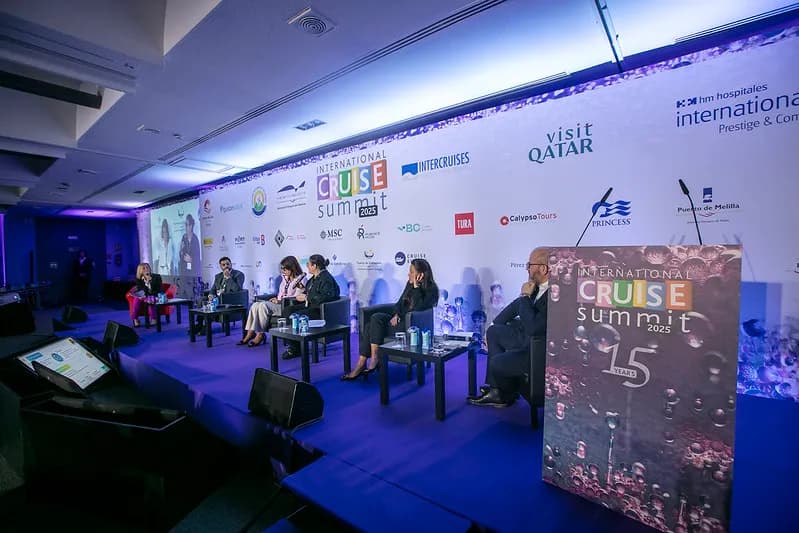
At its fifteenth edition, the International Cruise Summit in Madrid confirmed a now-irreversible trend: artificial intelligence is entering every corner of the cruise industry, reshaping processes, strategies, and business models.
For two days, on November 18 and 19, executives and representatives from over 25 cruise lines, ports, and related companies discussed a sector that is growing, evolving rapidly, and facing new global challenges.
The event, inaugurated by Carolina Toledo Martínez de Galinsoga, Deputy General Director for Tourism Promotion of the Community of Madrid, and Gustavo Santana Hernández, President of Puertos del Estado, brought together an international audience ranging from cruise industry giants to niche luxury operators. In 2024, the sector reached 35 million passengers and created 440,000 jobs in Europe alone, with an estimated global economic impact of $198 billion. These figures represent an 18% increase compared to the previous year, yet they are not enough to prevent new fiscal pressures from local governments, which, according to attendees, remain largely unaware of the benefits cruise tourism brings to communities.
One of the dominant themes of ICS 2025 was the growing role of artificial intelligence, now integrated into nearly all operational processes within the industry. In sales, Expedia is focusing on a new AI-based trip planner projected to reach 400 million users. The e-Hoi group is also developing a sales assistant fully supported by intelligent algorithms.
But AI is not only a tool to accelerate commercial conversions. It is increasingly being applied to itinerary planning, traditionally the domain of human expertise, through predictive systems capable of evaluating weather conditions, tourist flows, environmental impacts, and operational costs. While human insight still holds an advantage in intuition and cultural sensitivity, automation is becoming essential for optimizing time, consumption, routes, and sustainability.
Environmental impact prevention, now central to every international tourism meeting, finds a decisive ally in AI. Algorithms allow for anticipating and mitigating critical situations, improving waste management, and optimizing fuel use, supporting a sector that aims to lead the way in sustainability.
Another major highlight of ICS 2025 was the luxury segment, which is currently growing three times faster than the market average. Established hospitality brands such as Ritz-Carlton, Four Seasons, Orient Express, and Aman are launching or expanding their fleets, targeting clientele seeking not only comfort but also uniqueness.
A striking example was the interview with Jonathan L. Wilson, President and CEO of Aman at Sea, who presented the Amangati yacht project, set to begin operations in summer 2027. With only 94 passengers and 207 crew members, the vessel is designed more as a floating sanctuary than a traditional cruise ship. Wilson described a form of luxury that is not synonymous with opulence but with access to unique, once-in-a-lifetime experiences: 10×10-foot windows, interiors inspired by Japanese aesthetics, stops in hard-to-reach locations, and even helicopter embarkation and disembarkation. According to Wilson, true luxury is “something money cannot buy.” This statement perfectly encapsulates the transformation of the segment: the goal is to create unforgettable memories rather than simply provide high-end services.
Beyond the luxury segment, traditional cruise lines are also deeply redefining the concept of experience, both onboard and during shore excursions. Trends emerging at the summit highlighted how the experiential aspect has become central to attracting new travelers.
These initiatives range from creating itineraries inspired by famous film sets, transforming a simple visit into a journey through the collective imagination, to reinventing airport transfers, which shift from mere logistical movements to full-fledged mini-tours, such as train journeys through natural parks. Activities designed for social media sharing are also becoming increasingly important: content creation is now an integral part of cruise lines’ marketing strategies, aiming to offer visually engaging moments that are easily shareable online. This new experiential dimension, appealing both to mature travelers and Gen Z, represents a generational bridge: everyone, regardless of age, seeks authentic narratives to live and share, turning each journey into a personal story.
ICS 2025 also featured an in-depth analysis of climate change impacts. Discussions highlighted that in summer some cities can reach temperatures of up to 45°C, making excursions during traditional hours difficult or even impossible. Some ports are already developing plans to manage this new reality, while the summit debated shifting excursions to late afternoon or evening. This represents not only an organizational but also a cultural revolution, requiring new safety protocols and a rethinking of port schedules.
Despite one of the highest growth rates in the global tourism sector, operators report a persistent lack of recognition from local authorities. Many executives warned that new tourist taxes in various destinations could harm a sector that generates significant economic and employment value. The shared message from many speakers was clear: better communicate the benefits of cruise tourism to communities and governments, demonstrate its sustainability, and highlight its positive impact on local economies.
The International Cruise Summit closed this edition with a highly anticipated announcement: the event will return on November 10–11, 2026, again at the Hotel Meliá Castilla in Madrid. It will be an opportunity to review the progress of AI, address new climate challenges, and examine the transformations the cruise industry will continue to face in the coming years.
If 2025 marked the beginning of a new technological and cultural phase, 2026 promises to be the year in which the industry must consolidate this evolution, maintaining a balance between innovation, sustainability, and appeal for travelers worldwide.
Don’t miss news, updates, and cruise reviews on Cruising Journal, featuring photos, videos, and special cruise offers.