
Expedition cruises today represent one of the most authentic and transformative forms of travel: not mere crossings, but true explorations led by experts, designed to reach some of the last untouched places on Earth.
In Antarctica, the Arctic, or South Georgia, every landing, every excursion, and every silence under incredibly dark skies becomes part of an experience that combines adventure, scientific knowledge, and deep respect for the environment.
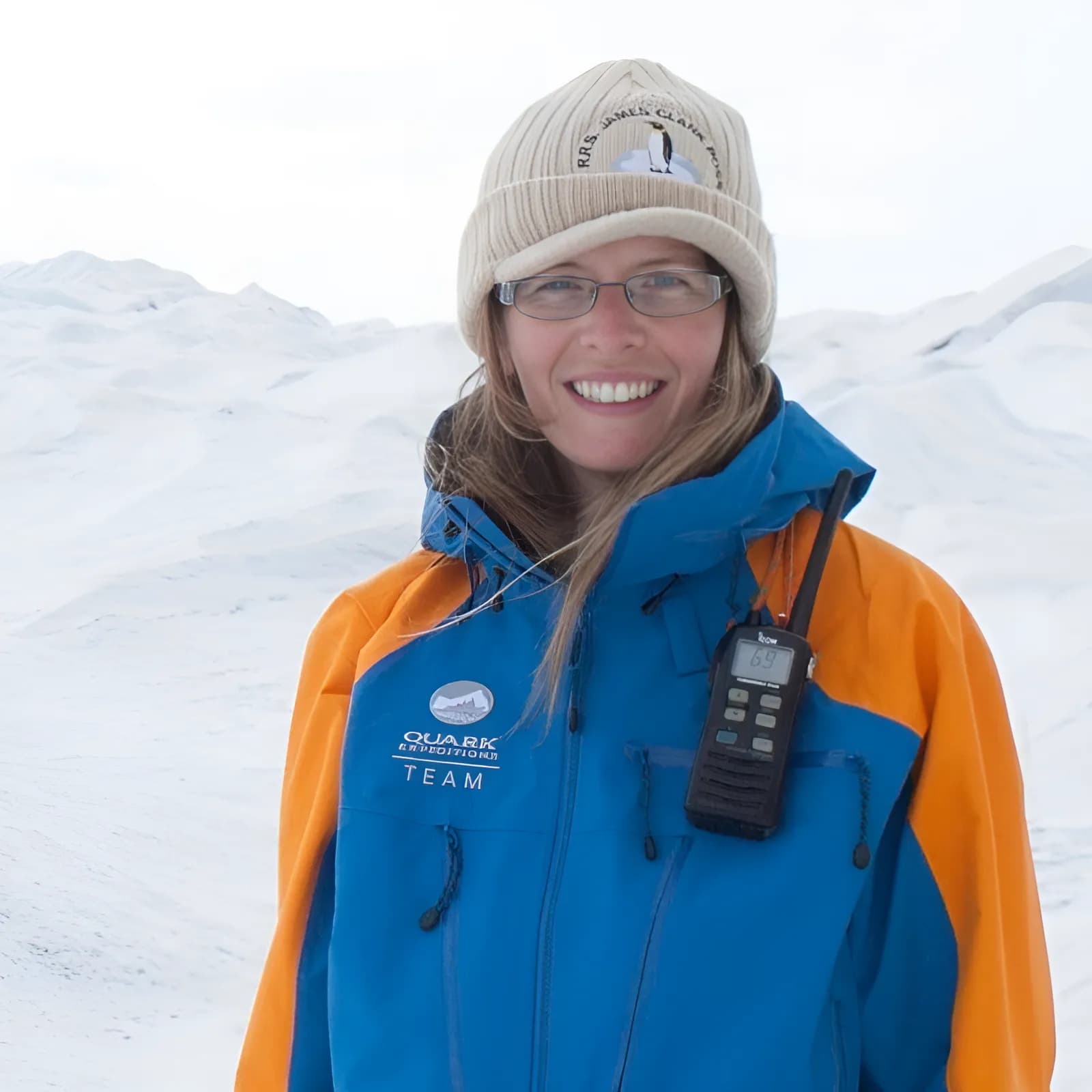
In this world, Quark Expeditions is recognized as one of the leading expedition cruise companies globally. At the helm of its operations are a team of experts which has been recently joined by Sam Crimmin, currently Senior Director of Operations, a figure who embodies the spirit of expedition cruising: expertise, leadership, and the ability to operate in extreme environments.
Sam’s journey, however, did not begin in adventure tourism. It is rooted in emergency and expedition medicine and in a transformative experience: a 16-months living and overwintering in South Georgia with the British Antarctic Survey 2010 to 12. This was followed by further time of the island working for the Government of South Georgia on its largest conservation project and supporting scientific research with the UK’s National Oceanography Centre Since 2012, she has worked with Quark Expeditions as a polar guide, doctor, and photographer, gaining field experience in Antarctica, the Arctic, and other remote regions. She joined Quark shoreside team in 2021 and worked as part of the leadership overseeing return to operations post COVID, focusing on risk and safety and finally moving to Senior Director of Operations (2025), working alongside Quarks Senior Director or Marine Operations, Captain Will Bennett, overseeing expedition, helicopter operations on a global scale.
Building on these experiences, we asked Sam Crimmin a series of questions to better understand her journey and her vision for polar expeditions.
Sam, thank you so much for being here and for your time. Before diving into your current role, we would like to understand the path that led you to where you are today. Choosing to work in polar expeditions represents far more than a simple career move: it implies a distinct approach to risk, time, and the purpose of one’s work. It is a choice that suggests strong personal values and a vision shaped by exploration and service. What motivations and reflections guided you toward embracing such a unique, demanding, and remote professional journey?
I’ve worked in the polar regions for the past 15 years and have been fortunate to experience them through the lenses of science, conservation, and expedition cruising. Like many people in this industry, what began as a short-term role quickly became something far more enduring. These places have a way of getting under your skin and becoming part of who you are. The unique combination of landscapes, wildlife experiences that don’t exist anywhere else in the world, the history and shared values of the people who gravitate to working there is a powerful combination.
Leadership in expedition operations has many similarities to leadership in medicine, it’s about navigating complexity, managing risk and bringing people with a diverse set to skills together to a shared goal. Being able to support a team of experts build and deliver transformative experiences for our guests who are often experiencing that same sense of awe for the first time makes for a rewarding career change.
I believe that certain experiences, especially those lived in extreme and isolated environments, have the power to leave a lasting and profound mark. Your winter in South Georgia with the British Antarctic Survey seems to have been one of those moments, capable of shaping your journey not only professionally but also personally. How pivotal was that experience in defining your professional and personal direction?
South Georgia is an extraordinary place—remarkable wildlife, dramatic mountain scenery, and a deep sense of history. Experiencing it by living on the island, and especially overwintering there, was truly special. The memories and perspective gained from that time will stay with me for life.
South Georgia also became my entry point into the expedition cruising industry. What initially began as a way to return to Antarctica quickly evolved. Working with Quark I experienced being part of a close-knit, highly experienced, and deeply passionate team, my motivation to stay in this industry was driven as much by the people as by the places.
Operating in remote and unpredictable environments means managing uncertainty, making rapid decisions, and keeping people at the center of every action. In extreme polar settings, preparation, experience, and leadership skills become decisive factors. Which competencies from emergency medicine have proven most useful in your role as an operational leader in polar expeditions?
At its core, the most transferable competency from emergency medicine is working with people—often under pressure, and always as part of a team. Operating in complex environments requires clear communication, trust, and the ability to bring diverse skill sets together toward a common goal.
Preparation, attention to detail, and strong culture are fundamental. In both emergency medicine and polar operations, success is rarely about a single decision in the moment—it’s about the groundwork laid beforehand: training, planning, rehearsing, and supporting high-performing teams so they can execute confidently when conditions are challenging. These principles are what allow us to operate safely and responsibly, particularly when delivering complex, helicopter-supported itineraries.
Experiencing polar expeditions from different roles allows for a broader and deeper understanding of field operations, combining operational skills, attention to safety, and the ability to observe and document. Over the years, you have approached these extreme environments from very different perspectives. How has this combination of roles—guide, physician, and photographer—influenced the way you experience and interpret polar expeditions?
My background is rooted in risk management, operational safety for us is a baseline capability and something that is consistently woven into every decision we make.
Personally, I’ll probably always see the polar regions partly through a camera lens. That perspective highlights just how beautiful and dynamic these places are.
The same location can feel entirely different depending on the light, the weather, the snow conditions, or the stage of a penguin colony’s life cycle – something our guides understand instinctively and use to consistently deliver exceptional guest experiences.
Today, I use my experience to support a team of experts many of whom have been in the industry longer than the 15 year’s I have.
That shift has brought a different kind of perspective—less about personal experience, and more about creating the conditions that allow our teams to operate safely, responsibility and excel at delivering highly personalised, meaningful guest experiences.
Among the most memorable moments of a polar expedition are encounters with species that are emblematic of these remote ecosystems. The emperor penguins of Snow Hill are among those that leave the strongest impression on those fortunate enough to observe them up close. Why do these animals have such a powerful impact on those who see them?
Visiting Snow Hill Emperor penguin colony is one of the worlds rarest wildlife experiences. You are not simply observing wildlife—you are a temporary visitor in their world, witnessing a complex and highly adapted ecosystem functioning on its own terms.
When we visit the colony is often at its most active, guests get to observe the curiosity of the fledging chicks and dedication of adults tobogganing to and from the ice edge for food. Guests have a variety of things to say about the experience, many are reminded of the scale of the natural world, our small place within it and take away a genuine sense of awe and lifelong memories.
Each polar region has distinctive characteristics, shaped by its landscapes, wildlife, and environmental conditions. Experiencing these differences firsthand means confronting very diverse challenges and sensations. Between South Georgia, Snow Hill, and the most remote areas of Antarctica, which excursion or destination has moved you the most—and why?
It’s hard to single out one place, because each of them has left its mark in a very different way. South Georgia will always feel deeply personal to me. Living there—particularly overwintering—creates a connection that goes far beyond a visit.
Snow Hill is different, but instantly and equally powerful. Reaching the emperor penguin colony feels like standing on the edge of what is possible. The remoteness, the effort required to get there, and the privilege of being present during such a critical stage of the colony’s life cycle make it incredibly moving—not just for the wildlife encounter itself, but for what it represents in terms of teamwork, preparation, and responsibility.
Operations at Snow Hill are considered among the most complex in the world of expedition cruises due to extreme conditions, delicate logistics, and the need to coordinate safety, crew, and guests in remote environments. At the same time, the success of these missions represents one of the most iconic and rewarding moments of a polar expedition. What makes these operations so challenging and yet so fulfilling?
Snow Hill is challenging because there is very little margin for error. You’re operating in a part of Antarctica, with highly dynamic ice and weather and travelling long distances from the ship.
What makes these operations possible is the depth of preparation and experience behind them. Success at Snow Hill isn’t about pushing limits; it’s about disciplined planning, strong safety culture, and a high performing team who are confident in dynamic decision making. Helicopter operations add significant complexity, but when used responsibly and supported by the right expertise, they allow access that would otherwise be impossible.
When everything does come together, it represents expedition operations at their best. You see months—often years—translate into a safe, respectful encounter with an extraordinary place. For guests, it’s a rare and deeply moving moment. For the teams delivering it, it’s a quiet sense of pride in knowing that it was achieved through teamwork, professionalism, and a shared commitment to doing things the right way.
Exploring pristine territories requires clear protocols and rigorous operational measures to minimize environmental impact. Environmental responsibility is therefore translated into concrete procedures, from respecting wildlife and ecosystems to the sustainable management of daily operations. Quark Expeditions often emphasizes environmental responsibility. How is this philosophy implemented in day-to-day operations?
Our teams—both on board and ashore—bring decades of collective experience in the polar regions, a deep respect for these environments and a genuine commitment to their protection. As a founding member of IAATO and AECO, Quark is not only dedicated to complying with the IAATO/AECO standards but actively contributes to their development and evolution. This shared polar obsession enables us to educate and inspire our guests, fostering a strong sense of stewardship and responsibility that comes with visiting such unique places. It is reflected in our commitment to conservation and community—and in the past year alone, with the support of our guests, we have invested in a range of conservation organisations working to protect the regions we operate in and facilitated on the ground scientific endeavours supporting national science programs.
Before we conclude, is there anything you would like to add — perhaps a final thought, a piece of advice, or a broader reflection — that you feel could be valuable for readers who are curious about this kind of path or inspired by your experience?
What excites me most about the future of polar expeditions is the opportunity to go deeper rather than broader. It’s not about scale for its own sake, but about creating access and genuine connection to places that remain truly rare, delivered by teams with the passion and expertise to operate responsibly. In my role, what’s most rewarding is being able to focus on people, capability, and planning increasingly complex operations in a way that remains, safe, and responsible. When those foundations are in place, innovation means we’re able to keep evolving while staying true to the privilege that come with operating in the polar regions.
Thank you very much, Sam, for your time and for sharing your journey and experiences. We wish you all the best for future expeditions and for all the projects ahead. Sam Crimmin’s career demonstrates that leadership is not tied to a single sector, but to the ability to adapt, listen, and operate even in the most extreme conditions. From emergency medicine to the icy expanses of Antarctica, his journey is a testament to the transformative power of exploration, nature, and the human connections forged at the edges of the world.
Don’t miss more updates, news and reviews about the world of cruises on Cruising Journal.