
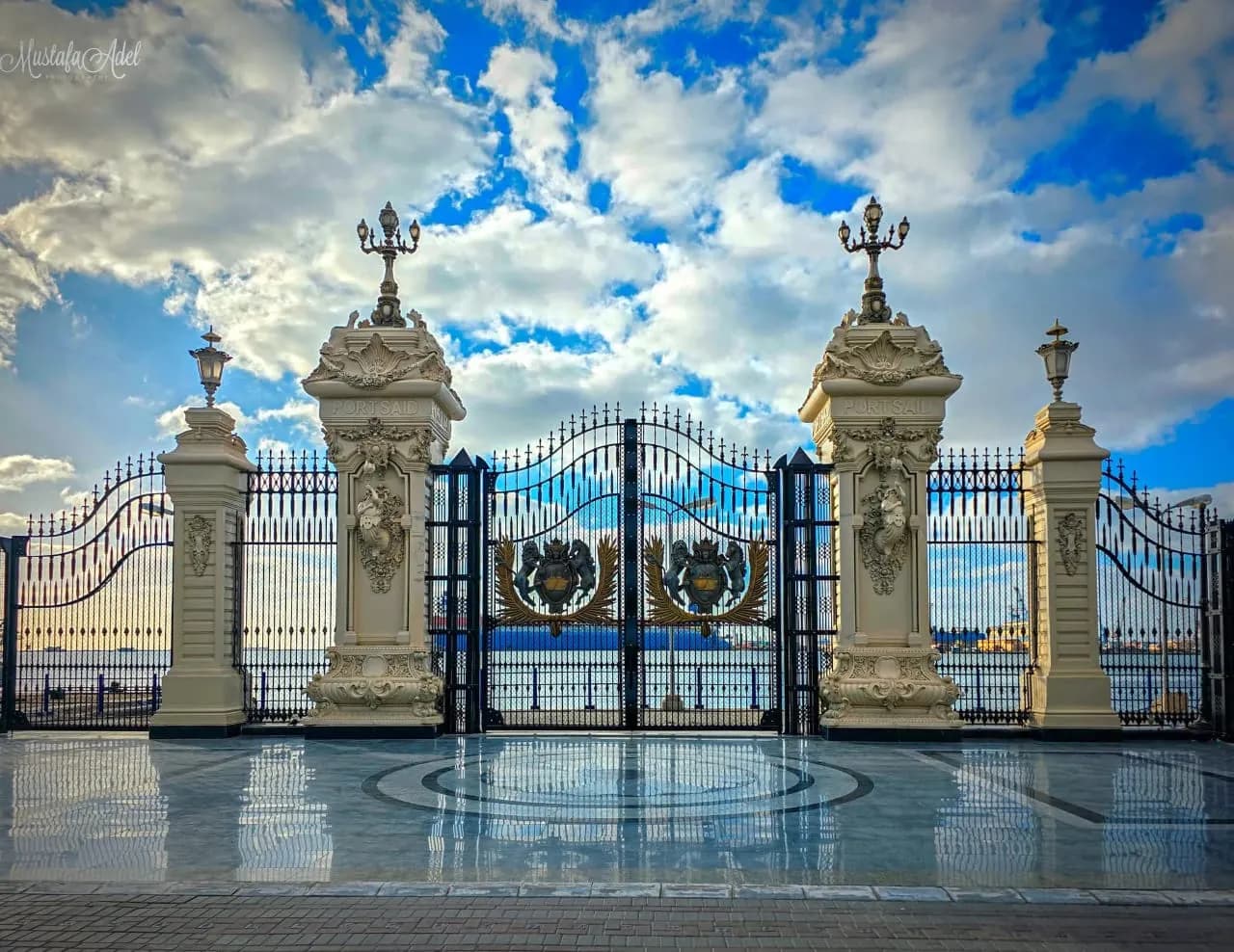
Located at the northern mouth of the Suez Canal on the Mediterranean Sea, Port Said is a city that combines history, commerce, and culture.
Its strategic position has made it a key point for international trade and maritime routes connecting the Mediterranean to the Red Sea for over a century, serving also as an important maritime, commercial, and logistical hub and marking the canal’s entry point.
The Port of Port Said, inaugurated in 1869 alongside the Suez Canal, was designed to handle the ever-increasing commercial traffic between Europe and Asia. From its foundation, the port has played a fundamental role in the Egyptian economy, serving both commercial and military vessels. Today, it remains one of the busiest ports in the Mediterranean, with terminals for containers, ferries, and cruise ships. Its port architecture reflects the French colonial style, with historic piers and warehouses that tell the story of a century of international trade.
Founded in 1859 during the construction of the Suez Canal, Port Said was born as a city of port and commerce. The city saw a flourishing of diverse cultures: French, Italian, Greek, and Jewish communities helped create a cosmopolitan society, still visible today in the historic buildings and waterfront cafés. During the Suez Crisis of 1956, Port Said was the scene of pivotal events that marked modern Egyptian history.
However, Port Said is not just a commercial port: it also offers a variety of interesting tourist attractions. The metropolitan area includes Port Said in Africa and Port Fuad in Asia, often considered a single urban unit, with the main city on the western (African) bank and its partner, Port Fuad, on the eastern (Asian) bank, forming a rare metropolitan area that spans two continents.
One highly recommended stop for cruise visitors is the Corniche, the long and scenic waterfront promenade of Port Said. Strolling along the Corniche, visitors can admire the ships docked in the port and the lively bustle of the harbor city, with historic cafés, gelaterias, and restaurants serving fresh seafood. Along the way, elegant French and Italian colonial-style buildings stand as a testament to the city’s cosmopolitan past. The Corniche is ideal for photography, leisurely walks, and soaking in the authentic atmosphere of Port Said without venturing far from the port. Reaching the Corniche from the cruise terminal is simple and quick: most of the main attractions are just a few minutes’ walk or a short taxi ride from the port. For those who prefer a more convenient experience, many organized tours offer guided visits that include a stroll along the waterfront, stops at historic cafés, and the opportunity to explore the nearby small souks. In just a few hours, visitors can get a full taste of the city, combining history, architecture, and daily life without risking missing the ship’s departure.
Continuing along the Corniche, you will reach the Port Said Lighthouse, the city’s iconic landmark. Erected at the end of the 19th century, the lighthouse is one of the oldest in Egypt and a symbol of the city. Located at the entrance of the port, it features a unique architectural style that blends Eastern and Western elements, with an elegant tower topped by a lantern that still guides ships through the Suez Canal. Its panoramic location offers spectacular views of the Mediterranean, passing vessels, and the city’s waterfront. Beyond its practical function, the lighthouse represents a piece of Port Said’s history, a witness to the times when the city was establishing itself as an international commercial hub.
Not far from the lighthouse is the National Museum of Suez, created to replace the old museum that collapsed during the 1967 war, whose collection was temporarily moved to the storage rooms of the Egyptian Museum in Tahrir Square. The new museum aims to be a cultural beacon and a tourist destination, telling the story of the Suez Canal, which links the Red Sea to the Mediterranean, and of the city of Suez from prehistoric times to the modern era. Officially inaugurated on September 29, 2014, the museum spans two floors separated by a large central exhibition hall, where visitors can admire archaeological columns from the Greek, Roman, and Islamic periods. Among the most interesting halls are those dedicated to the construction of the Suez Canal and other historical waterways, such as the “Canal of the Pharaohs” dug by Nekau II, featuring insights on shipbuilding, mining, trade, and Suez’s strategic role in the Hajj pilgrimage to Mecca. Particularly impressive is the mummification hall, which recreates the interior of an ancient cemetery and displays tools, offering tables, votive steles, colorful sarcophagi, and a priest’s mummy with protective spells. Among the most notable objects are a statue of King Senwosret III from the 12th Dynasty and a stele of the Persian King Darius I, one of four erected along the canal linking the Nile to the Red Sea. The museum also includes a library and an activity center for educational events, while its garden houses a modern replica of a ship from the reign of Hatshepsut, used for trade expeditions to distant lands.
Walking through the central streets of Port Said feels like stepping back in time. The streets are lively with shops, cafés, and small boutiques, but what immediately catches the eye are the historic French and Italian-style buildings lining the main roads. Constructed between the late 19th and early 20th centuries, these buildings feature ornate façades, wrought-iron balconies, and architectural details reflecting European influence on the port city. Strolling through these streets allows visitors to appreciate the unique fusion of Egyptian tradition and colonial elegance, a tangible reminder of Port Said’s cosmopolitan history.
The balconies, often adorned with intricate iron railings and slender columns, provide perfect photographic opportunities. The colorful and decorated façades tell stories of families who once dominated local trade and hosted European communities living in the city during the colonial era. This contrast between historic architecture and modern daily life makes walking through the city particularly fascinating, especially for those looking to experience Port Said’s authentic, less touristy side.
Another significant attraction for history enthusiasts is the Port Said Military Museum, located on July 23 Street in the heart of the city. Inaugurated in 1964, the museum was established to commemorate the heroic resistance of the people of Port Said during the Suez Crisis of 1956, as well as to document subsequent conflicts, including the wars of 1967 and 1973. A visit to the museum offers an in-depth look at the city’s military and civilian efforts: the exhibition is organized into several thematic halls, including those dedicated to the 1956 war, the Suez Canal, and the Yom Kippur War. In the outdoor gardens and open areas, visitors can see weapons, military vehicles, and other historical equipment that illustrate the evolution of warfare and Port Said’s role in some of the most critical moments of modern Egyptian history. Although located just a few minutes from the waterfront, the museum is easily accessible by taxi or a short walk from the city center, and it can be explored in about an hour, making it an ideal stop even during a cruise port visit.
Among the city’s most striking historic buildings is the Al‑Abbasy Mosque, one of the oldest and most important religious monuments in Port Said. Built in 1904 at the behest of Khedive Abbas Helmi II, the mosque is located in the city’s “Arab” quarter and represents a remarkable example of Islamic architecture, with well-preserved artistic and decorative details. The mosque is not only a place of worship but also a symbol of Port Said’s social history: over the years, it has played a central role not only in religious ceremonies, such as the celebrations of Isra and Miʿraj or Eid, but also in moments of popular resistance during historical events like the Tripartite Aggression of 1956. Following a careful restoration aimed at preserving its original architectural elements, the Al‑Abbasy Mosque continues to attract visitors for its artistic beauty, featuring intricate decorations, ornamental inscriptions, and a style that reflects classical Islamic tradition.
Another stop that should definitely be included on any must-see list is the historic French pilots’ complex in Port Fuad, which represents a unique example of European residential architecture in Egypt. It is a neighborhood of villas built in the 1920s to provide housing for French and foreign pilots and officials of the Suez Canal. The area stands out for its quiet and distinctive design, heavily influenced by European styles, and is laid out as a true “garden city” composed exclusively of villas. The houses were designed in Colonial Revival or Craftsman style, often featuring small church-like structures and pyramidal roofs, and are surrounded by private gardens and white wooden fences, enhancing their elegance and exclusivity.
Equally unmissable is a visit to the local markets, located just a few blocks from the main streets. Here, visitors can immerse themselves in the colors and scents of spices, textiles, and traditional crafts, among bustling vendor stalls. Walking through the souk’s corridors reveals small treasures, from hand-embroidered fabrics to carved wooden objects, from traditional jewelry to local food products. The markets also provide direct interaction with residents, making the experience more authentic and lively than in more touristy areas.
Beyond shopping, the markets offer a genuine cultural immersion: it is possible to observe local customs, traditional bargaining, and everyday habits that make Port Said so unique. Even visitors with limited time during a cruise stop can gain great satisfaction from a brief visit, strolling among the city’s vivid colors, sounds, and aromas. This combination of historic architecture and lively markets makes walking through central Port Said a complete experience, giving visitors a deep sense of the city’s history, culture, and cosmopolitan character.
Those seeking a seaside break during their stop can head to the beaches of Port Said and its surroundings. Port Said Beach, easily reachable by taxi from the port, offers a long stretch of golden sand overlooking the Mediterranean, ideal for relaxing walks or simply watching the ships pass by. For those looking for a quieter and more scenic setting, the nearby Port Fouad Beach features fine sand and clear waters, perfect for a short swim or just enjoying the sun. It’s an excellent opportunity to combine the city’s historical charm with a bit of coastal relaxation.
Port Said remains a city that captivates with its unique blend of history, commerce, and Mediterranean culture, offering visitors a rare glimpse of Egypt’s maritime heritage. Visiting Port Said means immersing oneself in a mosaic of cultures, architectures, and stories that have intertwined over the centuries.
Stay updated with the latest news, reviews, and updates from the world of cruising on Cruising Journal, featuring photos, videos, and special cruise offers.