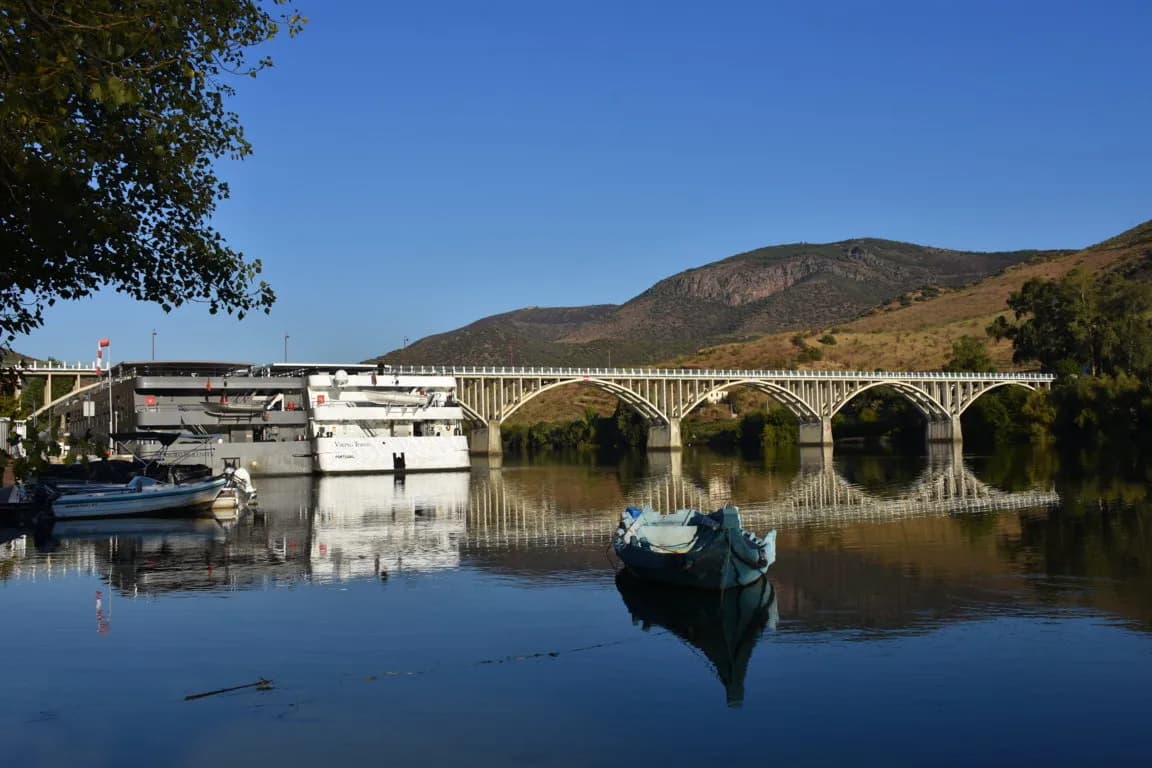
The history of cruising in Barca d’Alva is intrinsically linked to the Douro River, as it is a picturesque riverside village that serves as the gateway to river cruise experiences in the region, near the border with Spain. The village provides access to breathtaking experiences on the Douro and is the final stop for many cruises before entering the neighboring country.
Barca d’Alva is located on the left bank of the Douro River and belongs to the parish of Escalhão, in the municipality of Figueira de Castelo Rodrigo, situated north of the Guarda district and within the Douro International Natural Park. Adjacent to the village is the border with Spain, defined here by the courses of the Águeda and Douro rivers.
Barca d’Alva developed with the construction of the Douro Line in the 19th century and the subsequent railway connection with Spain (Fregeneda station), which allowed a link to the rest of Europe. With the closure of the station, Barca d’Alva experienced a significant impact on the region, which lost part of its tourist and commercial flow.
With the construction of a dock for cruise ships, Barca d’Alva has had a major impact on increasing the number of tourists visiting the area, offering an immersive cultural experience to visitors who explore the landscapes, vineyards, local villages, historical heritage, gastronomy, and wine production of the region. The impact of river cruises is very positive, as it transforms Barca d’Alva into a central tourist hub for exploring the Douro and its cultural and enological treasures.
The best time to visit Barca d’Alva is between April and October. In spring, the landscapes are particularly beautiful, with blooming vineyards and lush vegetation spreading across the hills. In autumn, the Douro takes on golden and brown hues, creating an idyllic setting for those seeking relaxation and wishing to enjoy a peaceful cruise along the Douro River.
Between late February and early March, the village is adorned in white and light pink, with the blossoming of almond trees. It is during this period that the Almond Blossom Festival (Festa do Flor do Amendoeira) is celebrated, a tradition of over 70 years that extends beyond the Douro banks into Spanish territories.
Barca d’Alva Station
The Barca d’Alva station, located in the Arribas do Douro Natural Park, was operational from 1887 to 1988. This border station, in addition to its regular railway functions, housed a customs office, a fiscal guard, and a hotel.
Today, the station is an abandoned historic building, which once served as an important stop for the train connecting Porto to Paris. Since 1987, the station has been closed to railway traffic and is currently the starting point of the “Rota dos Túneis” (Tunnel Route).
The station remains a symbol of the village’s history, attracting visitors interested in its architecture and heritage value. It is a site of great interest, where many tourists take photographs and explore the surrounding area.
Cruise Pier
The modern cruise pier in Barca d’Alva was developed thanks to the construction of dams on the Douro River, which made the river navigable. The uppermost dam, the Barragem do Pocinho, inaugurated in 1982, marks the furthest point upstream that cruises can reach on the Douro River, all the way to Barca d’Alva. Thanks to the cruise docking facilities, Barca d’Alva has become a regular stop for Douro River cruises.
Today, Douro River cruises are the primary form of tourist river transport, bringing visitors to the village and offering a unique experience.
During their stop in Barca d’Alva, tourists can visit the municipalities of Figueira de Castelo Rodrigo, Freixo de Espada à Cinta, Poiares, Escalhão, and Salamanca, or explore on foot the “Rota dos Túneis” and various viewpoints offering panoramic views of the vast Douro Internacional landscape, with its rich flora and fauna.
Figueira de Castelo Rodrigo
Located in the heart of the Riba Côa region, the municipality of Figueira de Castelo Rodrigo boasts a rich architectural heritage, with particular prominence given to Castelo Rodrigo, one of the most beautiful and evocative Historical Villages of Portugal. For over 600 years, this village was a center of local power and the stage for important historical events.
With its unique charm among Portugal’s Historical Villages, and recognized as one of the 7 Wonders of Portugal, Castelo Rodrigo stands out as an authentic monumental complex reflecting the medieval era. It still preserves significant traces today: the ruins of Cristóvão de Moura’s Palace, the 16th-century pillory (Pelourinho), the Mother Church, the Medieval Cistern, and other landmarks that testify to the presence of ancient Jewish communities in the village.
Escalhão
The parish of Escalhão is located 8 km from the municipal seat, on a plateau offering wide views of the surrounding horizon. Over time, it has been an important area for the municipality, thanks to its significant economic and demographic wealth.
Visitors can admire the Mother Church, reminiscent of a stern fortress, with robust lines and an elongated structure dating back to the 16th century. The façade of the church and its clock tower are believed to be remnants of an ancient medieval castle. Notable features include the main chapel covered by a ribbed vault and the gilded altars. The church was classified as a Property of Public Interest in 1978.
In one of the village squares stands the Cruzeiro (stone monument). On the occasion of the centenary of the Foundation and Restoration of Portugal in 1940, as in other locations in the municipality, a cruzeiro was erected, blessed, and inaugurated on July 14 of the same year.
Poiares
Visiting the village of Poiares, the visitor encounters a town where traditional houses are built from slate.
But there are many other reasons to explore this locality, situated in the heart of the Douro International Natural Park, surrounded by breathtaking scenery. Particularly fascinating is the Roman road of Alpajares, which once extended over a bridge built with such daring engineering that for a long time people believed it to be the work of the devil. Although the bridge was destroyed by the force of the waters, the legend persists, as do the stones of the Roman road, next to which stands the Fraga do Gato, famous for its Paleolithic rock paintings, including a figure that many see as a feline, while others interpret it as an otter.
Freixo de Espada à Cinta
Freixo de Espada à Cinta is a Portuguese border village located in the Douro subregion, part of the Northern region and the district of Bragança.
The origins of the village of Freixo de Espada à Cinta are lost in the mists of time, with its founding and toponymy shrouded in legend. However, several historians claim that the Narbassos, a pre-Roman Iberian people mentioned by Ptolemy, inhabited this entire area of the peninsula, suggesting that settlements in this region predate the foundation of the Kingdom of Portugal.
Tourists strolling through the village can be captivated by its beauty and its monuments, such as the Heptagonal Tower, the Pelourinho of Freixo de Espada à Cinta, the Mother Church, and the Historic Center, among others.
Salamanca
Salamanca, located in northwestern Spain, is the capital of the province of the same name, part of the Castile and León region. With a history dating back to the Celtic era, the city is renowned for its intricate sandstone architecture and for the University of Salamanca. Founded in the 12th century and an important intellectual center during the 15th and 16th centuries, the university continues to bring the city to life with its population of international students.
Rota dos Túneis
The Rota dos Túneis and Bridges of the Douro Line is an extraordinary hiking trail along the abandoned railway line between La Fregeneda (Spain) and Barca d’Alva (Portugal), located in the heart of the Arribas do Douro Natural Park, the Spanish equivalent of the Douro Internacional.
It covers the last 17 km of the old and now abandoned Douro railway line, which once connected Salamanca to Barca d’Alva and later to Porto. A true masterpiece of industrial and railway engineering, the line today is only operational between the Pocinho station and the city of Porto.
Along the Camino de Hierro route, which follows the Águeda River to its confluence with the Douro, hikers pass through 20 tunnels—the longest nearly 1,600 meters—and cross 10 dizzying metal bridges, some built by the Eiffel school. All of this unfolds amid breathtaking landscapes overlooking the steep cliffs of the Arribas do Douro Natural Park.
Miradouro Alto da Sapinha
The viewpoint located along the road connecting Figueira de Castelo Rodrigo to Barca d’Alva is a must-visit, offering a fantastic view that inspires tranquility and allows observation of various species of birds of prey.
The view from the Sapinha viewpoint in March is particularly spectacular thanks to the blooming almond trees and the sparkling waters of the Douro and Águeda rivers in the deep valley opposite Barca d’Alva. During other months, the effect is more deceptive: the brightness of the surrounding nature masks the sense of abandonment.
Miradouro Penedo Durão
Considered the oldest viewpoint in the wide scenic area, the Penedo Durão viewpoint is located on the right bank of the Douro, between Poiares and the municipal seat. It rises to an altitude of 727 meters above sea level, offering a breathtaking view of the Douro — which here forms the international border — the Spanish Saucelle Dam, the mouth of the Huebra River (province of Salamanca), and the surrounding settlements of olive groves, vineyards, and almond orchards, all contributing to a pristine natural environment.
Penedo Durão is a massive rock rising on the right bank of the Douro River. At its summit, there is a viewpoint that not only offers excellent vistas but is also a prime spot for birdwatching, with particular attention to the bearded vulture and, in spring, the Egyptian vulture. Peregrine falcons are also regularly spotted at this site.
Visiting Barca d’Alva means immersing yourself in a unique experience, where time seems to flow more slowly and every landscape tells a story. It is the ideal destination for those seeking authenticity, beauty, and tranquility in the heart of one of Europe’s most captivating regions.
Stay updated with the latest news, updates, and reviews from the world of cruising on Cruising Journal, featuring photos, videos, and cruise offers.
Rui Minas
Barca d’Alva: Magic on the Banks of the Douro | Cruising Journal