
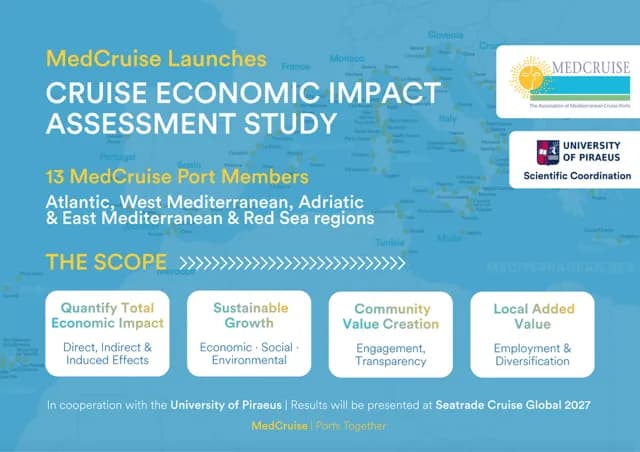
MedCruise has launched a Cruise Economic Impact Assessment Study, a major initiative aimed at providing a comprehensive, evidence-based understanding of the economic, social, and environmental contribution of cruise tourism.
By combining robust data collection with in-depth analysis, the study aims to generate valuable insights for port authorities, cruise lines, policymakers, and local communities, supporting informed decision-making and sustainable growth.
The project, conducted in collaboration with Professor Thanos Pallis from the Department of Maritime Studies at the University of Piraeus, involves more than 12 MedCruise member ports, including Cabo Verde, Cartagena, Dubrovnik, Gibraltar, Kotor, Lavrio, Sardinian Ports, Sibenik, Taranto, Tarragona, Toulon Bay Ports, Volos, and Western Sicilian Ports. This broad geographic coverage reflects the diversity of cruise destinations and market dynamics across the Mediterranean and beyond.
The Cruise Economic Impact Assessment Study aims to thoroughly understand the effects of cruise tourism on local economies and communities. In particular, it seeks to quantify the overall economic impact, including not only direct effects but also indirect and induced impacts. The study also aims to identify opportunities for more sustainable cruise development, enhancing local value creation. Another important goal is to strengthen engagement with local communities by clearly and transparently communicating the benefits generated by cruise activity. Finally, the project provides practical guidance for increasing the sector’s added value through job creation, diversification of port activities, and improved passenger experiences on board.
The study is based on a solid, multidimensional methodology that combines quantitative and qualitative data to fully capture the impact of cruise tourism. Specifically, the project analyzes the expenditures of cruise companies, passengers, and crew members, aiming to map the economic flows generated by cruises. It also evaluates value added and employment effects, considering direct, indirect, and induced impacts on the local economy. The study further examines different types of activities, passenger profiles, and port characteristics to better understand market dynamics and visitor preferences.
Theodora Riga, President of MedCruise and of the Corfu Port Authority, emphasized the importance of data, while highlighting that their true value emerges through effective communication. According to Riga, cruise tourism is a complex, multifaceted phenomenon that requires a holistic approach to fully understand its real impact. Through this perspective, MedCruise ensures a comprehensive representation of the sector, fostering informed dialogue and balanced decision-making.
Lorenzo Vera, Member of the MedCruise Board of Directors and coordinator of the initiative, highlighted that the study represents a turning point in understanding cruise tourism in the Mediterranean and adjacent seas. By relying on concrete, shared data, the study helps build a common framework that allows ports and destinations to plan for a more resilient and sustainable future.
Professor Thanos Pallis, from the Department of Maritime Studies at the University of Piraeus, stated that the initiative will allow a more accurate understanding of the real impact of cruises on Mediterranean ports and destinations, providing valuable information for all stakeholders. According to Pallis, fostering a culture based on concrete data and establishing a framework for similar studies facilitates decision-making and the necessary dialogue to promote sustainable growth in the cruise sector.
The study is expected to become a key reference point for evidence-based policymaking, sustainable cruise development strategies, and constructive dialogue with local communities. Data collection has already begun and will continue throughout the cruising year, ensuring a comprehensive view of seasonal and regional variations, in order to provide an accurate and realistic picture of cruise impacts in the Mediterranean. The study results will be consolidated and presented at Seatrade Cruise Global 2027, offering ports and stakeholders a strategic roadmap to optimize the economic, social, and environmental benefits of cruise tourism.
Stay up to date with news, updates, and reviews from the world of cruising on Cruising Journal, featuring photos, videos, and special cruise offers.