
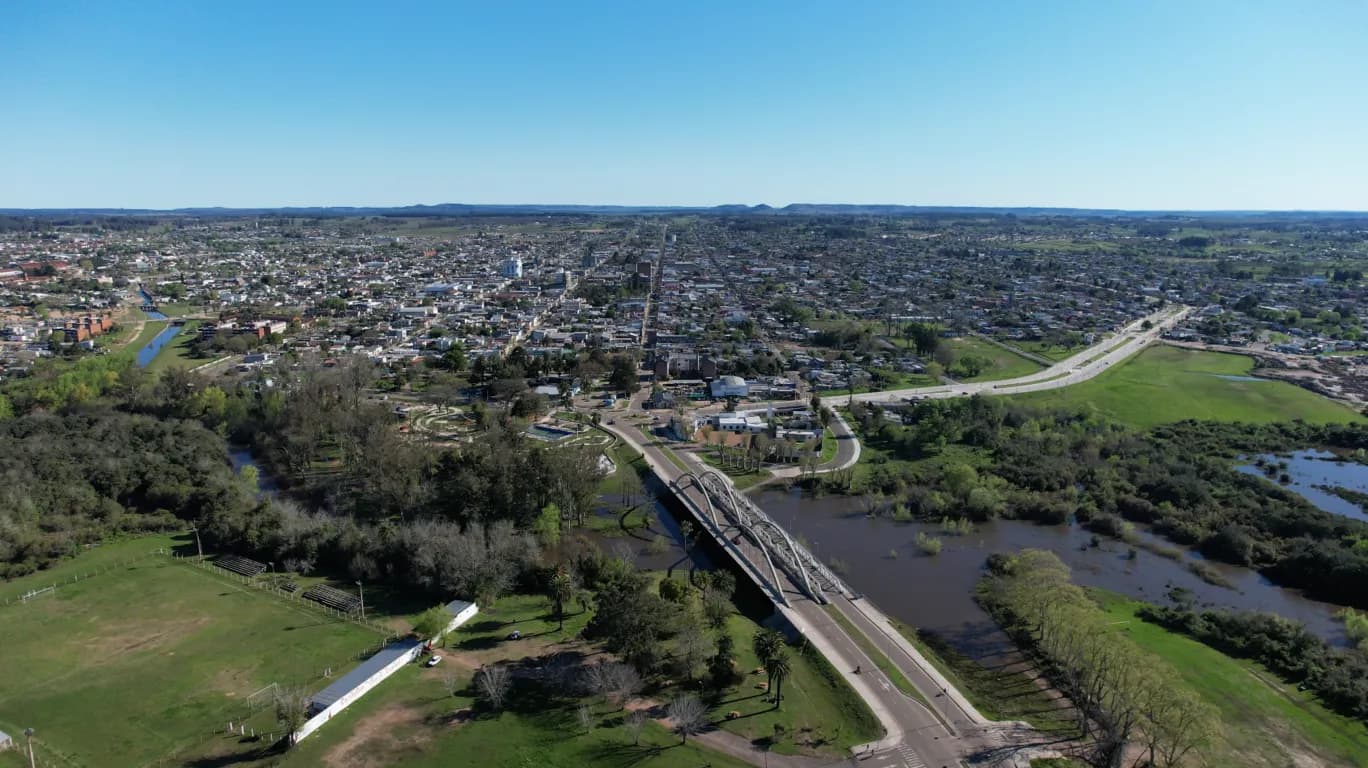
Some countries tell their story through mountains, others through deserts, and still others through cities. Uruguay, instead, tells its story through water, not as a mere natural resource, but as a deep structural element of its territory, culture, and political vision.
It is from this awareness that 53.86% Uruguay, Land of Water was born, the project that represented the country at the 19th International Architecture Exhibition, La Biennale di Venezia 2025.
53.86% Uruguay, Land of Water was the winning project of the public open call promoted by the National Directorate of Culture of Uruguay’s Ministry of Education and Culture for the national pavilion in Venice. The project was developed by Sei Fong, Art, Architecture and Design Studio, curated by Katia Sei Fong, Ken Sei Fong, and Luis Sei Fong.
The proposal represented Uruguay at the Architecture Biennale from May 10 to November 23, 2025, within the Uruguayan Pavilion located in the Giardini della Biennale, a state-owned venue that attests to the country’s long-standing and continuous presence in one of the most significant international cultural contexts.
From the outset, the project established itself as a clear political position and an urgent invitation to rethink the relationship between architecture, territory, and water resources. Water is not treated as a simple natural or infrastructural element, but as a cultural structure capable of shaping economies, borders, urban models, and social relationships.
The title is not a metaphor, but a factual datum: 53.86% of Uruguay’s territory is maritime, an area larger than its landmass. This dimension has often remained invisible in traditional narratives of the country, yet today it emerges as a fundamental lens through which to understand contemporary environmental, urban, cultural, and geopolitical challenges. At a historical moment marked by climate crises, tensions over water governance, and profound ecosystem transformations, Uruguay places a crucial question at the center of the global architectural debate: what does it mean to inhabit a territory of water?
Uruguay is crossed by an extensive water network that includes rivers, lagoons, basins, and a vast maritime area. This constant presence of water has shaped not only the landscape, but also settlement patterns, modes of production, and relationships with the territory. Yet, as the project highlights, water has often been relegated to a secondary role in urbanization processes, treated as a boundary, a technical infrastructure, or a resource to be exploited.
In this context, Uruguay occupies a particularly significant position: its maritime sovereignty and geography place it at the forefront of global challenges related to water. 53.86% Uruguay, Land of Water emerges from this awareness and proposes recognizing water as a central element in the country’s future, not only environmentally, but also culturally, politically, and in terms of design and planning.
One of the project’s most compelling aspects is the way water is reinterpreted: no longer merely as a resource to be managed, but as a foundational structure of contemporary culture. In this vision, water becomes a key to understanding economic transformations, geopolitical dynamics, and relationships between territories.
The project suggests that we may have entered a new era, described as the “Hydrocene”, the age of water. A time in which the way societies manage, protect, and share water resources will determine the future of humanity. In this scenario, architecture assumes a crucial role: it can contribute to more equitable, efficient, and conscious water management, ensuring reliable supplies for human consumption, agriculture, industry, and energy production.
Within 53.86% Uruguay, Land of Water, architecture is not presented as an isolated technical solution, but as a cultural and design tool capable of addressing water-related challenges. Through strategies that integrate architectural thinking, design, and art, the project invites us to imagine new ways of inhabiting territory. From this perspective, water opens up innovative possibilities for urban planning and design. It becomes a unifying element, capable of connecting spaces, communities, and infrastructures. Rain, waves, wind, and sunlight, the most powerful natural forces, are among the few direct experiences of the natural world that still pass through contemporary cities. Recognizing and integrating them means radically rethinking how we build and live in urban spaces.
Uruguay’s participation in the Venice Biennale was the result of a cultural policy supported by the Ministry of Education and Culture and the Ministry of Foreign Affairs, in collaboration with the Directorate General for Cultural Affairs, the Embassy of Uruguay in Italy, and the Honorary Consulate in Venice. The project also benefited from the support of academic institutions such as the Faculty of Architecture, Design and Urbanism of the University of the Republic, the Faculty of Architecture of ORT University Uruguay, and the Viñoly Foundation, which announced a sponsorship commitment for the next ten years.
This network of collaborations strengthened the overall value of the initiative, confirming it not only as an exhibition project, but as a tool for positioning Uruguay internationally within the global architectural and environmental debate.
Sei Fong, Art, Architecture and Design Studio is a multidisciplinary collective composed of Luis Sei Fong, Katia Sei Fong, and Ken Sei Fong. The synergy between their diverse areas of expertise, visual art, architecture, urbanism, and design, has enabled the studio to address complex themes through an integrated and culturally layered vision. In 53.86% Uruguay, Land of Water, this multidisciplinary approach translates into a language that combines theoretical reflection with expressive power. The goal was not to offer definitive answers, but to open a debate, stimulate reflection, and invite audiences to consider water as a foundational element of contemporary design.
53.86% Uruguay, Land of Water is not merely the narrative of a geographical feature. It is a manifesto that calls for a rethinking of how we inhabit the planet. At a decisive historical moment, in which water management and its symbolic value are essential to life, the project proposes looking to Uruguay as a laboratory of ideas, capable of offering the world a clear and necessary perspective.
By placing its water-based identity at the heart of the Venice Biennale, Uruguay affirms that the future of architecture, cities, and societies depends above all on the ability to preserve, protect, and design with water not as a limitation, but as an opportunity; not as a resource to be consumed, but as a vital element to be shared.
Don’t miss news, updates, and reviews from the world of cruising on Cruising Journal, featuring photos, videos, and cruise deals.