
Egypt is certainly renowned for its iconic symbols—the Pyramids, the Nile, and Luxor—but the country also offers an extraordinary variety of lesser-known destinations that enrich the travel experience.
Thanks to the network of Egyptian ports and the five cruise terminals, these destinations are easily accessible, turning every port call into a starting point for unique cultural, religious, and natural itineraries. Egyptian ports are not merely transit points; they are true tourist hubs that connect the sea to a mosaic of diverse experiences: historic cities, off-the-beaten-path archaeological sites, spiritual routes, innovative museums, and testimonies of a millennia-old multicultural heritage.
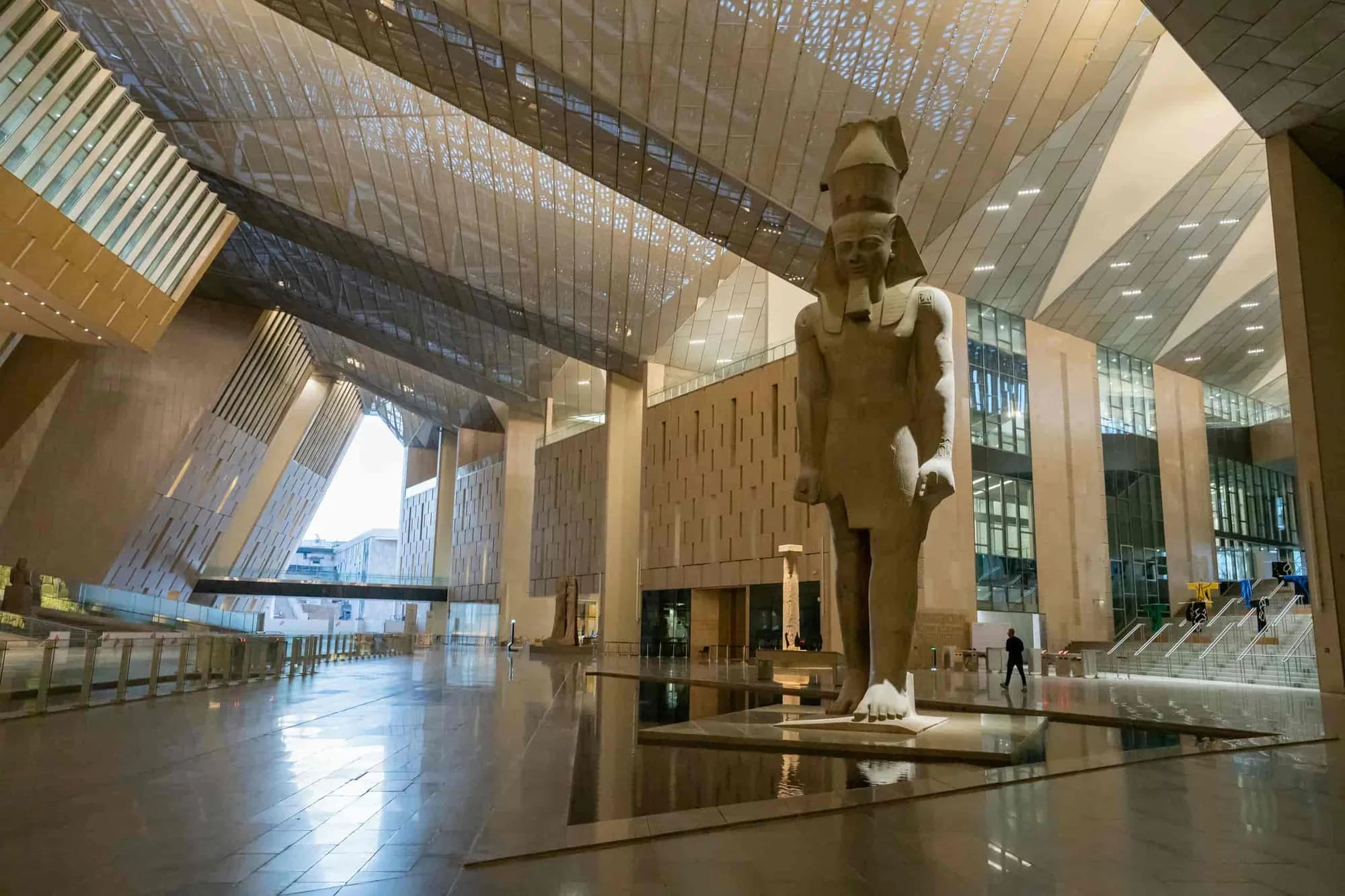
The Grand Egyptian Museum (GEM) represents one of the most remarkable cultural destinations in contemporary Egypt and a symbol of its forward-looking vision. Located on the Giza Plateau, just steps from the Pyramids, it is the largest museum in the world dedicated exclusively to ancient Egyptian civilization, spanning from prehistory to the end of the Greco-Roman periods. The museum houses the complete collection of Tutankhamun, with over 50,000 artifacts on display for the first time, offering visitors an unprecedented experience. Designed as a cutting-edge cultural complex, the GEM integrates the latest museum technologies, including virtual reality, a children’s museum, a conference center, and a training center. Accessible from the country’s main ports and entry points—particularly from the port of Alexandria via organized transfers or guided excursions directly to Giza—the museum serves as a bridge between past and present, enriching every cultural itinerary with an immersive and contemporary narrative of Egyptian civilization.
From the port of Alexandria, visitors can explore not only the city’s Greco-Roman heritage but also lesser-known sites such as the recently restored Eliyahu Hanavi Synagogue. Founded in 1362 AD during the Mamluk period and dedicated to the Prophet Elijah, the synagogue is one of the oldest and most significant in the world. Over the centuries, it underwent several restorations, including a major 19th-century reconstruction by French architects, which highlighted its refined architectural style, the result of a harmonious blend of Islamic and Mediterranean influences. After being closed to the public for many years, the synagogue has recently reopened following an extensive restoration project, as part of the Egyptian government’s efforts to preserve and promote the country’s Jewish heritage. Today, the Eliyahu Hanavi Synagogue is not only a place of worship but also a significant cultural destination, easily accessible from the port of Alexandria, about 5–7 km away, reachable in 15–30 minutes via land transfers, and capable of enriching visitors’ experiences with a unique and lesser-known historical perspective of Egypt.
Through the Mediterranean ports of Alexandria and Port Said, as well as from the Red Sea, it is possible to reach archaeological sites such as San El Hagar (Tanis) in the eastern Nile Delta by land, with the fastest access from the port of Port Said, which allows visitors to reach the site in approximately 1.5–2 hours. Once the ancient northern capital during the 21st and 22nd dynasties, the site today presents itself as a striking open-air museum, where stone blocks, columns, and monumental statues emerge from the sand exactly as they were discovered in the 19th century. Among the most significant remains are the colossal statues of Ramses II and the vestiges of temples dedicated to Amun, Mut, and Khonsu, reflecting the city’s central religious and political role in ancient Egypt. The intact and uncrowded atmosphere of San El Hagar allows visitors to enjoy an authentic, contemplative experience, offering a privileged insight into the life and urban planning of pharaonic Egypt, far from the more traditional tourist circuits.
The renovation of museums and historic palaces further expands the range of destinations accessible from the ports. Sakakini and Baron Palace, both unique examples of European architecture reinterpreted in an Egyptian context, reveal a lesser-known chapter of the country’s modern history. Sakakini Palace, located in the heart of Cairo in the area that now bears its name, is one of the most distinctive buildings of late 19th-century Egyptian urban architecture. Built in 1897 at the behest of Habib Sakakini Pasha, a Syrian-born entrepreneur, and designed by Italian architects inspired by European Rococo, the palace is notable for its circular structure, richly decorated façades, statues, curving balconies, and abundant ornamental details. A symbol of an era of cultural openness and cosmopolitanism, Palazzo Sakakini provides visitors with a fascinating glimpse into modern Cairo’s history and the meeting of European taste with the Egyptian context.
The Baron Empain Palace, simply known as Baron Palace, is located in the Heliopolis district of Cairo and is one of the city’s most iconic and recognizable buildings. Constructed between 1907 and 1911 for the Belgian magnate Édouard Empain, founder of the district, the palace is renowned for its architectural style inspired by Indian temples, blending Hindu and European influences, and characterized by towers, sculpted statues, and richly detailed decorations. After years of abandonment, the palace underwent a major restoration, reopening to the public as a cultural site and museum, becoming a symbol of Egypt’s early 20th-century modernization and a highly interesting stop for those wishing to discover a lesser-known side of the country’s historical heritage.
These sites, easily integrated into cruise itineraries, attract travelers interested in art, architecture, and urban history, and are accessible via land transfers ranging from approximately 2 to 4 hours, making them ideal for half-day or full-day guided excursions.
Similarly, the reopening of the Graeco-Roman Museum provides an in-depth look at daily life and culture in Hellenistic and Roman Egypt, completing the cultural experience for passengers in transit from the northern ports. Founded at the end of the 19th century, the museum houses a vast collection of statues, mosaics, sarcophagi, coins, and everyday objects that testify to the intersection of Egyptian, Greek, and Roman civilizations. Recently renovated, the museum now offers modern exhibition spaces, educational rooms, a museum garden, and a children’s area, making the experience accessible and engaging for every visitor. Thanks to its strategic location in the heart of Alexandria, easily reachable from the port, the Graeco-Roman Museum allows visitors to explore a lesser-known side of Egyptian history, where art, religion, and daily life blend into a unique and fascinating narrative.
Another example of an emerging destination is the Holy Family Route, which spans several regions of the country, from the Sinai to Upper Egypt. This itinerary, now enhanced and made accessible through dedicated infrastructure and signage, represents an important opportunity for religious tourism and can be easily connected to port calls. The Egyptian authorities are promoting the route through restoration projects, improved infrastructure, signage, and visitor facilities, making access easier for pilgrims and tourists. The aim is to promote religious and cultural tourism by highlighting churches, monasteries, springs, and caves linked to the Holy Family’s journey, while integrating the itinerary with major port stops as starting points for exploring the interior of Egypt beyond its famous monuments.
On the Red Sea, the Hurghada Museum has established itself as one of the most interesting cultural destinations in the region, enriching a tourism offer traditionally associated with sun and diving. Opened on February 29, 2020, it is the first antiquities museum in the Red Sea Governorate and houses around 2,000 artifacts that narrate the history of Egyptian civilization from prehistory to the modern era, encompassing the Pharaonic, Graeco-Roman, Coptic, Islamic, and contemporary periods. Among the most significant items are the statue of Meritamen, daughter and consort of Pharaoh Ramses II, mummies over 2,000 years old, and a rich collection of everyday objects, art, and cultural artifacts reflecting the evolution of Egyptian society over millennia. Located on El-Nasr Road in Hurghada, the museum provides an ideal cultural complement to beach and diving activities, offering visitors an exhibition journey that connects ancient history to modernity and deepens understanding of Egyptian identity even during short stops in the Red Sea.
The strength of Egypt therefore lies in its geographical, cultural, and historical diversity, and its ports serve as the ideal connection between the sea and these multiple destinations. Through integrated planning and flexible incentives, the Egyptian port system allows cruise lines and visitors to discover an authentic, lesser-known Egypt full of surprises. Each port opens the way to new destinations, turning every call into an invitation to explore a country that goes far beyond its most famous icons.
Don’t miss news, updates, and reviews from the world of cruises on Cruising Journal, featuring photos, videos, and special cruise offers.