
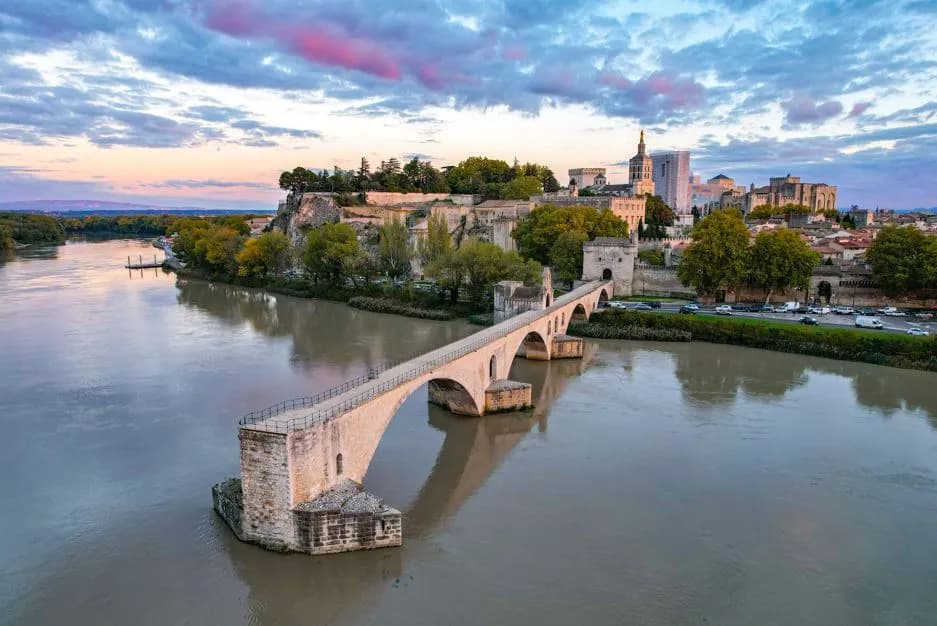
Avignone is a perfect city to begin or conclude a journey along the Rhône. Strategically located in the heart of Provence, it combines history, culture, gastronomy, and a welcoming, relaxed atmosphere.
The city encourages visitors to take their time to appreciate what it offers: significant monuments, a vibrant cultural life, excellent cuisine, and a historic center that is easily explored on foot. Avignon’s location is one of its major advantages. It is easy to reach, whether arriving from elsewhere in France or from further afield. High-speed rail connections place it just two and a half hours from Paris and around thirty minutes from Marseille, allowing travelers arriving at major international airports to reach the city quickly. Thanks to the national rail network, connections with other French destinations are equally efficient, greatly facilitating the organization of a pre- or post-cruise stay.
One of the features that impress visitors most is the city’s human scale. The historic center, enclosed by 14th-century walls, is ideal for those who enjoy exploring on foot. Walking through its streets means having everything within easy reach: shops, restaurants, cafés, museums, art galleries, markets, and shaded squares appear naturally, without long distances or major obstacles. Recent urban policies promoting sustainable mobility have further enhanced the city’s livability, making cycling, electric vehicles, and free shuttles highly convenient for navigating the busiest areas. For those with impaired mobility, a fully accessible electric transport service ensures that daily travel is simple, making Avignon inclusive and accessible for all.
Contributing to the city’s appeal is a generally calm and well-organized atmosphere. Despite the influx of tourists, Avignon maintains a strong local identity, perceptible in the way residents use public spaces and continue daily activities. With over three hundred days of sunshine per year, outdoor areas such as terraces, cafés, and pedestrian zones naturally become meeting points for locals and visitors alike. The streets of the historic center, especially on bright days, see a steady yet orderly flow of people moving between shops, artisan boutiques, and shaded squares. This balance between quality public spaces, pedestrian accessibility, and climatic comfort is a key factor that makes Avignon a welcoming and functional destination.
Avignon has long valued its historic heritage. Its most imposing monument is undoubtedly the Palais des Papes, a monumental Gothic structure that reflects the city’s power and importance in the 14th century. Visiting this building provides a deeper understanding of the history of the Avignon Papacy and offers a chance to appreciate French Gothic architecture at one of its most impressive expressions. A short distance away is the famous Pont d’Avignon, known worldwide for its history and its iconic image on the Rhône. Although only part of the bridge remains today, it retains a unique charm and offers one of the most beautiful views of the city and the river.Avignon is also home to numerous museums of considerable interest.
The Musée Calvet is the main fine arts museum, featuring collections of painting, sculpture, and archaeology. The Collection Lambert, on the other hand, focuses on contemporary art, showcasing works by important European and international artists. The Petit Palais houses a significant collection of Medieval and Renaissance art, while the Bains Pommer, a restored 19th century bathhouse, combines heritage and history of hygiene practices in Europe. In total, the city has ten museums, six of which are public and free of charge, allowing visitors to explore works by Botticelli, Cézanne, Van Gogh, Manet, Picasso, Cy Twombly, Basquiat, and many other artists. Even simply walking through the historic center means passing through centuries of architecture: noble residences, ancient chapels, monasteries, and private homes line the streets and squares, providing a unique and easily accessible environment.
Alongside its impressive historical legacy, Avignon has maintained a vibrant contemporary creative scene. A prime example is Les Fabricateurs, a group of eleven workshops and boutiques bringing together local artisans and designers. Visiting these workshops offers an opportunity to see traditional skills and techniques applied in modern ways: clothing, design objects, jewelry, ceramics, and wine-related products coexist in a dynamic, evolving environment. What makes this experience particularly engaging is the chance to meet the artisans directly, discuss their work, and observe practical demonstrations. This provides insight into how Avignon is not only a custodian of the past but also a place where contemporary craftsmanship thrives and finds recognition and audience.
Although Avignon is a cultural and historic center, it also offers ample opportunities for those seeking contact with nature. Barthelasse Island, located in the middle of the Rhône, represents the city’s main green oasis and is highly appreciated by residents. This large river island, the largest in France, offers ideal paths for walking, cycling, picnics, and outdoor activities such as kayaking. It is particularly pleasant during the warmer months, when the favorable climate allows for entire days spent outdoors.
Beyond the island, Avignon is surrounded by four significant natural parks that showcase the variety and richness of Provençal landscapes. The Alpilles Natural Park, with its stone villages and olive-covered hills; the Ventoux Park, dominated by the imposing Mont Ventoux; the Camargue Park, famous for its wild nature, pink flamingos, and white horses; and the Luberon Park, with its picturesque villages and vast lavender fields. Each of these parks offers hiking trails and cycling paths, providing opportunities to experience nature actively and sustainably.
Avignon also has a strong cultural identity. Its history linked to the Papacy in the 14th century created a cultural heritage that remains one of its defining characteristics. When it became the seat of the Catholic Church, Avignon attracted not only religious figures and diplomats but also artists, architects, scholars, and artisans from across Europe. This influx transformed the city into a major creative center, a status it maintained in the centuries that followed.
This cultural tradition is still evident today, not only in its monuments but also in the spirit of the city. Avignon maintains a constant engagement with culture, not limited to the tourist season or periods of high visitor numbers. Exhibitions, performances, festivals, and public initiatives take place throughout the year, involving both residents and visitors alike.
The most famous event is undoubtedly the Avignon Festival, which every July transforms the city into an international platform dedicated to theater, dance, and performing arts. During the festival, the courtyards of historic buildings, squares, and public spaces become performance venues, hosting companies from around the world. However, reducing Avignon’s cultural life to this single event would be limiting. Numerous other events take place in the months before and after, keeping the city’s cultural rhythm alive throughout the year. In the early months of the year, Cheval Passion, a festival dedicated to the equestrian world, attracts enthusiasts and professionals alike. In February, the city hosts Les Hivernales, an event focused on contemporary dance, which over the years has established a significant place in the French cultural landscape. In March, Spanish Week brings color, music, performances, and traditions to the historic center, highlighting the city’s Mediterranean cultural connections. In summer, before the Avignon Festival, the city comes alive with Id-Île, a contemporary music festival. Between June and December, the Palais des Papes hosts a major art exhibition that attracts visitors from across Europe, reinforcing the importance of this monument not only as a historic site but also as a contemporary cultural space.
Moving into the autumn season, Parcours de l’Art promotes contemporary art through a series of exhibitions spread throughout the city center, while Italian Week celebrates cultural ties with Italy through performances, tastings, and themed events. The year concludes with Christmas celebrations, during which Avignon is animated with lights, markets, and family-oriented activities. This continuous cultural activity makes the city interesting at any time of the year, allowing visitors arriving before or after a cruise to always find engaging experiences, regardless of the season.
Regarding gastronomy, Provence is one of France’s most renowned regions for the quality of its cuisine, and Avignon fully represents this culinary identity. The city offers a wide variety of gastronomic experiences, ranging from informal bistros to refined restaurants.
The local cuisine is primarily based on fresh, seasonal ingredients typical of the Mediterranean climate. Dishes are often simple, yet elevated by distinct flavors, aromatic herbs, high-quality oils, and products from the land. Eggplants, zucchini, sun-ripened tomatoes, olives, and Provençal herbs feature prominently in many traditional recipes. Among the typical dishes one can try in Avignon are papeton d’aubergines, an eggplant flan usually served as a starter; daube provençale, a slow-cooked beef stew with red wine, herbs, and vegetables; agnolade, a lamb stew popular during cooler seasons; ratatouille and tian, two iconic vegetable dishes from Provençal tradition; tapenade, an olive paste often served with appetizers or drinks; and a wide variety of local goat cheeses. For those with a sweet tooth, desserts include specialties such as sacristain, a braided puff pastry with almonds, or papalines, chocolates filled with a local oregano-infused liqueur.
For those wishing to explore local products up close, Les Halles d’Avignon is the ideal destination. This covered market, located in the heart of the historic center, brings together local producers, culinary artisans, and restaurateurs offering ready-to-eat dishes and tastings. The atmosphere is lively, colorful, and authentic, serving as a genuine meeting point for both residents and visitors. On Saturday mornings, the outdoor market provides an additional opportunity to immerse oneself in the flavors and traditions of Provence, wandering among stalls of fruits, vegetables, spices, flowers, and artisanal products.
The surrounding territory further enriches this gastronomic experience thanks to its proximity to some of France’s most famous wine regions. In just a few minutes, one can reach areas such as Châteauneuf-du-Pape, Tavel, Lirac, and the broader Côtes du Rhône regions, where visitors can tour wineries, participate in tastings, and meet producers directly. This makes Avignon a perfect base for those wishing to combine Provençal cuisine with wine exploration.
One of the reasons Avignon is an ideal choice for a pre- or post-cruise stay is its immediate access to the main attractions of Provence. Just minutes from the city center lies Villeneuve-lès-Avignon, a village on the opposite bank of the Rhône, home to the stunning Abbey of Saint-André and the Chartreuse, a monumental complex of significant historical interest. About half an hour away is the Pont du Gard, one of the best-preserved Roman aqueducts in the world, offering both a remarkable natural setting and a valuable testament to the region’s Roman past. At a similarly short distance, Orange is known for its perfectly preserved Roman theater, while wine enthusiasts will find Châteauneuf-du-Pape an essential stop. Provence also offers numerous hilltop villages, vast fields of lavender stretching as far as the eye can see, and rural landscapes that provide an authentic experience far removed from the hustle and bustle of larger cities.
Avignon thus presents itself as an efficient and comprehensive destination, capable of easily integrating a pre- or post-cruise stay along the Rhône. Planning two or three days in Avignon allows visitors to explore the cultural, historical, and environmental aspects of the region at a comfortable pace, without logistical challenges. Its urban layout, ease of access, and concentration of major attractions make it possible to organize visits in a straightforward and functional way, balancing activity with moments of relaxation.
Whether as a starting point or a final stop on a cruise, Avignon provides optimal conditions for completing the journey with a coherent and well-structured experience. Its combination of high-quality heritage, efficient services, and strategic location makes the city a solid and advantageous choice for any traveler heading to Provence or cruising along the Rhône.
Don’t miss news, updates, and reviews from the world of cruising on Cruising Journal, featuring photos, videos, and special cruise offers.