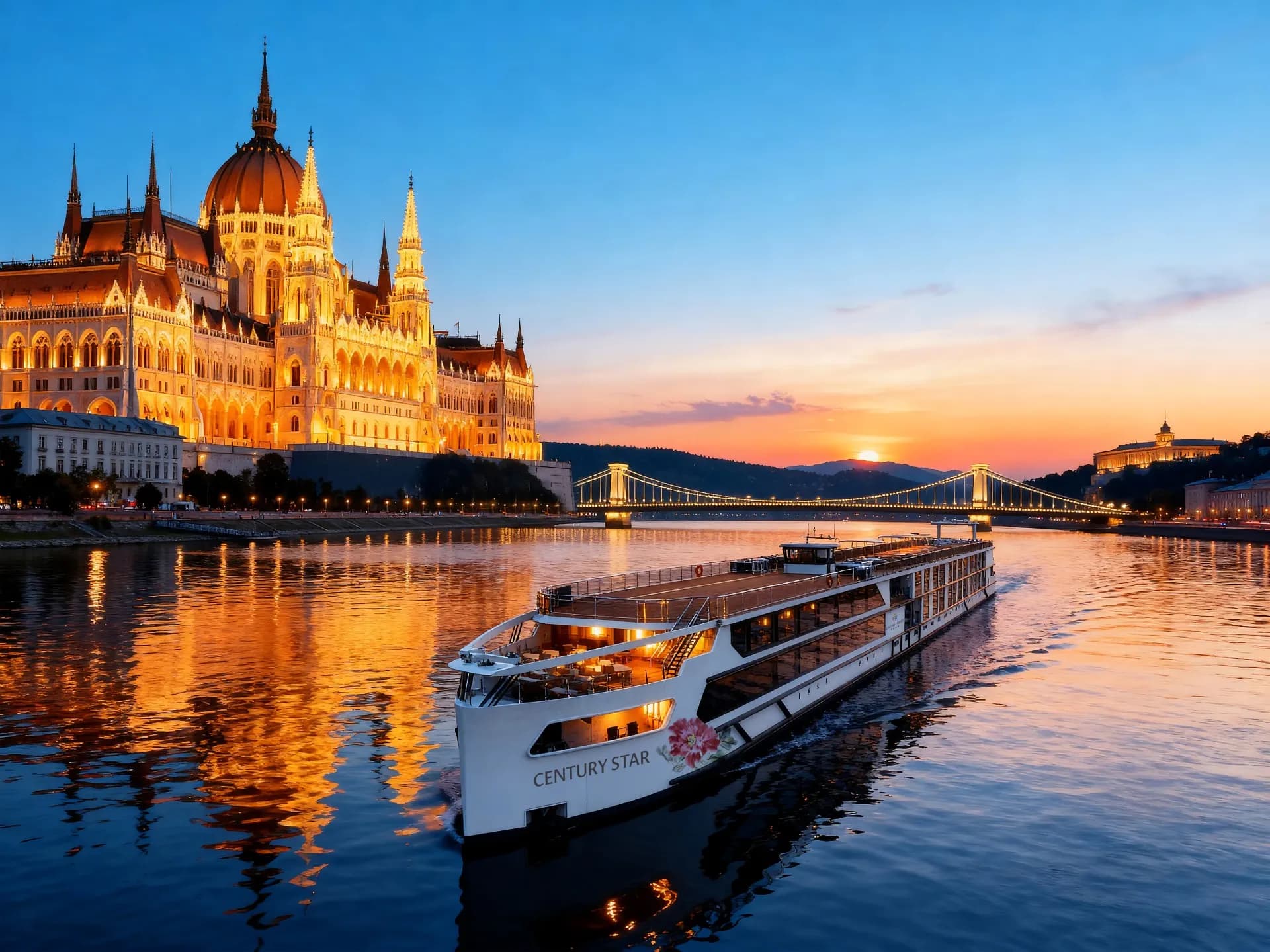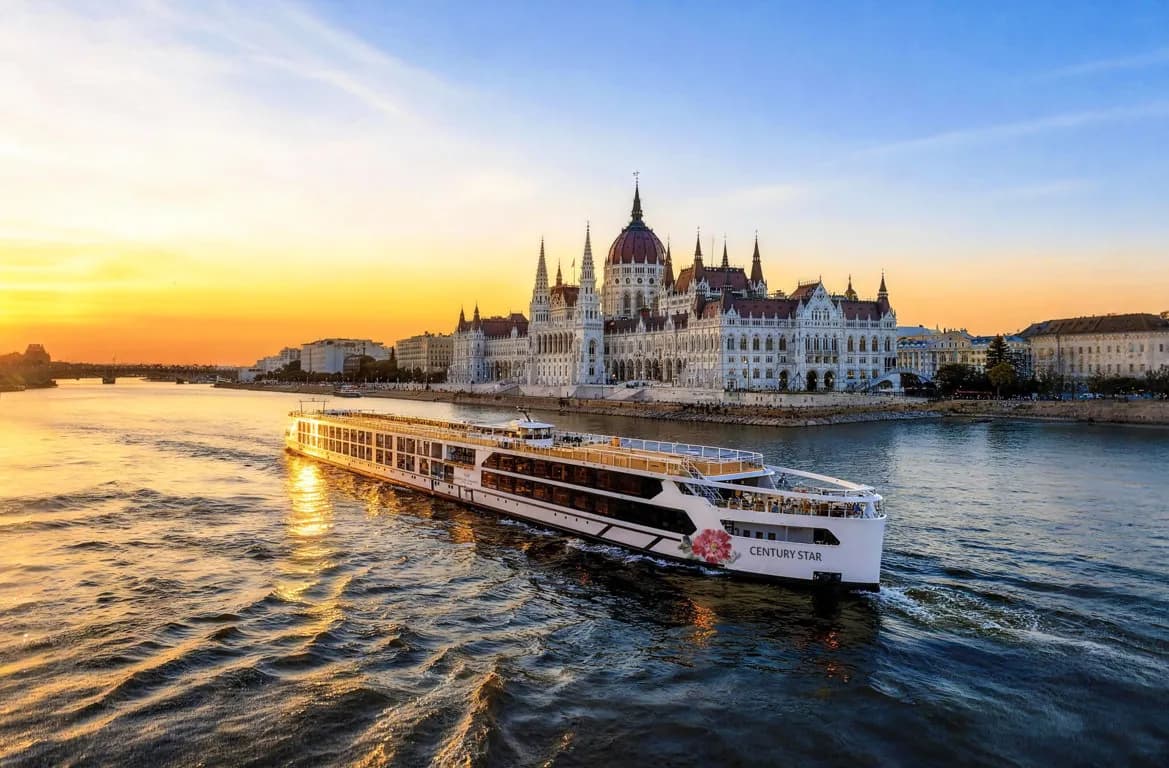
After thirty years of experience gained along the Yangtze, the great river of China, Century Cruises makes its European debut on September 18, 2026, with its new flagship, Century Star.
Choosing the Danube for its European debut is certainly a symbolic gesture, almost a statement of intent. If the Yangtze represents the backbone of Chinese civilization, the Danube is the great cultural artery of Central Europe. The Century Star, therefore, is not just a new ship, but a meeting point between two millennia-old traditions, between East and West, between technological innovation and historical heritage. And it is precisely along the route of the famous “Blue Danube” that this story begins.
The inaugural journey, “The Blue Danube: Budapest to Passau”, is a passage through European memory, a voyage connecting imperial capitals, Baroque cities, and UNESCO-recognized landscapes, following the course of a river that for centuries has united peoples, languages, and cultures.
Embarkation takes place in Budapest, a city symbolizing the continent’s dual soul. Once the co-capital of the Austro-Hungarian Empire, today it is a vibrant metropolis where imperial monumentality coexists with contemporary energy, expressed through historic cafés, grand boulevards, and striking architecture mirrored in the Danube. The beginning of the journey has a solemn air: crossing the Petőfi Bridge means leaving behind a lively Pest to ascend toward the more intimate and panoramic Buda.
The Parliament building rises along the river with its 96-meter-high dome, a number that symbolically recalls the year 896 AD, the founding of the Hungarian state. A little further on, Gellért Hill dominates the city, guardian of medieval legends and panoramic views embracing both banks. The journey continues toward St. Stephen’s Basilica, which houses the precious relic of the “Holy Right Hand,” and the elegant Gresham Palace, a refined example of Art Nouveau in the city center. Kossuth Square and Heroes’ Square recount national history through solemn monuments and identity symbols.
Once back on board, the ship sets sail toward Esztergom, entering the spiritual heart of Hungary. The grand basilica, the largest in the country, dominates the landscape with its majestic mass and narrates a layering of epochs, from the Roman era to the medieval period, and including Ottoman and Habsburg influences. Here, the river seems to slow down, almost inviting contemplation.
One of the most striking moments of the voyage is passing through the Gabčíkovo lock, one of the most impressive river infrastructures in Europe. The ship is lifted or lowered by more than twenty meters depending on the river’s conditions: a fascinating experience that combines engineering precision with natural power, a reminder of how the Danube has always been a corridor of primary commercial and cultural importance.
The route then leads to Bratislava, a surprising capital. Once the city of coronations for Hungarian kings, today it presents itself as an elegant mosaic of Baroque buildings, medieval churches, and compact squares. The historic center, colorful and intimate, invites leisurely strolls. Bratislava Castle, perched on a hill above the Danube, offers a sweeping view that, on clear days, stretches to the borders with Austria and Hungary. Walking through its streets means crossing centuries of Central European history in a surprisingly contained space, sensing the crossroads vocation that has always defined this city.
Arrival in Vienna marks one of the most anticipated moments of the entire itinerary. Here, the Danube meets the cultural heart of Europe, and the atmosphere shifts, taking on a more imperial tone. The Baroque gardens of the Belvedere Palace frame the city with elegant geometries, fountains, and sculptures that converse with the urban landscape. The Staatsoper, inaugurated in 1869 with Mozart’s Don Giovanni, remains one of the world’s foremost temples of classical music.
Crossing Stephansplatz, one enters the bustling center of the capital, where the Gothic cathedral coexists with modern shop windows and historic buildings. Nearby, Michaelerplatz leads to the Hofburg complex, residence of Habsburg power for over six centuries. Today, this vast complex houses museums, the office of the Federal President, and the renowned Spanish Riding School. Vienna is a continuous layering of styles and periods, a place where Baroque, Gothic, and contemporary architecture coexist in a surprisingly harmonious balance.
Leaving the Austrian capital, the navigation enters one of the most romantic stretches of the Danube: the Wachau Valley. Here, the ship docks at Dürnstein, a small jewel dominated by the blue-and-white tower of the Baroque abbey, which has become an iconic symbol of the river landscape. The terraced vineyards descending to the water tell of a centuries-old winemaking tradition, while the Treppelweg paths, once walked by men and animals towing boats upstream, evoke a past of labor and commerce.
The journey then continues to Linz, a city that embodies the meeting of past and avant-garde. The Baroque façades of the historic center converse with contemporary architecture and innovative cultural spaces. Linz surprises with its ability to reinvent itself without renouncing its roots, offering a dynamic and creative face of modern Austria. Finally, the voyage reaches Passau, an elegant Bavarian city situated at the confluence of three rivers, the Danube, the Inn and the Ilz, which intertwine in a captivating play of colors. The historic center, with its Italian influences and solid Germanic traditions, provides the perfect conclusion to a journey that has crossed geographical and cultural boundaries seamlessly.
The onboard experience aboard the Century Star will be defined by a concept designed to ensure comfort, seamless organization, and a level of service consistent with the company’s premium positioning. It is not merely a collection of ancillary services, but an integrated hospitality model, crafted to accompany guests through every stage of the journey with attention and continuity.
The goal is to offer guests a smooth and complete experience, where every phase of the voyage is harmonized and simplified. For premium cabin categories, international and domestic flights are included, transforming the cruise into an uninterrupted journey from the very moment of departure. Airport transfers, coordinated directly by the company, guarantee continuity and comfort, eliminating logistical complexities and allowing guests to focus solely on the experience.
During the navigation and onshore excursions, a professional English-speaking guide accompanies guests with expertise and storytelling ability, enriching each stop with historical and cultural insights. Excursions, one at each port on the itinerary, are included in the program, with the option to select even more personalized experiences through dedicated collections, designed for those seeking deeper exploration.
The culinary dimension is also an integral part of the overall vision. Full board allows guests to enjoy carefully crafted cuisine, attentive to the quality of raw ingredients, while lunch and dinner include an unlimited selection of beers and wines, fostering a convivial and relaxed atmosphere perfectly aligned with the leisurely pace of river cruising. Overall, the offering targets an international audience seeking not only comfort and impeccable service but also cultural authenticity and design coherence.
Built by the Dutch shipyard Concordia Damen Shipbuilding, the Century Star is the result of an international collaboration combining European engineering with Asian vision. Nearly 135 meters long and designed to accommodate 174 passengers in 78 luxury cabins, the ship is intended to provide an exclusive yet intimate experience. At its technological heart lies hybrid propulsion, placing it among the most advanced units in the European river fleet.
The hull, made of recycled steel, and adherence to European Union environmental standards reflect a clear objective: navigating toward carbon neutrality. At a time when sustainability is no longer an option but a necessity, Century Cruises makes its European debut with a concrete statement of environmental responsibility. Interiors, designed by MDesigns, reinterpret European elegance with an Eastern sensitivity: clean lines, natural materials, and details inspired by Viennese architecture. The lounge bar on the second deck, setting for the inaugural Welcome Drink, evokes Central European atmospheres with a contemporary touch.
After its debut on the Danube, the Century Star will embark on a second itinerary between Amsterdam and Basel along the Rhine, consolidating the company’s presence in Western Europe. Entry into the European market is therefore not an isolated event, but part of a long-term strategy, a symbolic bridge between two continents, between past and future, between sustainability and luxury.
In an ever-evolving industry, Century Cruises chooses to debut in Europe with a hybrid ship, an iconic itinerary, and a clear vision: to demonstrate that the future of river cruising can be elegant, sustainable, and culturally enriching.
Don’t miss more updates, news and reviews of Century Cruises on Cruising Journal.