
The Port of Alexandria, Egypt’s largest and oldest seaport, has served for more than two millennia as a strategic gateway between East and West. Founded around 331 BC by Alexander the Great, Alexandria rapidly emerged as one of the leading centers of the ancient Mediterranean world, evolving into a major hub for trade, culture, and intercultural exchange.
Its location between the Mediterranean Sea and Lake Mariout was the result of a deliberate strategic vision conceived during the Hellenistic era. The port was designed to connect maritime trade routes with the Nile River system, allowing goods to be distributed efficiently throughout inland Egypt. This unique geographical and logistical advantage enabled Alexandria to become one of the Mediterranean’s most influential commercial centers for centuries.
Today, the Port of Alexandria continues to play a vital role in Egypt’s economy, handling approximately 60% of the country’s imports and exports and maintaining its position as the nation’s primary maritime hub. Beyond commercial shipping, the port has also become an increasingly important destination for cruise tourism, supported by extensive modernization projects aimed at enhancing passenger facilities and operational efficiency.
Alexandria also occupies a privileged position within the Eastern Mediterranean cruise network, placing it among some of the region’s most remarkable itineraries. Its strategic location allows seamless integration with renowned destinations such as Greece, Türkiye, Cyprus, Italy, and the Levant, creating journeys shaped by a shared Mediterranean atmosphere, rich cultural interaction, and the extraordinary diversity of ancient civilizations. Few cruise routes in the world combine such a concentration of historical depth, architectural heritage, maritime legacy, and multicultural identity within a single maritime corridor.
Alexandria’s modern cruise terminal has become a cornerstone of the city’s tourism revival. Covering approximately 24,000 square meters across three floors, the facility includes a large parking area capable of accommodating up to 80 buses or 350 vehicles. The terminal is divided into dedicated sections for tourists, senior visitors, and administrative operations, while outside, a landscaped 4,000-square-meter green area featuring decorative fountains creates a welcoming environment for arriving passengers.
The terminal also incorporates a commercial area with 100 retail stores, five restaurants, and three cafés, in addition to a separate complex containing 38 mini-shops specializing in souvenirs and local handicrafts. Together, these facilities significantly enhance the commercial and tourism appeal of the waterfront district.
Operationally, the terminal offers four berths with a combined length of 820 meters and depths ranging from 9 to 11 meters, enabling the simultaneous accommodation of four large cruise ships and up to 7,000 passengers. The port is fully equipped with essential services for ships and yachts, including water supply, electricity, and telecommunications infrastructure.
One of the terminal’s greatest advantages is its central location within Alexandria itself. A dedicated 700-meter bridge connects the port directly to the city center through a separate entrance outside the customs zone, improving passenger movement and ensuring a more efficient arrival and departure experience.
For cruise travelers, Alexandria offers a distinctive blend of archaeology, Mediterranean culture, colonial architecture, and Oriental charm. Many of the city’s principal attractions are located within easy reach of the port and can comfortably be explored during a single-day visit.
A short distance from the harbor lies the historic district of Anfushi, one of Alexandria’s most authentic neighborhoods. Situated near the old harbor and the Mediterranean coast, Anfushi preserves the city’s traditional maritime identity. Its narrow streets are lined with fishermen repairing their nets, seafood restaurants, local markets, and historic cafés frequented by residents. The colorful facades, sea breeze, and constant movement of fishing boats create an atmosphere that captures the true spirit of Mediterranean Alexandria.
At the edge of the district stands the iconic Qaitbay Citadel, constructed in the 15th century by Sultan Al-Ashraf Qaitbay on the exact site where the legendary Lighthouse of Alexandria—one of the Seven Wonders of the Ancient World—once stood. Overlooking the Mediterranean, the fortress remains one of the city’s most recognizable landmarks and continues to symbolize Alexandria’s historic strategic importance in controlling Eastern Mediterranean trade routes.
Visitors can also easily access Alexandria’s famous Corniche, the scenic waterfront promenade stretching along the Mediterranean coast, as well as the Roman Theatre of Alexandria, an important archaeological site featuring the remains of an ancient Roman theatre, bath complexes, and richly preserved mosaic floors. The site provides valuable insight into daily life and public entertainment during the Roman period in Egypt.
Nearby are the Catacombs of Kom El Shoqafa, regarded as one of Alexandria’s greatest archaeological treasures; Pompey’s Pillar, a monumental Roman column erected in honor of Emperor Diocletian; and the Abu al-Abbas al-Mursi Mosque, the city’s most renowned mosque and one of the finest examples of Islamic architecture in Alexandria. Its grand domes, ornate minaret, and richly decorated interiors contribute to a deeply spiritual atmosphere within one of the city’s liveliest traditional districts.
Another significant cultural landmark is the Eliyahu Hanavi Synagogue on Nabi Daniel Street, one of the Middle East’s most historically important synagogues. Originally constructed in 1354 and later rebuilt in 1850 with support from the Muhammad Ali dynasty, the synagogue stands as a powerful testament to Egypt’s historic Jewish community and Alexandria’s long-standing multicultural identity. Designed in an elegant Italian architectural style, the building features marble columns, refined decorative elements, and a collection of Torah scrolls preserved from other synagogues across the city.
The Cavafy Museum, dedicated to the renowned Greek poet Konstantinos Cavafy, is located in the apartment where the writer spent his final years. The museum preserves manuscripts, photographs, books, and personal belongings that reflect both his literary legacy and his profound connection to Alexandria’s cosmopolitan society during the early twentieth century.
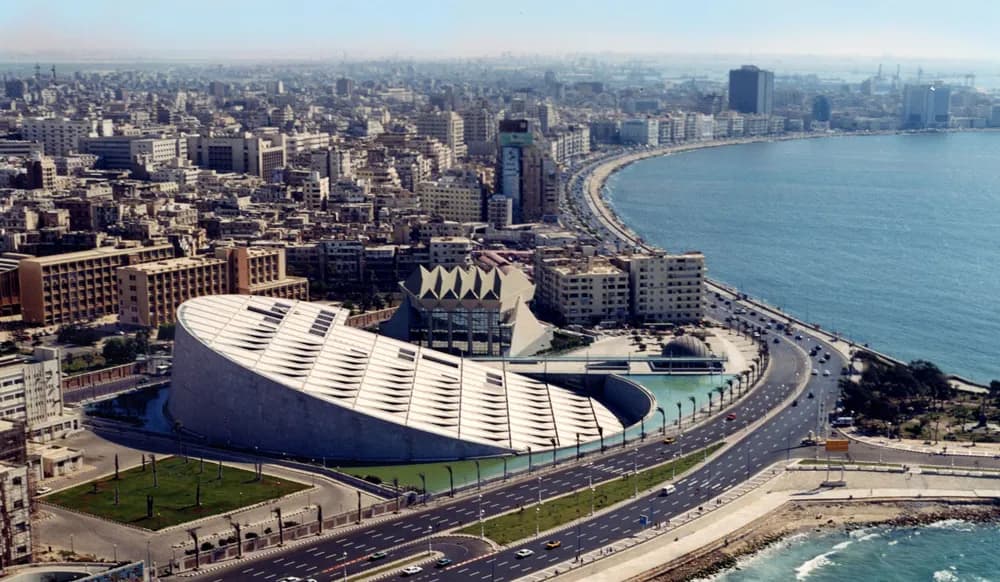
In contrast to these historical sites, the modern Bibliotheca Alexandrina represents Alexandria’s contemporary cultural renaissance. Its striking architecture, sloping toward the sea, pays tribute to the legendary Ancient Library of Alexandria. The complex houses extensive reading halls, museums, art galleries, and research centers, while its exterior walls are engraved with scripts from civilizations around the world. Today, it stands as one of the strongest symbols of the city’s intellectual and cultural renewal.ù
The Alexandria National Museum further illustrates the city’s rich historical layering through collections spanning the Pharaonic, Greek, Roman, Coptic, and Islamic periods. Artifacts recovered from the submerged ancient harbor, together with statues, jewelry, and everyday objects, reveal the remarkable diversity of civilizations that shaped Alexandria over the centuries.
Further east lies the Montaza Palace complex, one of Alexandria’s most elegant royal landmarks overlooking the Mediterranean Sea. Once used as the summer residence of Egypt’s royal family, the estate combines historic palaces, landscaped gardens, and scenic coastal views. Nearby, the Royal Jewelry Museum preserves crowns, jewelry, and personal possessions belonging to the Egyptian monarchy, offering insight into the luxury and lifestyle of Egypt’s aristocracy during the nineteenth and twentieth centuries.
The Antoniadis Gardens, inspired by European Renaissance landscapes, provide another refined cultural attraction, featuring fountains, statues, and tree-lined avenues once frequented by royalty and foreign dignitaries.
Outside Alexandria, the El Alamein War Cemetery serves as an important memorial site dedicated to soldiers who died during the North African Campaign of the Second World War. The cemetery commemorates both Allied and Axis forces and remains a place of reflection on one of the most significant military confrontations fought in the Egyptian desert between 1942 and 1943.
For visitors with additional time, excursions from Alexandria to Cairo and the Pyramids of Giza are among the most popular experiences. Located approximately three hours away, the pyramids of Khufu, Khafre, and Menkaure remain among the most iconic monuments of ancient civilization. The Great Pyramid of Khufu, the last surviving Wonder of the Ancient World, continues to astonish visitors with its scale and engineering sophistication. Nearby, the Great Sphinx stands as one of Egypt’s most enduring symbols of mystery and historical grandeur.
Many excursions also include the Grand Egyptian Museum, one of the world’s most important museums dedicated to ancient Egyptian civilization. Its collections include monumental statues, sarcophagi, papyri, mummies, jewelry, and the celebrated treasures of Tutankhamun, including the famous golden funerary mask. Together, the museum and the Giza Plateau offer an unparalleled introduction to the history and achievements of ancient Egypt.
Additional highlights in Cairo include the Historic Religious Complex of Old Cairo, where churches, mosques, and synagogues coexist within one of the city’s oldest quarters; the Saladin Citadel and the Mosque of Muhammad Ali; the historic Al-Muizz Street and Khan el-Khalili Bazaar; the Monastery of Saint Simon the Tanner carved into the Mokattam hills; and traditional Nile cruises offering panoramic views of the Egyptian capital.
Ultimately, Alexandria presents a side of Egypt unlike any other. Shaped by millennia of history and centuries of interaction between Mediterranean, Middle Eastern, African, and European cultures, the city possesses a uniquely cosmopolitan identity. Through its ancient monuments, seaside palaces, vibrant markets, and modern cultural institutions, Alexandria continues to preserve the extraordinary legacy that made it one of the most celebrated cities of both the ancient and modern Mediterranean world.
Don’t miss more updates, news and reviews from the world of cruises on Cruising Journal.