
Onboard flow management on a cruise ship is one of the most crucial yet least visible elements of the entire ship system, as it operates continuously on multiple levels without ever being openly apparent to passengers.
When it works well, it goes unnoticed; when poorly designed or inefficiently managed, it immediately becomes evident through congestion, waiting times, noise, operational stress, and a diminished overall experience. For this reason, today, flow management is no longer considered a secondary aspect of naval design or hotel operations, but a true cross-disciplinary field involving naval architects, interior designers, engineers, onboard staff, safety officers, and company management.
The first level at which flow management plays out is the design stage. A cruise ship is not a static building, but a three-dimensional, moving structure with extremely high usage density and a constant alternation of peak and off-peak periods. This means that every space must be considered not only for its primary function but also for how it intercepts, diverts, slows, or accelerates the movement of people. Corridors, foyers, staircases, elevators, open decks, restaurant entrances, pool accesses, theaters, and lounges are never isolated elements—they are nodes within a complex network where every choice affects the others. A common design mistake is concentrating multiple attractive functions in the same area without adequate capacity: for example, placing the main dining room, theater, and access to an outdoor area close together can create significant congestion during peak times, even on large ships.
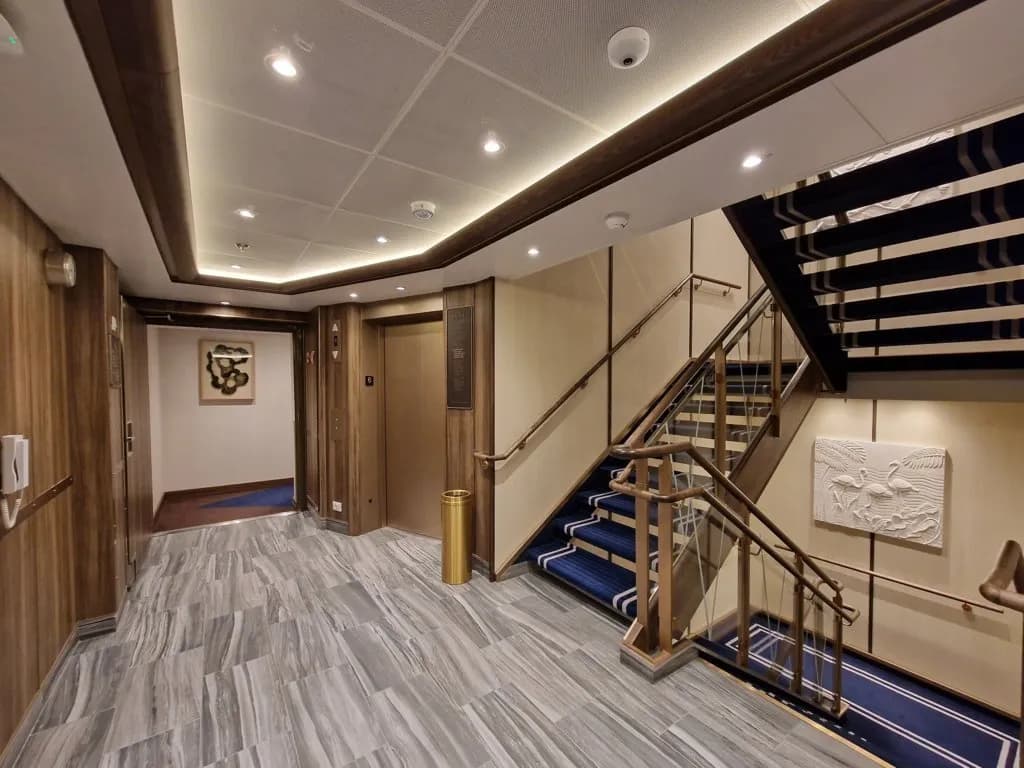
One of the most delicate aspects concerns the balance between horizontal and vertical flows. Modern ships span multiple decks, and vertical movement is inevitably one of the most critical factors. Elevators and staircases are not just service elements but actual regulators of human traffic. A recurring issue, especially on ships designed with strong aesthetic emphasis, is the presence of highly visible but inefficient showpiece staircases, which attract passengers but cannot handle high volumes, causing slowdowns and sudden diversions toward elevators. Conversely, well-distributed but less conspicuous staircases, integrated into the natural flow, decisively contribute to overall fluidity.
At this level, the hierarchy of space and time comes into play. Flows are not only spatial but also temporal, and a well-designed ship must account for overlapping events, services, and passenger habits. A concrete example is the simultaneous scheduling of an evening show and the end of the first dinner seating: if the theater and main dining rooms share corridors or access points, the result is sudden and hard-to-manage crowding. Better-organized ships work with intelligent temporal distribution, staggering events or differentiating access routes, thereby reducing pressure on critical points without invasive interventions.
Flow management on a ship, however, is not only about passengers. One of the greatest complexities of a cruise ship system is the continuous coexistence of guest flows and crew flows. A classic example of poor integration is the shared use of passenger elevators for transporting service materials during peak hours: a practice that, if not strictly controlled, undermines the perception of order and increases waiting times. Better-designed ships, instead, provide separate and redundant service routes, allowing the crew to operate efficiently without ever interfering with passenger movement.
Another level concerns the management of flows in relation to onboard revenue. Boutiques and bars located along main circulation axes can work very well if space is properly sized, but become problematic when they excessively reduce the usable passage area. A common mistake is sacrificing circulation space to increase commercial surface, with the paradoxical effect of reducing the quality of the experience and, in the medium term, also profitability. More mature layouts instead find a balance between commercial visibility and movement fluidity.
Wayfinding is another critical point. A typical example of an ineffective system is an overabundance of inconsistent signage, with different fonts, contrasting colors, and redundant information that confuses rather than guides. In contrast, ships with good wayfinding use clear, repeated references—intuitive deck numbering, visual landmarks, and consistent color schemes—which drastically reduce assistance requests and improve the spontaneous distribution of flows.
The moments when the flow system is most stressed are during boarding and disembarkation. A classic challenge is the simultaneous handling of arriving and departing passengers at the same terminal, without clearly separated routes. This creates interference, slowdowns, and a significant increase in the perception of chaos. More efficient operations, instead, use separate flows, staggered schedules, and clear, precise communication to passengers, reducing pressure both on the ship and on port infrastructure.
In recent years, technology has introduced new tools to address these challenges. Movement monitoring systems and data analytics allow, for example, real-time identification of areas approaching saturation, enabling rapid intervention, such as opening alternative routes or temporarily modifying access to a service. A common mistake, however, is to treat technology as a standalone solution: without a solid design foundation and well-trained crew, digital tools risk becoming mere observation systems, unable to produce meaningful improvements.
Finally, flow management is closely linked to safety and emergency procedures. A critical example is ships where evacuation routes differ significantly from regular pathways, creating confusion under stress. Best practices, instead, ensure strong consistency between everyday flows and emergency flows, as human behavior tends to follow familiar patterns even in critical situations.
In conclusion, onboard flow management is one of the areas where the technical quality of a ship and its organization is truly measured. It is a continuous process of design, observation, correction, and training, which never seeks visibility but delivers tangible results in terms of safety, efficiency, and quality of experience. It is precisely this ability to prevent problems before they become noticeable that distinguishes the best-designed and best-managed modern cruise ships.
Stay updated on the latest cruise news, reviews, photos, videos, and special offers on Cruising Journal.