
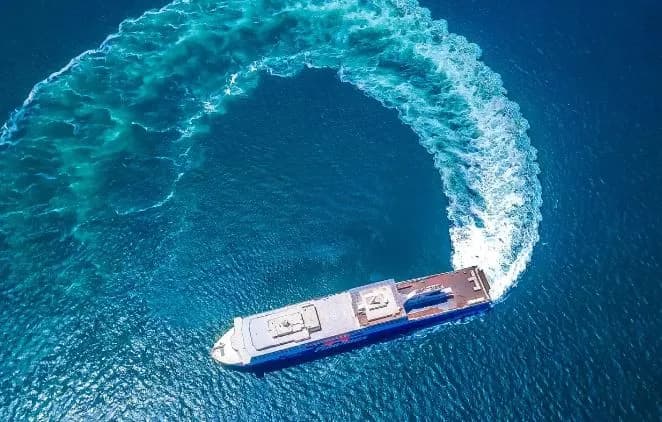
For those who observe the sea from the mainland, the horizon appears as an immutable line, a solid and reassuring boundary. For those who sail, however, that horizon is a plane in continuous motion, a perpetual and sometimes violent dance between the brutal forces of nature and the ingenuity of human architecture.
Designing a modern ship does not simply mean ensuring that it floats in calm waters – that is basic hydrostatics, a principle known since the time of Archimedes. The true engineering challenge lies in guaranteeing that this same ship can travel safely, maintain its commercial efficiency, and protect the psychophysical comfort of those on board even when the ocean decides to show its worst side.
This cutting-edge field of naval science is called seakeeping. It is an inherently multidisciplinary discipline that blends fluid dynamics, probabilistic statistics, vestibular medicine, and bioengineering.
What is Seakeeping and How is it Calculated?
In common jargon, saying a ship “holds the sea” evokes the romantic image of a steel hull cutting through waves without breaking during a storm. For marine scientists, the definition is much more rigorous and tied to daily operations.
Seakeeping is a ship’s ability to maintain its operational functions intact — whether it is carrying containers without damaging them, allowing the crew to rest, enabling military helicopters to take off, or ensuring that cruise passengers can dine in the restaurant — while minimizing involuntary movements and destructive structural loads.
When a hull encounters a wave train, it does not just oscillate in a trivial manner. It reacts in three-dimensional space by moving along six degrees of freedom, divided into three translational and three rotational motions.
The six hull motions in detail:
⦁ Heave: The vertical translational movement of the entire ship. Under the thrust of the wave, the vessel rises and falls like an elevator. It is the movement that most directly affects the gastrointestinal system.
⦁ Surge: Accelerations and decelerations along the longitudinal axis. When the bow impacts against a wave crest, the ship brakes abruptly; when it descends into the trough, it accelerates.
⦁ Sway: The lateral transverse movement. Waves hitting the side literally push the ship to the left or right of its theoretical track line.
⦁ Roll: The rotational oscillation around the longitudinal axis. The ship heels laterally, alternating between port (left) and starboard (right). It is the most frequent and energetic motion.
⦁ Pitch: The rotational oscillation around the transverse axis. The bow rises toward the sky and then dives into the wave trough while the stern does the exact opposite.
⦁ Yaw: The rotation around the vertical axis. Under the action of marine forces, the bow continuously deviates left and right, forcing the rudder (or automatic systems) to make continuous corrections to maintain the heading.
The Revolution of Predictive Calculations
Until the middle of the last century, seakeeping was an almost entirely empirical science: expensive scale models were built and tested in vast towing tanks hundreds of metres long, equipped with movable bulkheads to generate waves. Today, although model basin testing remains the ultimate proving ground for every design, ship design is based on sophisticated computer-driven statistical and probabilistic calculations.
The Modern Design Process Consists of Three Mathematical Stages:
1. The Sea Spectrum: The real sea is never regular. It is a chaotic superposition of waves generated by local winds and distant storms (swell). Engineers use standardized mathematical formulations—such as the JONSWAP or Pierson-Moskowitz spectra—to describe the sea’s energy in a specific geographical area, defining parameters such as significant wave height and mean wave period.
2. Response Amplitude Operators (RAOs): Using computational hydrodynamics and Computational Fluid Dynamics (CFD) software, the virtual hull is subjected to theoretical waves of every possible frequency and direction. This process generates the Response Amplitude Operators (RAOs), which effectively serve as the ship’s “dynamic fingerprint.” For example, a roll RAO indicates precisely how many degrees the vessel will heel for every metre of wave height at a given wave frequency.
3. Statistical Synthesis: By combining the real sea spectrum with the ship’s RAOs, the computer generates the response spectrum. This powerful tool enables designers to predict with remarkable accuracy how many times, over a month of operation, the vessel is likely to experience slamming—when the bow rises out of the water and then crashes back onto the surface with the force of a hammer striking an anvil—or how often the ship’s accelerations will exceed established safety thresholds.
The Physics of Roll: The Delicate Balance of GM
In the hydrodynamic DNA of every ship lies an invisible but fundamental geometric parameter that determines its behavior and “character” among the waves: the metacentric height, internationally designated as GM.
To understand exactly what it is, we need to dismantle the mechanism that allows a ship to stay upright. When the ship floats straight in calm waters, two main opposing forces act:
⦁ The Center of Gravity (G): The point where the entire weight of the ship is concentrated (steel, engines, fuel, cargo). This force pushes vertically downward. The position of $G$ depends solely on how the weights are distributed on board.
⦁ The Center of Buoyancy (B): The geometric center of the part of the hull immersed in the water (the underwater hull). From this point starts Archimedes’ buoyancy thrust, acting vertically upward.
What happens when a wave hits the ship and heels it onto its side?
The center of gravity G does not move (because the weights on board are fixed). The shape of the immersed hull, however, changes its geometry: the side that submerges “draws” more water. Consequently, the Center of Buoyancy shifts laterally toward the inclined side, becoming a new point (B’).
Now, if we draw a vertical line rising upward from the new center of buoyancy B’, this line will intersect the ship’s central axis of symmetry at a precise geometric point. That point is called the metacenter (M).
The geometric distance between the Center of Gravity (G) and the Metacenter (M) is our GM.
The Stability “Spring”: The Metronome Analogy
The GM represents the length of the lever arm that physics uses to right the ship. Imagining the GM as an invisible spring connecting the center of the ship to the sky:
⦁ If the GM is large, the spring is short, rigid, and extremely powerful.
⦁ If the GM is small, the spring is long, elastic, and flexible.
When the ship heels, the force of gravity (pushing down at G) and Archimedes’ thrust (pushing up through M) create a pair of forces called the Righting Couple. The strength of this couple depends directly on the magnitude of the GM.
The physical law governing the ship’s natural roll period (T), i.e., the time in seconds taken to complete one full oscillation back and forth (from left to right and vice versa), is regulated by:
This formula translates into two diametrically opposed seakeeping behaviours:
The “Stiff” Ship (High GM)
This occurs when most of the ship’s weight is concentrated low in the hull—imagine a naval vessel or a tugboat, with massive engines positioned close to the keel. In this case, the centre of gravity (G) is very low, and the distance to the metacentre (M) becomes exceptionally large.
As a result, the GM is very large. When a wave causes the vessel to heel, the ship’s “stability spring” reacts almost instantaneously and with considerable force. The vessel snaps back upright within just a few seconds. This behaviour is comparable to a metronome set at a very fast tempo or a racing car with extremely stiff suspension. The motions are abrupt and highly accelerated, resembling a series of sharp, violent lateral jolts.
While such a vessel is extremely difficult to capsize in heavy seas—thanks to its excellent static stability—it is also structurally demanding. The steel connections are subjected to significant stresses, containers risk breaking their lashings and being swept overboard, and the crew’s bodies are exposed to constant and sudden lateral accelerations that can be both exhausting and uncomfortable.
The “Tender” Ship (Reduced GM)
This occurs when a significant portion of the ship’s weight is distributed higher up in the structure—the classic case of modern cruise ships, which feature multiple decks of cabins, theatres, restaurants, and swimming pools on their upper levels. As a result, the centre of gravity (G) rises, moving closer to the metacentre (M).
In this configuration, the GM is relatively small. When a wave encounters the hull, the righting force acts in a slow and progressive manner. Rather than snapping back upright, the ship follows the motion of the sea, heeling gently before returning to the vertical with a smooth, broad, and predictable roll. It is the equivalent of a large pendulum oscillating slowly.
Lateral accelerations are kept to a minimum, making this configuration ideal for passenger comfort. Guests can walk through the corridors without being thrown against the walls, and glasses remain steady on restaurant tables. This is where the naval architect’s most delicate task lies: reducing the GM sufficiently to achieve these gentle motions while never allowing it to fall below the minimum safety threshold required to protect the vessel from the risk of capsizing in strong winds or severe sea conditions.
An Insidious Phenomenon: Parametric Roll
While classic roll is directly caused by waves hitting the side of the ship, there is a much more subtle and dangerous phenomenon that manifests mainly with head or following seas: parametric roll.
This phenomenon typically occurs in large modern ships (such as giant container ships) that have highly flared hull shapes at the bow and stern and vertical sides amidships.
When the ship sails into long waves, the shape of the submerged portion of the ship changes radically depending on whether the wave crest is amidships or at the extremities:
⦁ When the wave crest is amidships, the bow and stern are momentarily out of the water. In this configuration, the ship’s stability (the GM) is drastically reduced. The ship suddenly becomes “tender,” and a minimal disturbance is enough to make it heel slightly to one side.
⦁ A moment later, the wave moves: the crest shifts to the bow and stern, while amidships finds itself in the wave trough. At this moment, the flare of the bow and stern enters the water, geometrically increasing stability. The GM suddenly spikes, generating a very powerful righting force that gives a violent “push” to the ship to right itself.
If the wave period is equal to half of the ship’s natural roll period (for example, if a wave encounters the ship every five seconds and the vessel takes ten seconds to complete a roll cycle), a mechanism of geometric resonance is triggered. With each oscillation, the cyclical variation in stability “injects” energy into the motion, much like a person pumping their legs at precisely the right moment on a swing.
Within just a few cycles, even in the complete absence of beam seas, the ship can begin to roll through alarming angles exceeding 30 to 40 degrees. This is how enormous ocean-going container ships have suddenly lost hundreds of containers at sea, caught off guard by a phenomenon that is invisible to the naked eye yet potentially devastating.
Historical Evolution of Seakeeping
The history of naval architecture is a chronology of hard-learned lessons, often following catastrophes, illustrating the empirical transition to the modern scientific understanding of floating body dynamics.
⦁ Viking Ships (Drakkar): These masterpieces of wooden carpentry lacked a true covered deck. They were long, narrow vessels equipped with an incredible structural flexibility that allowed them to yield to the North Atlantic waves instead of rigidly opposing them. They had a relatively high GM due to their flat bottom; they rolled quickly and sharply (they were “stiff” ships), requiring a crew of elite sailors with exceptional physical qualities to withstand the continuous accelerations.
⦁ 17th-Century Galleons: With the introduction of artillery warfare, European galleons began to develop imposing superstructures (the forecastles and sterncastles) and to house dozens of heavy bronze cannons on the upper decks. This drastically raised the center of gravity (G), dangerously reducing the GM. Galleons were extremely “tender” ships, characterized by a slow but pronounced roll. The risk of capsizing due to a sudden gust of wind during a turn (as happened to the famous Swedish ship Vasa in 1628) was a constant threat.
⦁ The Era of Great Ocean Liners: At the beginning of the twentieth century, with the birth of mass ocean tourism, the absolute priority became stability combined with luxury. The Titanic and its contemporaries were designed with generous beams that guaranteed an optimal GM for the time: the ship was “tender” enough not to spill porcelain cups in the first-class dining rooms. However, the hull lines of that period did not yet deeply consider dynamic coupling between motions, making these ships very vulnerable to prolonged pitching.
⦁ World War II Destroyers: These military ships had to serve as stable platforms for aiming guns. For this reason, they were designed as markedly “stiff” ships, with a high GM to minimize the lateral heel angle. The price to pay was on-board comfort close to zero: crews lived immersed in sharp, constant accelerations.
⦁ Contemporary Cruise Ships: Modern colossi are the apotheosis of comfort research. Despite their monumental height, the use of light alloys for the upper decks and the placement of very heavy engines at the bottom maintain the GM in a perfect range. They are structurally engineered to be “tender” ships, and physics is further assisted in real-time by on-board electronics through active stabilization.
An Italian Milestone
A small anecdote that cannot be overlooked when discussing seakeeping is an entirely Italian one. In the 1930s, Italy’s shipping companies were playing a leading role in conquering the Atlantic routes with two giants of the sea: the Rex and the Conte di Savoia. While the Rex entered maritime legend by winning the prestigious Blue Riband for speed, the Conte di Savoia—launched in Trieste in 1931—became the protagonist of one of the most visionary technological revolutions in passenger comfort and in the fight against seasickness. Designed by engineer Nicolò Costanzi, the Conte di Savoia was the first major ocean liner in the world to be equipped with an active gyroscopic stabilisation system, supplied by the American company Sperry. The installation was colossal: three enormous steel flywheels, each more than three metres in diameter and with a combined weight of several hundred tonnes, were installed forward below the waterline. Exploiting the physics of the gyroscopic effect, these spinning masses actively counteracted the forces generated by the waves of the Atlantic Ocean.
The shipping company invested astronomical sums (about one million dollars at the time) and centered its entire global advertising campaign on slogans like “The ship that doesn’t roll” or “Travel pleasantly in any weather without seasickness.” There was even a glass elevator on board that allowed passengers to descend into the depths of the hull to observe the colossal gyroscopes in action.
The experiment was a partial engineering success: the gyroscopes proved extraordinarily effective in long, regular seas, drastically reducing roll. However, in very rough and chaotic seas, the system subjected the hull to enormous structural stresses and absorbed such an amount of electrical energy that it penalized propulsion (the reason why the ship missed the Blue Riband record by just a few tenths of a knot). It remains, however, a milestone: Italian engineering had demonstrated that a ship’s motions could be actively tamed.
Seasickness: The Conflict Between Biology and Algorithms
No analysis of seakeeping would be complete without considering the weakest link in the chain: the human being. Seasickness, scientifically called motion sickness (or kinetosis), is not a psychological weakness, but a precise neurological and sensory short circuit.
The Neurobiology of Sensory Conflict
Our brain maps our position in space instant by instant and maintains balance by orchestrating information from three independent sensory systems:
⦁ Vision: The eyes register our relative position with respect to surrounding objects.
⦁ The Vestibular Apparatus: Located inside the inner ear, it is composed of semicircular canals (biological gyroscopes) and otoliths (biological accelerometers).
⦁ Proprioception: The network of nerve receptors distributed in muscles and tendons that sense pressure and weight due to gravity.
When we are inside the cabin or lounge of a ship sailing in rough seas, sensory conflict breaks out. The eyes look at the walls of the room, the tables, and the armchairs, communicating a clear datum to the brain: “We are stationary, the surrounding environment is not moving.”
Simultaneously, however, the vestibular apparatus in the inner ear is stimulated by the accelerations of heave and pitch and sounds an opposite alarm: “We are moving in space with continuous changes of direction!”
This informational misalignment throws the central nervous system into crisis. Under an evolutionary profile, the brain associates this sensory conflict (eyes seeing stillness but body feeling fluctuation) with the ingestion of neurotoxins (poisonous mushrooms or berries). Consequently, as an ancestral defense mechanism to preserve survival, it activates the autonomic nervous system and stimulates the vomiting reflex to expel the presumed poisons.
The Mathematics of Comfort: The MSI Algorithm
To prevent a trip from turning into a collective nightmare, naval engineers quantify seasickness through an internationally standardized parameter (ISO 2631): the MSI (Motion Sickness Incidence) Index.
The MSI expresses the statistical percentage of passengers who will vomit after being exposed to the ship’s motions for a defined time (usually two hours). Research has shown that we are incredibly vulnerable to low frequencies of vertical accelerations, with a peak around 0.2 Hz (one full oscillation every 5 seconds).
If a ship, due to its length and speed, encounters waves that make it heave vertically at that precise rhythm, the MSI index spikes. The algorithm calculates the root-mean-square acceleration ($a_{rms}$), applies a frequency weighting that mimics the sensitivity of the human ear, and crosses everything with Gaussian statistical curves. A modern design is considered excellent if the calculated MSI remains below 5-10% under standard operating conditions.
Technological Solutions and Navigation Tactics
To fight unwanted motions and protect passengers’ stomachs, naval engineering relies on active mitigation systems and proper nautical management on the bridge.
Stabilizer Fins
To counteract rolling, passenger ships use hydrodynamic stabiliser fins. From a physical standpoint, these are essentially retractable aircraft wings that extend laterally from the hull below the waterline. The system is controlled by a gyroscopic unit coupled with a computer. When a wave strikes the ship’s side and begins to cause it to heel, sensors detect the angular acceleration. The computer then instantaneously commands powerful hydraulic actuators that adjust the angle of attack of the fins: one fin is positioned to generate an upward force (lift), while the other is oriented to produce a force in the opposite direction. This interplay of opposing forces creates a dynamic stabilising moment that counteracts the action of the wave, reducing the roll angle by as much as 85–90%. Naturally, the ship must be underway for the system to function effectively, since the generation of lift depends on the velocity of the water flowing around the hydrofoil-shaped fins.
The Geometry of Encounter: The Captain’s Choices
In open waters, the Master can radically alter the ship’s response by adjusting both speed and course. The objective is to modify the encounter frequency (ωe)—that is, the rate at which the hull meets successive wave crests.
– Head Seas: The ship sails directly against the waves. Roll is almost completely eliminated, but pitch and heave reach maximum levels. If the speed is excessive, the bow experiences slamming. The mandatory tactic is to drastically reduce knots of speed to soften structural impacts.
– Bow Quartering Seas: Waves hit the ship at an angle between 30° and 60° relative to the bow. It is considered one of the best headings in difficult conditions: the wave’s energy is distributed between roll and pitch, avoiding both violent vertical impacts and large lateral heel angles.
– Beam Seas: Waves at 90° relative to the hull. Pitch disappears, but roll becomes extreme. This is the most dangerous scenario for resonance: if the wave period coincides with the ship’s natural roll period, oscillations amplify dramatically with each cycle.
– Following Seas: Waves come from behind. The encounter frequency lowers, and comfort apparently increases. However, this heading hides the danger of broaching. If a steep wave lifts the stern, the ship loses rudder effectiveness and begins to slide down the wave front like a surfer. The thrust can cause the ship to suddenly swerve 90 degrees (broaching-to), exposing its undefended side to the next breaking wave.
Engineering assessment and certification: from monitor to ocean — how is the “quality” of a design measured and certified?
In the early stages of design, seakeeping performance is evaluated through stringent protocols that compare simulated data with the limits imposed by international classification societies (such as RINA, Lloyd’s Register, or DNV).
Designers analyze three macro-areas of risk:
⦁ Habitability Criteria: The entire ship is mapped, calculating local accelerations and the MSI index to ensure that in areas intended for passengers or berths, vertical accelerations remain within minimal fractions of G.
⦁ Structural Safety: The statistical probability of occurrence of slamming and green water (solid waves climbing onto the weather deck) is calculated. If the probability exceeds a critical threshold, the hull shapes are modified.
⦁ Added Resistance in Waves: The increase in hydrodynamic resistance due to rough seas is quantified, ensuring that the engines have the necessary power margin to maintain the commercial route without out-of-control fuel consumption.
The Baptism of the Sea: Post-Construction Trials
No computer calculation can replace the final appointment: sea trials, conducted in the months preceding the official delivery of the ship.
The hull is equipped with accelerometers at the bow and stern, pressure sensors along the keel, laser gyroscopes to track angles, and wave buoys released in the test area. Verifications include:
⦁ The “Zig-Zag” Maneuverability Trial: The ship is launched at cruise speed, and the rudder is shifted abruptly to starboard and then immediately to port. This test measures the hull’s ability to counteract inertia and yaw.
⦁ The Stabilization Test (Die-Down Test): Stabilizer fins are intentionally used in reverse to artificially roll the ship up to a certain angle. Subsequently, the system is turned off to measure how many cycles the hull takes spontaneously to stop oscillating, verifying the exact value of the real GM.
⦁ Navigation in Rough Seas: The ship is deliberately taken into areas of rough sea to test the effectiveness of automation systems and verify that structural vibrations fall within strict tolerance limits.
Ultimately, seakeeping teaches us that a ship is not an unperturbed island of steel that challenges nature with brute force, but rather a complex hydrodynamic organism designed to constantly dialogue with the kinetic energy of the ocean.
Don’t miss updates, news and reviews about the world of Cruises on Cruising Journal.