
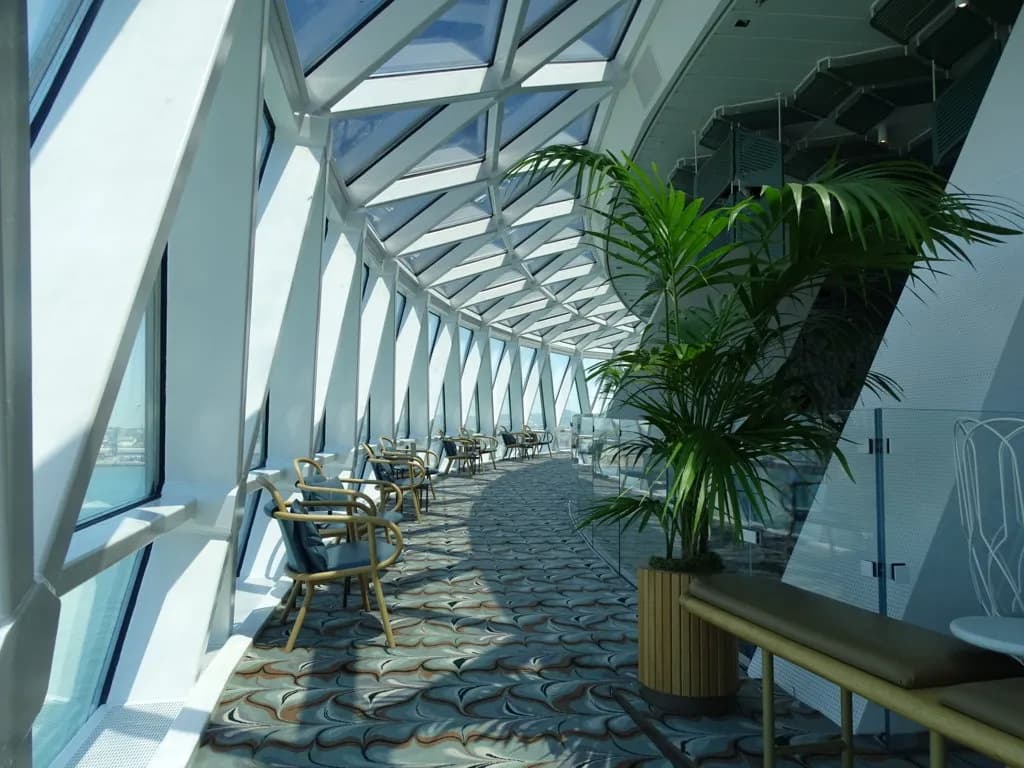
Over the past twenty years, the design of cruise ships has undergone a profound transformation that goes far beyond the simple increase in vessel size or the introduction of new spectacular onboard attractions.
What has changed most significantly is the way space itself is conceived, organized, and experienced by passengers. While in the 1990s a cruise ship could still be described as a relatively straightforward sequence of decks and functional spaces—restaurants, theaters, pools, lounges, and cabins arranged according to a fairly linear logic—today’s most modern ships are designed according to a very different principle, one that in some respects resembles urban planning more than traditional naval architecture. This principle is that of the so-called onboard “neighborhoods”: areas of the ship with their own identity, recognizable function, and distinctive atmosphere, conceived to make the passenger experience more intuitive, varied, and engaging.
In other words, the contemporary cruise ship is no longer simply a large container of services distributed across multiple decks. Instead, it has become a collection of distinct places that in many ways resemble the organization of a small city. Moving around the ship means passing through environments with different characters, each playing its own role in the daily life of the cruise. This evolution did not happen suddenly, but rather is the result of a gradual shift that has affected the entire cruise industry over the past few decades.
To understand how this model emerged, it is useful to remember that not long ago the structure of cruise ships was relatively simple and easy to read. Vessels built between the 1980s and the early 2000s were significantly smaller than today’s ships and offered far fewer public spaces. The theater was generally located at the bow, the main dining room at the stern, while the upper decks hosted swimming pools and areas dedicated to sunbathing and relaxation. In between were lounges, bars, and shops arranged along an interior promenade that served as the social heart of the ship.
In such a setting, finding one’s way around was relatively easy, because passengers only needed to remember a few key landmarks in order to move confidently throughout the ship. Even as ships gradually began to grow in size, the underlying layout logic remained largely unchanged for some time. However, as the cruise market expanded and new companies entered the industry, competition pushed operators to differentiate their offerings more and more by introducing new activities, new attractions, and new environments.
Ships began to grow rapidly, both for economic reasons and because companies wanted to offer increasingly complex experiences. Within just a few years, passenger capacity increased significantly and the number of decks dedicated to public areas multiplied. This development brought with it an important design challenge: how to organize coherently an environment that had effectively become as large as a small urban district.
If spaces are simply distributed along corridors and decks without any clear hierarchy, the result can easily feel disorienting. Passengers may perceive the ship as an indistinct collection of restaurants, bars, and rooms that follow one another without a clear order. Finding one’s way around becomes more difficult, and the overall experience can feel less intuitive. It is precisely in response to this challenge that designers and architects began to develop a new approach to ship layout, inspired in part by the logic of urban planning.
In a city, functions are not distributed randomly. There are commercial districts, residential areas, zones dedicated to leisure, and public spaces that function as gathering points. This type of organization makes a city legible and helps people orient themselves. Applying a similar principle to a ship means creating distinct areas, each with its own identity and a specific role in onboard life. Passengers no longer need to remember only the deck number or the name of a particular restaurant. Instead, they can think of themselves as being in a specific area of the ship, much as they would when moving between neighborhoods in a city. In this way, the experience becomes more natural and intuitive, because each space is associated with a particular function and atmosphere.
One of the most evident examples of this design philosophy can be found in Royal Caribbean’s Oasis-class ships. Vessels such as Oasis of the Seas, Allure of the Seas, Harmony of the Seas, and Wonder of the Seas are organized into several themed neighborhoods. Among these, the most famous is Central Park, a large garden located at the heart of the ship where real trees grow and where restaurants and lounges overlook an unexpectedly quiet green space. Walking through Central Park, especially in the evening, feels less like being on a ship and more like strolling through an urban park. Next to Central Park lies the Boardwalk, located at the stern and inspired by the seaside promenades of American beach towns. Here passengers find casual restaurants, attractions, entertainment venues, and lively public spaces. The architecture of the area—with its bright colors and structures reminiscent of seaside piers and coastal amusement parks—creates an atmosphere completely different from the refined elegance of Central Park.This contrast clearly illustrates how the neighborhood concept allows multiple experiences to coexist within the same ship. Royal Caribbean pushed this philosophy even further with Icon of the Seas, which entered service in 2024. On this ship, the neighborhood concept becomes even more articulated and specialized. Some areas are designed specifically for families, such as Surfside, where pools, restaurants, and play areas for children are concentrated within a single environment. Other neighborhoods are dedicated to relaxation, entertainment, or dining, allowing passengers to choose spaces that match their interests and mood.
Another interesting example of neighborhood-based design can be found in the Edge-class ships of Celebrity Cruises, including Celebrity Edge, Celebrity Apex, and Celebrity Beyond. On these vessels, spaces are arranged to create distinct yet interconnected environments. The Resort Deck forms the center of outdoor life, with pools and panoramic lounges, while the Rooftop Garden offers a completely different setting, combining vegetation, artistic installations, and areas designed for evening socializing.
Norwegian Cruise Line has developed the neighborhood concept through a particularly strong connection with the sea. Ships such as Norwegian Prima and Norwegian Viva feature Ocean Boulevard, an open-air promenade that encircles the ship and links several different environments. Along this route passengers encounter infinity pools, panoramic lounges, art installations, and restaurants overlooking the ocean.
MSC Cruises has developed its own interpretation in ships of the Seaside class and especially on MSC World Europa, where the World Promenade represents one of the most striking spaces on board. This ocean-facing boulevard is designed as a pedestrian street where restaurants, bars, and entertainment venues are concentrated. Other companies have developed different interpretations of the neighborhood concept. Carnival Cruise Line’s Excel-class ships, such as Mardi Gras and Carnival Celebration, are organized into themed zones inspired by different places and atmospheres. Summer Landing, for example, recreates the ambiance of an American seaside destination, with casual dining venues and live music. Princess Cruises has instead developed the concept of a central Piazza, present on ships such as Sky Princess and Enchanted Princess. This large atrium represents the social heart of the ship, where restaurants, cafés, performances, and activities take place throughout the day. More recently established companies have also embraced this approach. Ships operated by Virgin Voyages, such as Scarlet Lady, feature areas with very distinct identities, including The Dock, designed as a seaside beach club where passengers can relax close to the water. Even within the luxury segment this design philosophy is beginning to emerge. Ships such as Explora I from Explora Journeys offer a sequence of lounges, terraces, and panoramic spaces that create distinct environments dedicated to socializing, relaxation, or contemplation of the sea. All of these examples demonstrate how cruise ship design is increasingly adopting principles typical of urban architecture. The ship becomes a small floating city, where passengers move between neighborhoods with different identities. This evolution also reflects a broader change in the way travelers experience cruising. More and more passengers are not simply looking for a means of visiting multiple destinations, but for a complete experience that unfolds during the voyage itself. The ship therefore becomes a destination in its own right.
Looking toward the future, it is likely that this trend will continue to evolve. Designers are experimenting with new panoramic promenades, open-air boulevards facing the ocean, and new neighborhoods dedicated to gastronomy, wellness, and entertainment. In this context, the cruise ship will increasingly resemble a floating city, where each neighborhood offers a different way of experiencing the sea and the journey
Don’t miss more updates, news and reviews about the world of cruises on Cruising Journal.