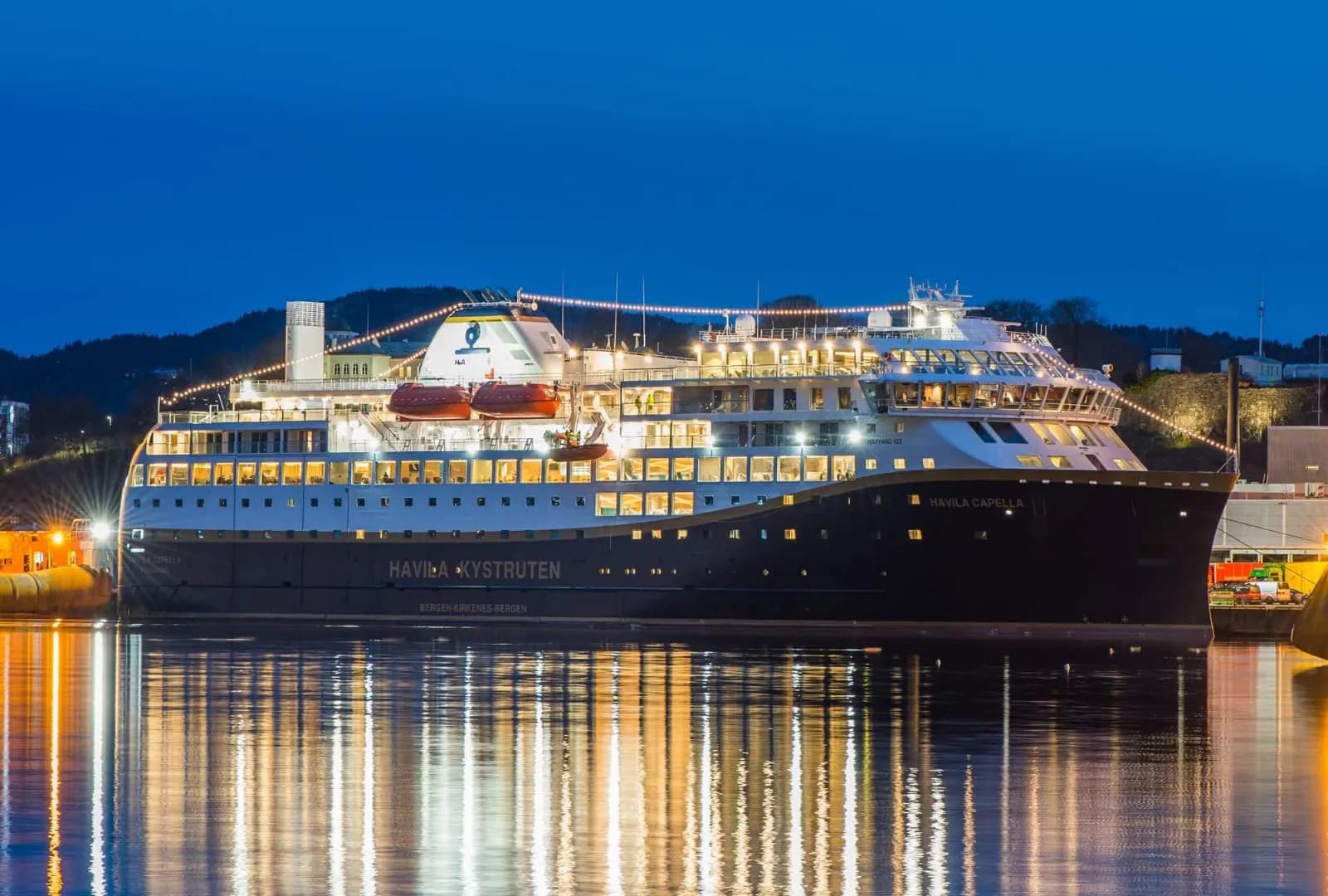
In recent years, the cruise industry has been called to face an increasingly urgent challenge: reducing the environmental impact of its operations without compromising the quality of the passenger experience.
In this context, Havila Voyages is emerging as one of the most advanced and concrete players on the path toward sustainable navigation, demonstrating how technological innovation and operational efficiency can coexist with tangible results.
The year 2025 marked a particularly significant milestone for the company, with concrete progress toward ambitious environmental goals. Compared to 2017 baseline levels along the Norwegian coastal route, Havila achieved a 36% reduction in CO₂ emissions, a result that reflects a substantial improvement in environmental performance. At the same time, the company reached another key sustainability target: reducing food waste to just 65 grams per guest per day, exceeding its original goal of 75 grams. These results demonstrate that sustainability extends beyond energy technologies and encompasses every aspect of operational management.
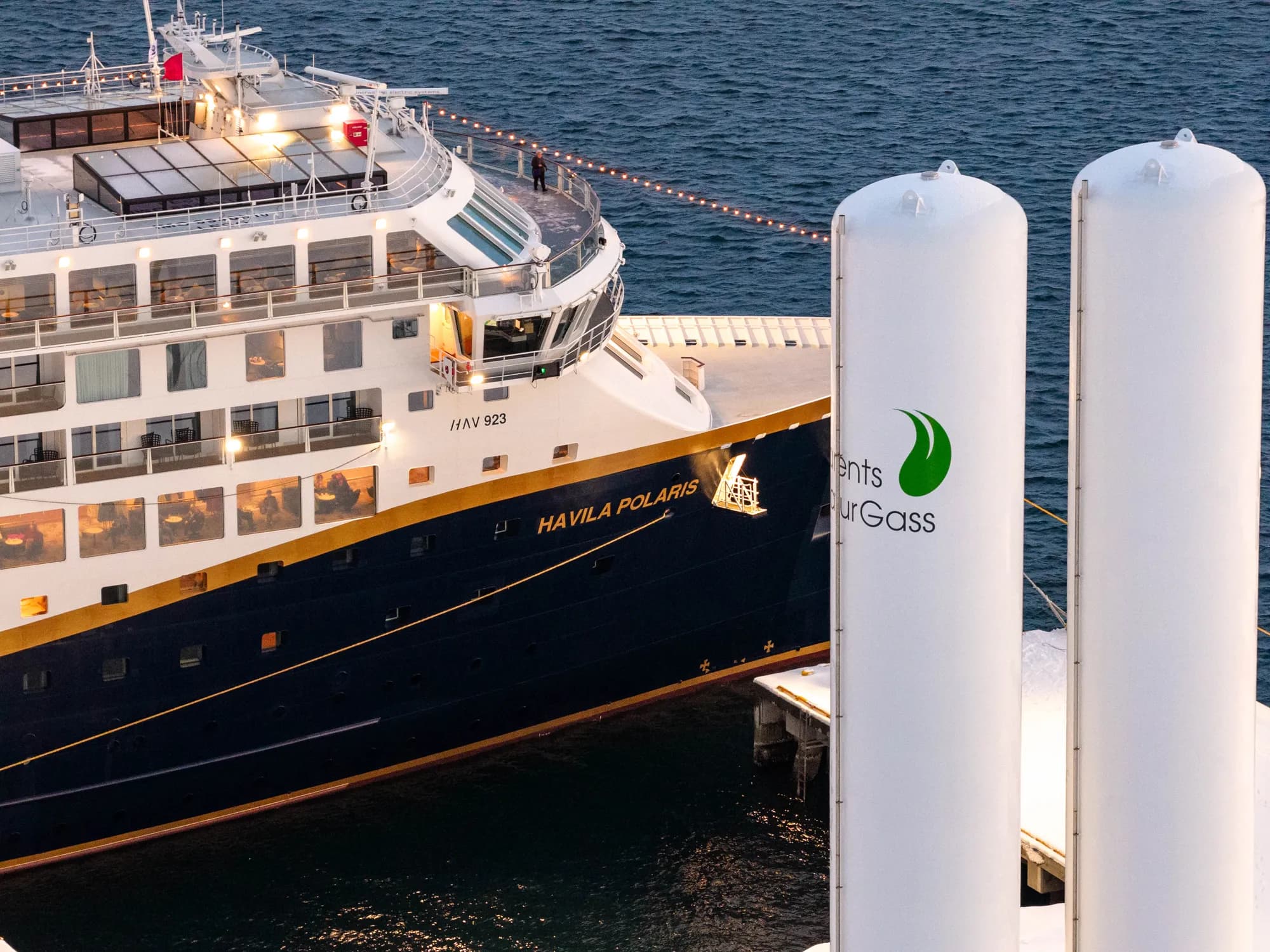
One of the most emblematic moments in this journey was the first climate-neutral voyage carried out by the ship Havila Polaris between November and December. This milestone marked a concrete breakthrough in sustainable navigation, proving that it is already possible to operate along the Norwegian coast with extremely low emissions. The achievement was made possible through the use of liquefied biogas (LBG), combined with energy supplied by the ship’s large onboard battery packs.
During the voyage, the vessel initially bunkered 200 cubic meters of biogas at Polarbase, followed by an additional 150 cubic meters loaded in Bergen, for a total of 350 cubic meters. Analysis showed a CO₂ emissions reduction of approximately 92% across the full lifecycle of the fuel (well-to-wake), alongside the complete elimination of local emissions of nitrogen oxides (NOx) and sulfur oxides (SOx). These figures not only confirm the effectiveness of biogas as an alternative to fossil fuels, but also represent concrete proof of the feasibility of large-scale sustainable solutions.
Biogas stands out as one of the most promising short-term options for the maritime sector. Unlike other emerging technologies, it can be used within existing liquefied natural gas (LNG)-based infrastructure without requiring significant technical modifications to vessels. This makes it an immediately deployable solution, capable of delivering substantial environmental benefits in a short time. Moreover, as it is produced from waste materials and biomass, it supports the development of a circular economy, transforming waste into valuable energy resources.
Havila Voyages is firmly moving in this direction, aiming for a gradual transition toward increasingly cleaner energy sources. Its stated objective is to further reduce emissions over time by combining highly efficient operations with the progressive adoption of low- and zero-emission solutions, as they become available at industrial scale. In this context, biogas represents a crucial intermediate step, capable of guiding the sector toward an even more sustainable future.
However, the company’s strategy goes beyond energy solutions alone. Significant attention is also given to optimizing onboard operations, with targeted initiatives to improve restaurant efficiency and resource utilization. These measures, together with revised LNG procurement agreements, enable more effective cost control while contributing to a reduction in overall environmental impact. This reflects an integrated approach in which sustainability and economic efficiency advance hand in hand.
The market environment appears favorable to this evolution. Demand for travel to Norway continues to grow, and Havila’s modern, environmentally friendly fleet is receiving strong positive feedback from both passengers and the international market, as demonstrated by numerous awards. This success is further supported by a focused commercial strategy that prioritizes direct bookings—typically more profitable—and aims to optimize the balance between occupancy rates and pricing.
Outlook for 2026 confirms this positive trajectory. In the early months of the year, approximately 63% of total capacity is already booked, a figure significantly higher than during the same period last year. This early booking momentum provides greater visibility on future revenues and strengthens expectations for continued growth, both in terms of turnover and operating margins. Occupancy levels in the first quarter are also encouraging, reaching around 70%, up from 61% in the previous year.
Another key pillar of Havila’s strategy is its ongoing investment in marketing, sales, and organizational development. Initiatives launched in 2025 have strengthened the company’s structure, creating a solid foundation to face future challenges. The goal is not only to increase brand visibility but also to enhance average cabin revenue by offering a high-quality product capable of standing out in a competitive market.
Sustainability, therefore, is not merely a communication element for Havila Voyages, but a structural component of its business model. From food waste management to the adoption of alternative fuels, as well as operational efficiency and technological innovation, every decision is aimed at reducing environmental impact while creating long-term value.
Equally significant is the company’s contribution to the development of local communities. The use of biogas, for example, supports the creation of new supply chains linked to waste management and renewable energy production, generating jobs and economic opportunities in coastal regions. At the same time, by-products such as biofertilizer can benefit the agricultural sector, fostering further synergies across industries.
Looking ahead, the path taken by Havila Voyages is clear: to continue innovating, experimenting, and investing in sustainable solutions while keeping the passenger experience at the core. The challenge will be to integrate new technologies, such as hydrogen and ammonia, with existing infrastructure, ensuring safety, reliability, and competitiveness.
In a rapidly evolving industry, where regulatory pressure and customer expectations are constantly increasing, Havila stands as a concrete example of how economic growth and environmental responsibility can successfully coexist. The course set is ambitious, but the results already achieved demonstrate that the direction is the right one.
Ultimately, Havila Voyages is not merely adapting to change—it is leading it. Through a pragmatic and innovation-driven approach, the company is helping redefine the standards of sustainable maritime navigation, proving that a cleaner future for shipping is not just a goal, but a reality already taking shape.
Don’t miss more updates, news and reviews about Havila Voyages on Cruising Journal.