Antarctica21 is taking a significant step forward in the way it communicates — and, above all, measures — its approach to sustainability. The Chilean operator specializing in Antarctic air-cruises has published its first Sustainability Report, “Ambassadors of the White Continent,” covering the 2025-26 season.
The document goes beyond compiling environmental and social initiatives already implemented by the company. It establishes a baseline against which Antarctica21 intends to measure its progress through 2033, the year of its 30th anniversary. The company has committed to publishing an update every season, gradually building a comparable set of data over time. The report was prepared in accordance with the GRI Universal Standards 2021 and incorporates SASB indicators applicable to the cruise sector, covering a total of 104 indicators related to operations, people and the company’s ties to Chilean Patagonia.
This is probably the most interesting aspect of the project. Talking about sustainability in Antarctic tourism is relatively easy; translating that concept into parameters that can be verified and compared year after year is far more challenging. The value of this first report therefore lies not in presenting Antarctica21 as a definitive model for the entire industry, but in establishing a declared and measurable starting point for the company’s journey. The distinction matters: a baseline on its own does not demonstrate improvement, but it makes it possible to measure progress in the seasons ahead. And in a segment such as polar expeditions, where sustainability has become an integral part of commercial communication, access to consistent data can help shift the conversation from statements of intent to actual results.
During the 2025-26 season, Antarctica21 calculated a total carbon footprint of 6,878 metric tons of CO2 equivalent across Scopes 1, 2 and 3, and says it fully offset those emissions through certified credits linked to renewable energy projects in Chile. The figure is particularly relevant because it makes the scale of the company’s operational impact visible. At the same time, offsetting is not the same as reducing the emissions actually generated. One of the key elements to watch in future reports will therefore be the evolution of the company’s absolute carbon footprint and the extent to which direct measures involving fuels, energy efficiency, logistics and transportation contribute to reducing it.
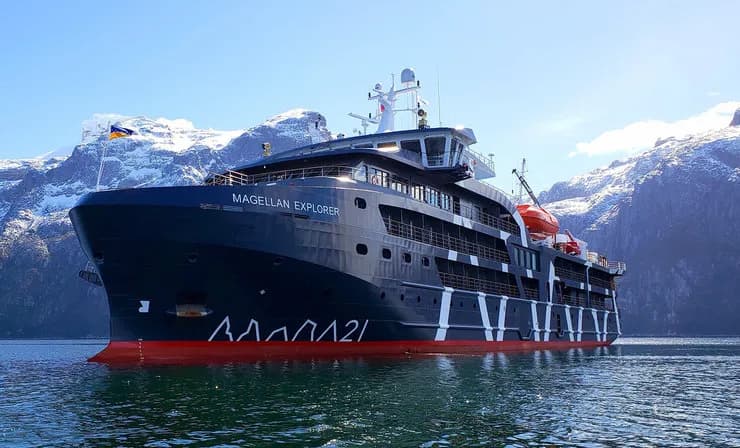
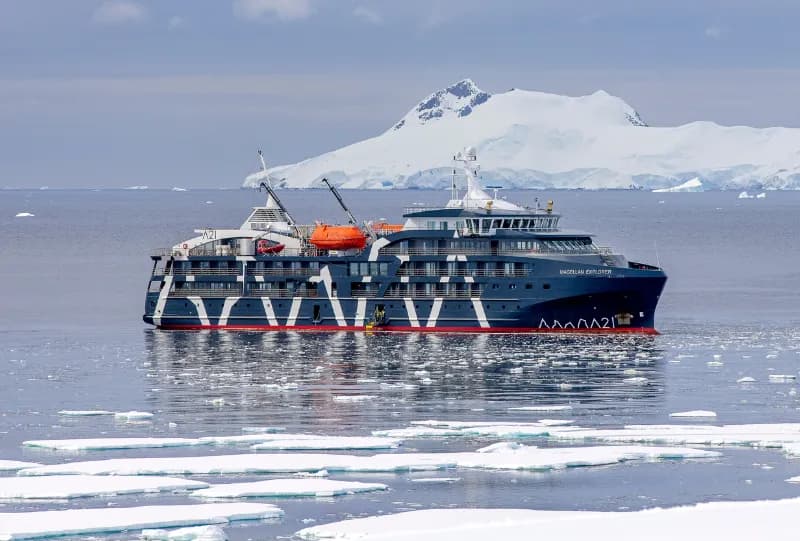
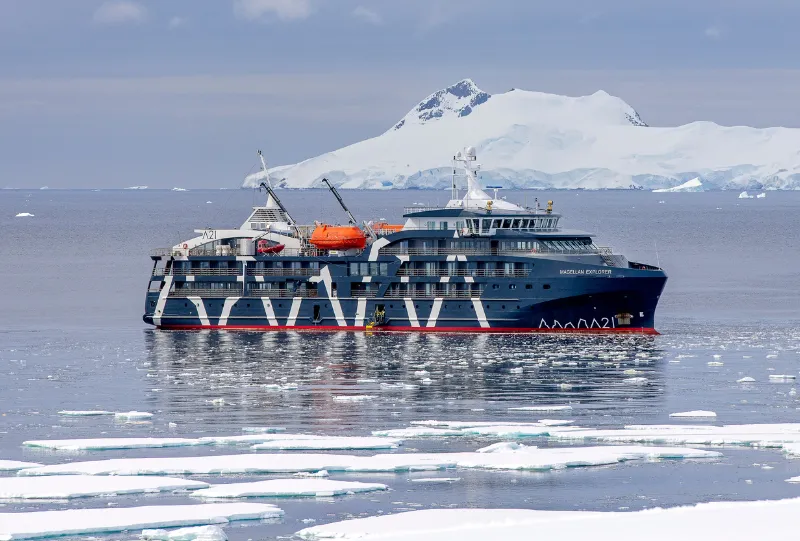
Against this backdrop, the e-Fuel program is particularly noteworthy. Antarctica21 has completed its second consecutive season using e-Gasoline to power the fleet of ten Zodiacs deployed for landing operations from Magellan Explorer. The synthetic fuel is produced locally at HIF Global’s Haru Oni facility in the Magallanes Region using green hydrogen and recycled CO2. Antarctica21 describes itself as the first and only Antarctic tourism operator to use e-Fuel for its excursion boats. The company is also assessing the potential expansion of synthetic fuels to the ship’s main engines through e-MGO and to aviation operations through e-SAF.
The scale of the Zodiac initiative naturally remains limited when compared with the overall energy requirements of a journey combining aviation and ocean navigation. But that is precisely why the project can be viewed primarily as an operational testing ground. Using alternative fuels under real-world conditions in an environment as complex as Antarctica allows the company to build practical experience with a technology it hopes to apply progressively to much larger components of its operations. Over the coming years, it will therefore be interesting to see how far this roadmap actually moves from experimentation to broader operational use.

The report, however, extends well beyond fuels. During the season under review, Antarctica21 recorded 4,180 kilograms of locally recycled waste, 1,400 kilograms of recovered organic waste and 8.7 metric tons of CO2 equivalent avoided through solar power. The company also reports 730 metric tons of waste treated and diverted from municipal landfills through regional partnerships. These figures may be less immediately striking than an e-Fuel project, but they help illustrate how much a sustainability strategy also depends on the sum of numerous everyday operational decisions.
One example is Explorers House, Antarctica21’s expedition center in Punta Arenas. During the period covered by the report, solar panels supplied 44% of the facility’s energy consumption. And it is precisely the relationship with Punta Arenas and the Magallanes Region that appears to be one of the most interesting aspects of the document. Antarctic tourism inevitably tends to focus attention on the continent being visited, but there is also a gateway region that makes those operations physically possible and provides personnel, suppliers, infrastructure, logistics and expertise.
In 2025-26, 25.4% of Antarctica21’s total supplier spending went to companies based in the Magallanes Region. The report also records more than 3,000 hours of training and states that 35% of leadership positions are held by people who have built their careers within the company. On the social front, the Antarctica21 Foundation reached 4,000 direct beneficiaries during the season, while the cumulative total reported by the company now exceeds 17,000 people. This approach appears to broaden the concept of sustainability in a useful way. Measuring the share of local procurement or internal career development may seem less dramatic than discussing synthetic fuels, but it provides a way to assess how much economic and social value remains in the region from which the tourism operation originates. Antarctica21 structures its policy around three broad areas: environmental responsibility; social value creation and support for science; and business sustainability and operational excellence.
This approach is complemented by smaller-scale circular economy initiatives. In 2025, for example, the company partnered with local business Puro Viento to transform old technical garments into new reusable items. These initiatives do not address the central issue of emissions generated by ships and aircraft, and it would therefore be misleading to give them disproportionate weight. They do, however, play a complementary role, showing how sustainability is being addressed both through major energy-related decisions and through the everyday management of materials, waste and procurement.
The central issue remains the one that surrounds Antarctic tourism as a whole. Bringing travelers to one of the most remote and sensitive ecosystems on the planet requires ships, aircraft, fuel and a complex logistics chain. It is an inherent tension that no Sustainability Report can eliminate. What a document of this kind can do is make the way that impact is calculated, managed and, ideally, reduced increasingly transparent. From this perspective, the most important figure in future editions will probably not be the amount of emissions offset, but the trend in the emissions actually produced. The same applies to e-Fuel adoption: more significant than its use in ten Zodiacs will be whether and when synthetic fuels are introduced into far more substantial parts of the operation, such as ship propulsion and aviation. Antarctica21 has outlined that direction, and its annual reports will make it possible to assess how quickly the company is able to move along that path.
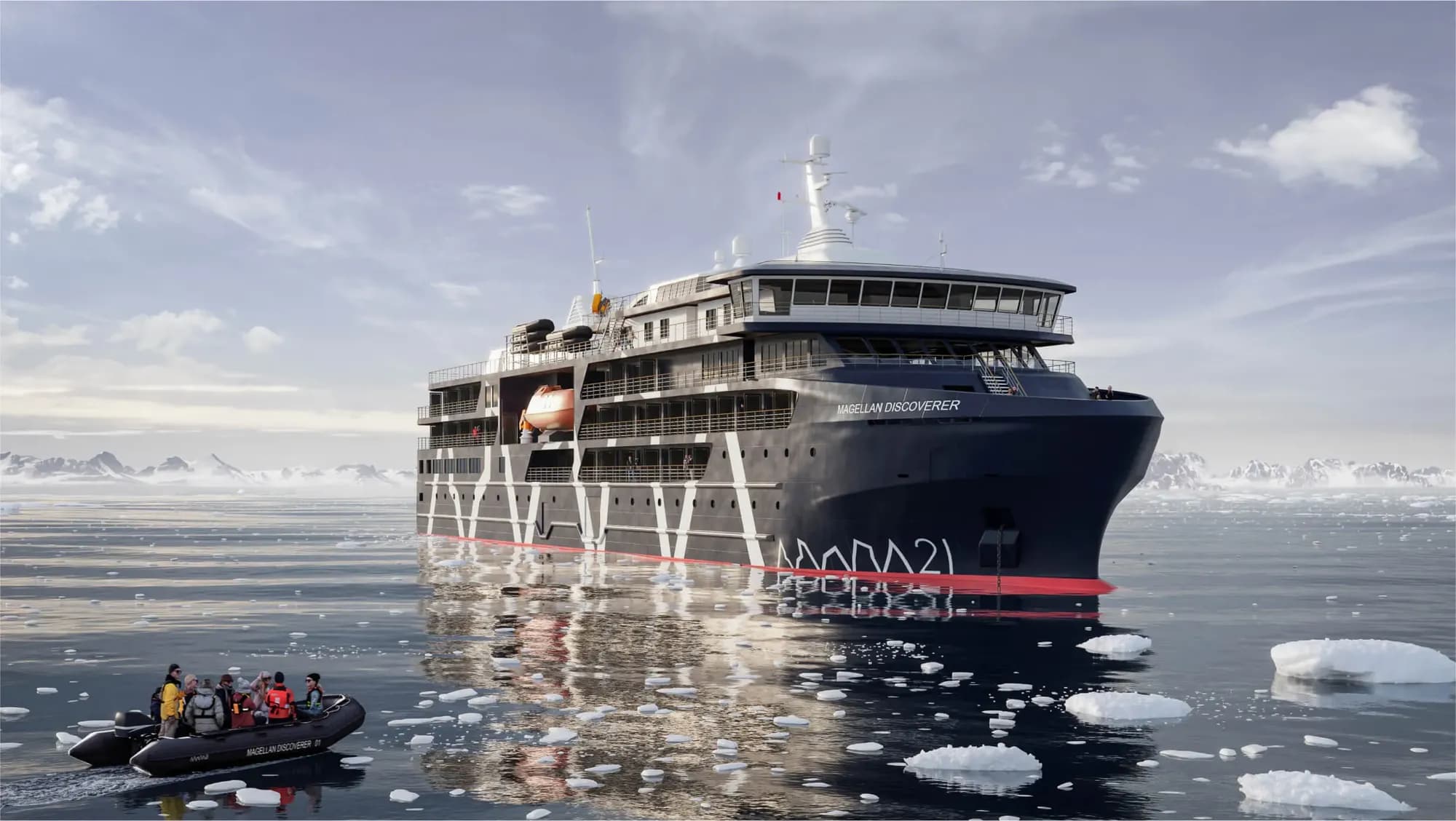
The initiative should also be viewed within a broader strategy. In 2022, Antarctica21 created a dedicated Sustainability and Energy department, while the company says it has held CarbonNeutral® certification since 2019. At the same time, it continues to invest in its fleet: Magellan Discoverer, the new vessel scheduled to enter service in November 2026, has been designed as a hybrid-electric expedition ship and represents another component of the operator’s technological development program. The title chosen for the report, “Ambassadors of the White Continent,” also reveals an important part of the company’s philosophy. Antarctica21 believes that people who visit Antarctica can return home with a heightened sense of awareness and carry it into their work, families and communities. It is an appealing concept, closely connected to the very nature of expedition travel, but one that is difficult to quantify. That makes it all the more useful to place it alongside much more concrete indicators: metric tons of CO2, energy generated, fuels used, local spending, waste recovered, training hours and beneficiaries of social programs. The emotional impact of the journey may help raise awareness; the operator’s environmental performance, however, must be assessed through verifiable data.

Verónica Peragallo, CEO of Antarctica21, has described the report as the beginning of a new chapter, emphasizing the company’s intention to continue measuring its impact and progressively raising its standards. “Beginning” is probably the most appropriate word. A first Sustainability Report is not an end point, nor does it yet make it possible to identify a trend; it does, however, establish the reference point from which that trend can be measured. This is where the commitment to publish a report every season through 2033 takes on particular significance. If maintained, it will create a historical data series showing how much emissions have declined, what role alternative fuels have come to play, how infrastructure efficiency has evolved and how much value has remained within the local community. In other words, it will make it possible to distinguish more clearly between targets, experimentation and results. For an industry that sells access to one of the planet’s most extraordinary and fragile environments, this kind of transparency seems likely to become less of an added feature and increasingly an integral part of the product itself. The most interesting contribution of Antarctica21’s first report therefore probably lies in its methodology: it does not claim to settle the debate over the sustainability of Antarctic tourism, but it does put forward a set of numbers and a clearly defined timeline. The seasons ahead will show how far that baseline can be translated into measurable progress.
Gabriele Bassi