
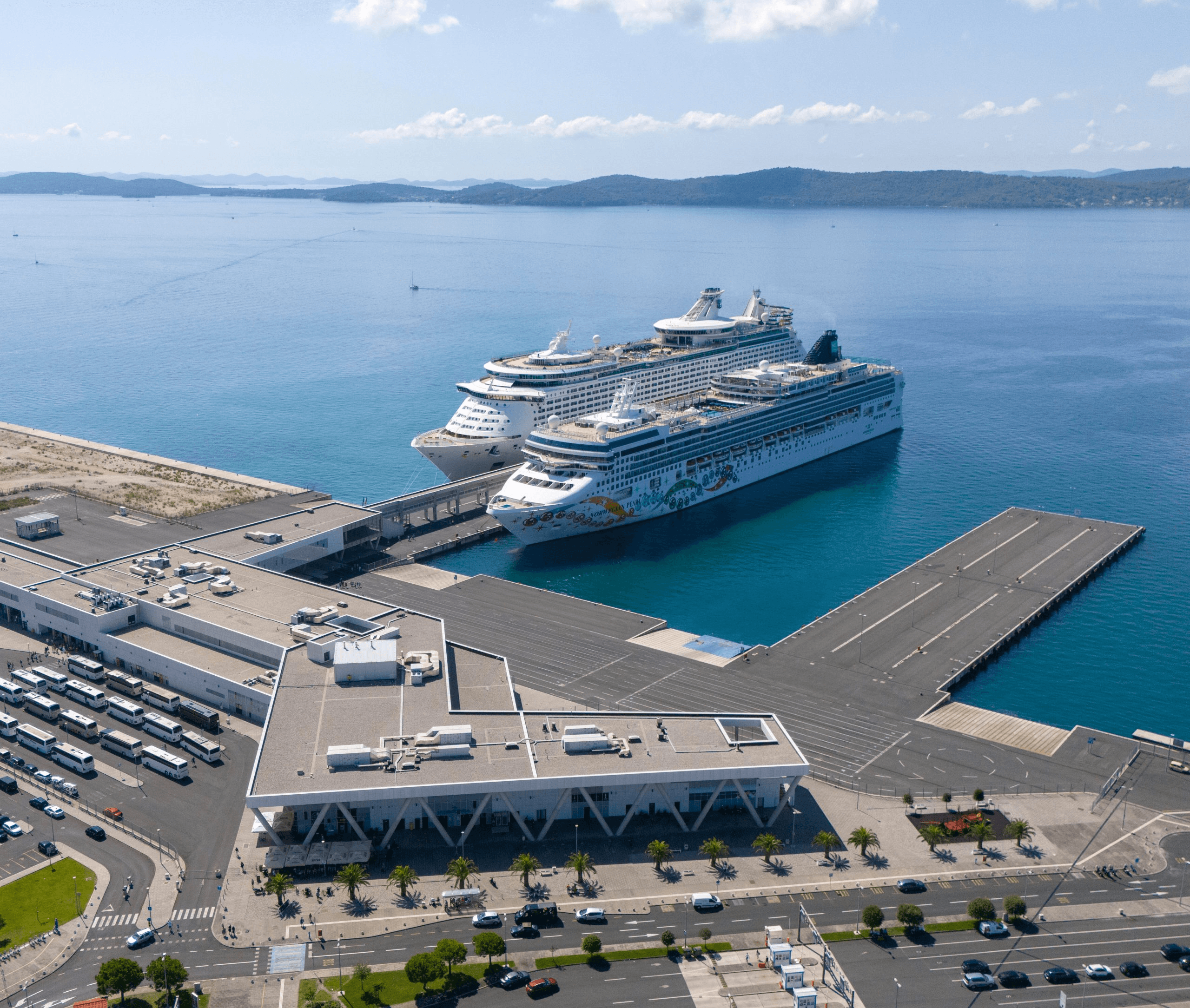
In the heart of the Adriatic Sea, along Croatia’s Dalmatian coast, Zadar Cruise Port truly earns its title as the gateway to Croatian treasures, allowing guests to discover the seaside city of Zadar and its surrounding area.
Arriving in Zadar by sea offers a particularly captivating perspective: from the open sea, the Dalmatian coastline unfolds as a succession of islands, like a picture book leading visitors through crystal-clear waters, ancient walls and Mediterranean landscapes to Zadar, a city with a wealth of cultural heritage rooted in more than two thousand years of history.
One of the port’s main strengths is its location and connectivity, opening the door not only to the historic Old Town but also to the islands, nature parks and hinterland beyond the city limits. The close proximity of the port, historic centre and waterfront makes it possible to combine very different aspects of the destination within a single visit. Within just a few hours, visitors can experience the atmosphere of a historic city, discover the contemporary character of its waterfront, or venture further into the landscapes of Dalmatia. In this way, Zadar Cruise Port represents the first point of contact with the destination and an important part of the overall visitor experience.
Located in the Gaženica area, just a few kilometres from the historic centre, Zadar Cruise Port features a modern passenger terminal designed to accommodate both transit and turnaround operations. The facility offers a wide range of passenger services, including dining areas, cafés, shops, Wi-Fi, parking facilities, tourist information and transportation services to the city.
The port experience is also designed with accessibility and inclusivity in mind. The terminal provides a barrier-free environment, while the port offers dedicated services for passengers with mobility needs. Zadar Cruise Port has also introduced the Hidden Disabilities Sunflower Programme, becoming the first Croatian cruise port to join the international programme dedicated to supporting people with non-visible disabilities.
But Zadar Cruise Port’s role extends beyond hospitality and operational efficiency. The port is developing an increasingly strong focus on environmental and social sustainability, with the aim of ensuring that the growth of cruise tourism makes a positive contribution to the local area.
A significant example of this is the collaboration with SeaCras to monitor marine water quality in real time. Maximising the use of AI-enhanced algorithms, the project translates raw satellite data into accessible information about water quality, available via QR codes located in the terminal and at selected local beaches. In this way, technology becomes a tool for transparency and environmental awareness, engaging not only cruise passengers but also residents and other visitors.
Sustainability is also understood as a commitment to the local community. Within the terminal, local shops offer locally made products and souvenirs, including handicrafts, natural cosmetics, olive oil and regional specialities. These activities help support small businesses and contribute to the local economy, while partnerships with educational institutions, including the University of Zadar, support visits, internships and training programmes for students and future professionals in the maritime and tourism sectors.
Together, these initiatives contribute to a model of cruise tourism in which the port is not simply infrastructure through which thousands of passengers pass, but a bridge between the cruise industry and the local destination.
That connection with the destination begins within the terminal itself. The modern terminal features a Guest Information Center, providing information about the destination, alongside a new collaboration with local Croatian company Authland, which offers authentic local experiences and excursions, helping visitors discover Zadar and the surrounding area with ease.
A must for visitors is the city’s Old Town, known to locals as Poluotok (Half Island), which encapsulates the richness of a once-important centre of the Roman Empire with the vibrant and accessible scale of a destination that can be explored within just a few hours. Here, the grandeur of the ancient past remains very much present in day-to-day life. Historic monuments sit alongside bustling cafés, restaurants and public spaces, creating a city centre where centuries of history form part of the rhythm of everyday life.
Among Zadar’s most iconic attractions, the Sea Organ holds a special place among locals and visitors alike. Opened to the public in 2005, the Sea Organ is a unique architectural sound art installation along the waterfront that stretches over 70 metres and features 35 pipes that convert the energy of the sea into an experimental musical instrument. There is no predetermined melody and no scheduled performance: the movement of the sea continuously shapes the sounds that emerge, physically giving the sea its own voice.
Next to the Sea Organ lies another of Zadar’s most recognisable attractions, the Greeting to the Sun. This modern art installation is a scale model of the Solar System, from Neptune to the Sun, and consists of hundreds of glass panels set into the pavement along the waterfront. During the day, these elements collect solar energy, and after sunset they transform it into a spectacular light display, bathing the waterfront in a sea of colour.
Side by side, the two art installations were designed by renowned Croatian architect Nikola Bašić and are a fitting representation of Zadar in modern times. The Greeting to the Sun reflects the city’s contemporary character, while the Sea Organ, hewn out of stone and set into the waterfront, evokes the city’s enduring relationship with the sea and its historic waterfront. Sound and light come together, transforming Zadar’s waterfront into one of the Adriatic’s most distinctive urban spaces and helping set the city apart from other historic destinations along the Croatian coast.
Venturing to the opposite side of the city, visitors come face to face with stone archway gates that remain from the former Venetian fortifications of the Old Town. Built in the 16th century, the Land Gate once served as one of the principal entrances to the fortified city. The winged Lion of St. Mark, a symbol of the Republic of Venice, bears testimony to the city’s ties with one of the most significant periods in its history. Passing through the Land Gate feels like stepping into another era. From here, a walk through the historic centre unfolds among narrow streets, elegant squares, historic buildings and architectural landmarks shaped by the many cultures and periods that have left their mark on the city.
Following a direct path from the Land Gate takes visitors to the heart of the city — the Roman Forum. Built by Roman Emperor Gaius Julius Caesar Octavian in the 3rd century, its history is evidenced by stone inscriptions in the old square, which was once enclosed by a portico with galleries on the first floor and public amenities, shops and stalls underneath.
Beside the Roman Forum stands one of the city’s most recognisable architectural monuments, the Church of St. Donatus. Built in the 9th century on top of the old Roman Forum by Bishop Donatus of Zadar, it is the largest pre-Romanesque church of its kind and features a distinctive circular floor plan that makes it immediately identifiable. Originally titled the Church of the Holy Trinity, it was re-dedicated in the 15th century to the bishop, now canonised as St. Donatus. Although the church has not celebrated Mass in over two centuries, it has a deep connection to the city’s neighbouring cathedral, the Cathedral of St. Anastasia, where the remains of St. Donatus rest to this day.
The Cathedral of St. Anastasia, also known as Zadar Cathedral, is the largest cathedral in Dalmatia and one of the city’s most significant Catholic buildings. Its history stretches back to the 4th and 5th centuries, while much of the present Romanesque three-nave structure was constructed during the 12th and 13th centuries. The cathedral also stands as a testament to the city’s historical continuity and the important role Zadar has played over the centuries as a religious and cultural centre of Dalmatia.
The city’s rich Catholic history is further reflected in the Monastery of St. Francis of Assisi, a stone’s throw from the Sea Organ and Greeting to the Sun. Construction of the monastery began in 1221, and it was formally dedicated to Saint Francis just 61 years after the death of the young saint. A precursor to the city’s university, the University of Zadar, the monastery is home to a collection of important codices and parchments. The sacristy is particularly important in the history of Croatia, as it houses the Treaty of Zadar, a 14th-century document declaring the independence of the Croatian people from Venetian rule.
Venturing further into the city, the Museum of Ancient Glass offers a different perspective on the destination’s history. Housed in the historic Cosmacendi Palace, the museum preserves a remarkable collection of Roman glass objects, primarily from Dalmatia. Vessels, containers, bottles and other artefacts provide insight into the widespread use and importance of glassmaking in the ancient world, making it an especially interesting stop for visitors wishing to explore Zadar’s archaeological heritage in greater depth.
The People’s Square, locally known as Narodni Trg, is one of the most important spaces in the city’s urban life. For centuries, the square has been a focal point for the people of Zadar, and it continues to retain a lively atmosphere thanks to the cafés, restaurants and historic buildings that surround it.
But Zadar extends well beyond its historic centre, seamlessly connecting the mainland with the Zadar Archipelago. Lying directly opposite the city, its numerous islands and islets form one of the most captivating features of the Dalmatian landscape.
Among them, the island of Ugljan is one of the most interesting destinations for those wishing to combine cultural discovery with time immersed in nature. Its Mediterranean landscape, surrounding sea and stone architecture offer an authentic glimpse of Dalmatia and its close connection to local traditions. Of particular note are the fishing traditions of Kali, where visitors can discover the island’s maritime heritage and experience locally caught seafood while learning about traditions that have shaped the community for generations.
A little further along lies Dugi Otok, an island stretching 45 kilometres along the Adriatic and whose name fittingly translates as “Long Island.” Known for its unspoilt coastline, Dugi Otok is home to the towering cliffs of Telašćica Nature Park and Sakarun Beach, arguably one of Croatia’s most pristine swimming spots. The island’s coastline also reveals layers of more recent history, with former submarine bunkers still visible along the shoreline.
Travelling further inland, the Zadar Hinterland and Ravni Kotari area reveals a fertile land full of flavour, where the authentic spirit of Dalmatia lives on. Vineyards and olive groves unfold across a landscape where history and agricultural heritage remain intertwined. Here, farm-to-table experiences come to life through initiatives such as Welcome Taste & Buy, connecting visitors with family farms and small producers to taste award-winning wines, extra virgin olive oils, cheeses and local produce, discover how they are made, and experience the region through its people.
From the ancient streets of the Old Town and the sound of the sea along Zadar’s waterfront to the islands of the archipelago and the vineyards and olive groves of the hinterland, the destination offers far more than a single glimpse of Dalmatia. At the centre of that journey is Zadar Cruise Port, connecting guests with the people, landscapes, culture and traditions that define the region. More than simply a place of arrival and departure, the port is a gateway to discovering Zadar and the wider region and to experiencing the many different treasures of Dalmatia within a single visit.
Giorgia Lombardo