
A cruise brochure will happily tell you that a ship is "ice-strengthened" or "polar-ready" and leave it at that, but what it rarely explains is how much work those apparently simple descriptions are doing, because behind them sits a complex engineering and regulatory framework that influences where a vessel can operate, in what seasons and under what ice conditions.
For an expedition cruise industry increasingly offering voyages deep into the Arctic and Antarctica, understanding what actually sits behind an ice-class notation is becoming increasingly relevant, not only for ship designers and operators but also for technically curious passengers who want to know what a vessel is genuinely capable of. The first thing to understand is that "ice class" is not a single universal scale, since several classification systems coexist and were developed for different regions and operating conditions. The Finnish-Swedish Ice Class system, with ratings such as 1A Super, 1A, 1B and 1C, was developed primarily around navigation in Baltic seasonal ice and is widely encountered on ferries and merchant ships operating in northern Europe, while Russia has historically used its own Arc classification system for vessels operating in Arctic waters, including those navigating routes along the Siberian coast. For expedition cruising, however, the most useful reference is generally the Polar Class system developed through the International Association of Classification Societies, or IACS, and this is the PC notation increasingly found in the technical specifications of modern expedition ships.
The Polar Class system contains seven levels, running from PC1, the highest, to PC7, with a numbering system that can initially seem counterintuitive because the smaller the number, the greater the structural capability required for navigation in demanding ice conditions. PC1 is defined for year-round operation in all polar waters, while PC2 is intended for year-round operation in moderate multi-year ice conditions and PC3 and PC4 progressively reduce the severity of ice for which the vessel is designed. PC5 is defined around year-round operation in medium first-year ice that may contain inclusions of older ice, whereas PC6 and PC7 are oriented toward summer and autumn navigation in progressively lighter first-year ice conditions.
For the expedition cruise market, the most interesting part of the scale therefore lies between PC2 and PC7, and at one extreme is Ponant's Le Commandant Charcot, which carries a PC2 classification and is consequently exceptional within the passenger fleet. That rating allows Ponant to design expeditions fundamentally different from those possible aboard most conventional expedition vessels, including itineraries to the Geographic North Pole and operations deep into high Arctic ice. Le Commandant Charcot is not simply an expedition cruise ship fitted with a strengthened hull, because its entire architecture, propulsion plant and operational concept were developed around navigation in extreme polar conditions. The vessel was designed with input from Finnish ice-navigation specialist Aker Arctic and is classed by Bureau Veritas, while its propulsion system includes two powerful ABB Azipod units capable of rotating through 360 degrees and giving the ship exceptional manoeuvrability in ice. This is an important distinction, because ice capability is not achieved simply by adding thicker steel around the waterline: hull geometry, propulsion, power availability, frame spacing, plating, machinery redundancy and the protection of critical systems all form part of the equation.
Moving down the scale, PC5 has become an important benchmark among some of the more capable purpose-built expedition ships, including Lindblad Expeditions' National Geographic Endurance and National Geographic Resolution. Both were purpose-built for high-latitude exploration and combine their ice-class capability with a distinctive hull design intended to improve performance in rough seas and polar conditions, while Swan Hellenic's SH Minerva and SH Vega are also PC5 vessels designed specifically for expedition cruising. Together, these ships demonstrate how this level of structural capability can be incorporated into comparatively small, contemporary passenger vessels rather than traditional icebreaker-style ships. For travellers, that distinction can become particularly relevant toward the edges of the polar season, because a stronger ice class does not guarantee that an itinerary will proceed through a particular area, but it does give the vessel a broader structural envelope within which its captain and operational team can work. The difference is therefore less about whether one ship can "go to Antarctica" and another cannot, and more about the range of ice conditions for which each vessel has been engineered and certified.
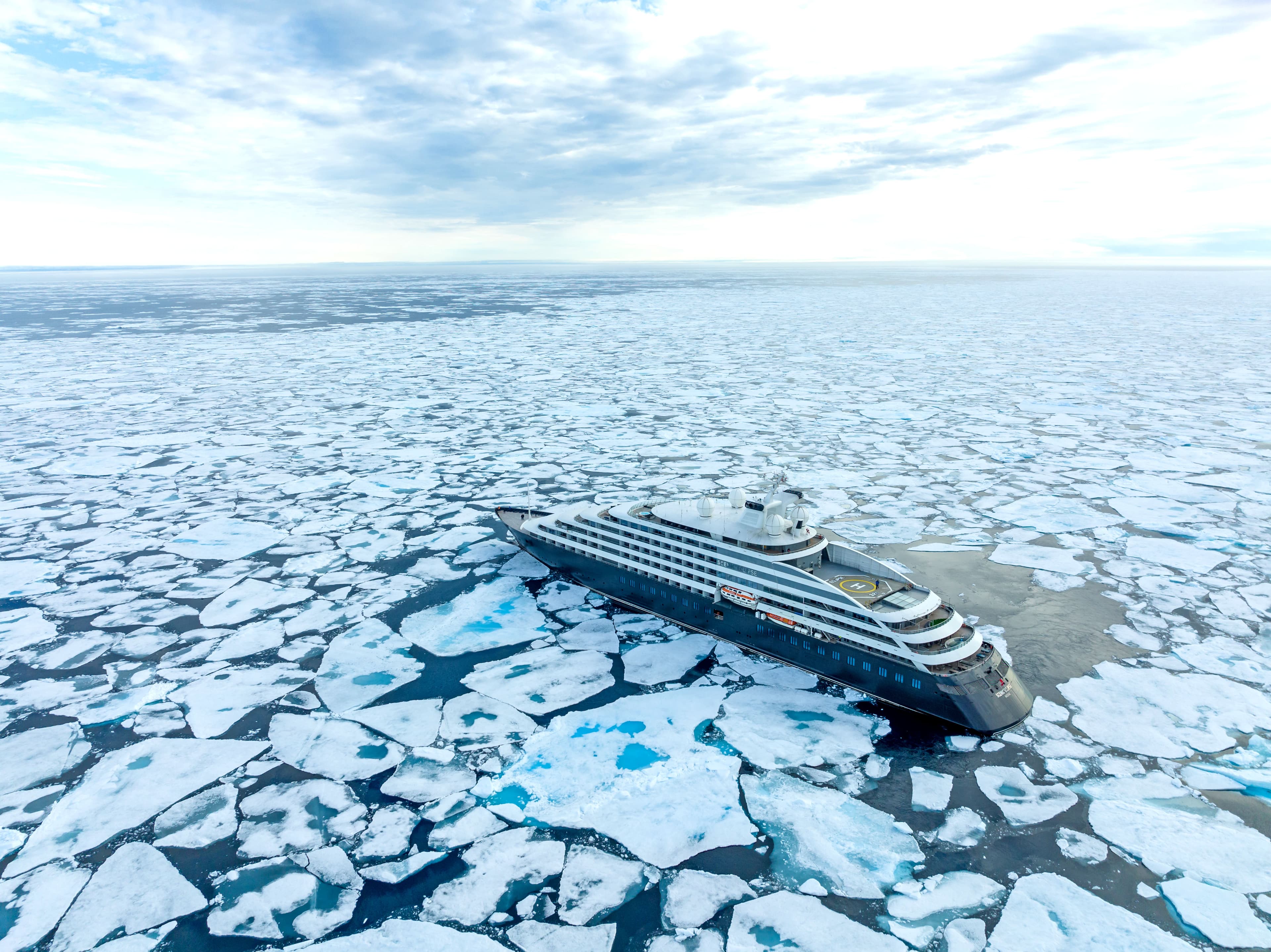
Many differently classified vessels can visit the Antarctic Peninsula during the austral summer, but what changes is the severity and type of ice conditions they are designed to handle. PC6 is perhaps even more representative of the modern expedition market, with Viking Octantis and Viking Polaris both carrying Polar Class 6 classification and operating in destinations such as Antarctica, Greenland and other high-latitude regions. Quark Expeditions' Ultramarine is another familiar PC6 example, combining its polar capability with two twin-engine helicopters, a substantial Zodiac operation and purpose-designed expedition spaces, which also illustrates an important point: ice class is only one component of an expedition vessel's overall capability. Scenic Eclipse and Scenic Eclipse II also carry Polar Class 6 classification, and both combine strengthened hulls and polar engineering with Azipod propulsion, dynamic positioning and unusually extensive expedition equipment for luxury vessels.
The range of ships within PC6 shows why comparing vessels solely by a single classification number can be misleading, because two ships carrying the same Polar Class notation may have very different propulsion systems, manoeuvring characteristics, expedition equipment, passenger capacities and operational philosophies. Ice class tells us something important about the structure, but it does not describe the entire ship, even though the engineering behind that number is substantial. IACS requirements divide the hull into different structural regions according to the ice loads those areas are expected to encounter, and the bow, intermediate areas, midbody, stern, waterline regions and lower hull do not necessarily receive identical treatment. The higher the required class, the greater the loads for which key parts of the structure must be designed, affecting plating thickness, framing, steel grades and structural reinforcement, particularly in areas expected to experience repeated contact with ice. The result is largely invisible to most passengers, since two expedition ships tied alongside one another may look broadly comparable from the quay while being engineered for very different operating envelopes beneath their exterior finishes.
Propulsion is equally important, because a strengthened hull capable of withstanding ice loading is of limited value if the ship cannot effectively manoeuvre in the conditions for which that structure was designed. This is one reason azimuthing propulsion has become such an important technology for modern ice-going vessels: unlike a conventional arrangement built around fixed propeller shafts and rudders, an Azipod can rotate and direct thrust around the vessel, providing exceptional manoeuvrability while also allowing propeller wash to help clear broken ice around the hull. The technology is particularly relevant to the concept of the double-acting ship, because traditional icebreakers are shaped primarily around their ability to work in ice, while a hull optimised purely for icebreaking may be less efficient in open water. That represents a significant compromise for expedition and commercial vessels that may spend much of a voyage outside heavy ice, and the double-acting principle addresses it by allowing a ship to use different parts of its hull for different conditions. A vessel can therefore operate efficiently bow-first in open water but, when necessary, navigate stern-first through difficult ice conditions, making use of the specialised hull form around the stern and the manoeuvrability of azimuthing propulsion.
Le Commandant Charcot incorporates the ability to operate astern in demanding ice conditions, an important part of the ship's overall polar design, but Polar Class itself is only part of the regulatory framework governing expedition navigation. The International Maritime Organization's Polar Code adds operational requirements for ships sailing in polar waters, extending well beyond hull strength and covering navigation, machinery, communications, crew competence, lifesaving equipment, voyage planning and environmental protection. The Polar Code broadly divides ships into Categories A, B and C according to the kinds of ice conditions for which they are designed to operate: Category A covers ships designed for operation in at least medium first-year ice, which may include old-ice inclusions, Category B applies to ice-going ships that do not meet the Category A threshold, while Category C covers ships intended for open-water or comparatively mild ice conditions. The distinction is important because a ship's ability to conduct a polar voyage is the result of several overlapping factors, including structural classification, Polar Code certification, the ship's Polar Water Operational Manual, crew competence, actual ice conditions and operational decisions. This is why an expedition itinerary should never be read in the same way as a conventional Mediterranean port schedule, because an operator may plan to reach a particular bay, channel or landing site while polar navigation remains conditional by nature. Wind can compress sea ice within hours, icebergs can block an entrance and pack ice can move into an area that was open only days earlier, meaning a captain may decide not to enter an area even when the ship's classification theoretically permits it. Conversely, unusually light ice can allow comparatively modestly rated vessels to reach locations that would be inaccessible to them in a more difficult season, so classification defines capability rather than certainty. This becomes particularly clear when comparing the ships now operating at different levels of the expedition market.
Le Commandant Charcot's PC2 capability places it in a category effectively of its own among contemporary passenger ships, because it was conceived around high polar exploration where substantial encounters with sea ice are integral to the itinerary rather than something to be avoided whenever possible. At PC5, ships such as National Geographic Endurance, National Geographic Resolution, SH Minerva and SH Vega occupy another distinctive position, offering a higher structural ice capability than the large group of PC6 expedition vessels without being heavy icebreakers. PC6, meanwhile, includes some of the best-known expedition ships operating today, among them Viking Octantis, Viking Polaris, Quark Expeditions' Ultramarine, Scenic Eclipse and Scenic Eclipse II, and that variety is useful because it demonstrates how misleading the generic expression "ice-strengthened" can be.
A traveller looking at Le Commandant Charcot, National Geographic Resolution and Viking Octantis could reasonably describe all three as modern polar expedition ships, yet their PC2, PC5 and PC6 ratings immediately reveal that they were designed around significantly different assumptions about ice. This does not make one automatically "better" than another, because a passenger sailing to the Antarctic Peninsula in January may gain little practical benefit from travelling aboard a vessel engineered for substantially more severe ice than the voyage is likely to encounter, while factors such as passenger capacity, expedition-team size, Zodiac logistics, stability, deck layout and time ashore may matter considerably more.
On a voyage explicitly designed around heavy ice, high Arctic penetration or unusual shoulder-season conditions, however, classification can become central to what is operationally possible and is therefore best understood as a tool rather than a ranking. The same is true when comparing older expedition vessels with newbuilds, since some long-serving ships began life as research, survey or supply vessels and were later converted for passenger use, retaining considerable ice capability even though their hotel and expedition layouts reflect a different generation of ship design. Newer vessels tend to integrate polar requirements from the first lines of the design brief, allowing hull structure, survival equipment, Zodiac embarkation areas, observation spaces, bridge visibility, mud rooms and environmental systems to be considered as parts of a single operational concept rather than added later. Neither approach, however, can be judged from an ice-class number alone.
For passengers interested primarily in itineraries rather than naval architecture, the practical lesson is relatively simple: ice class is not decorative terminology, but a meaningful technical indication of the conditions for which a ship's structure has been designed, and it should always be read alongside the vessel's broader certification, equipment, design and intended operating profile. PC6 vessels such as Viking Octantis, Viking Polaris, Ultramarine, Scenic Eclipse and Scenic Eclipse II are capable polar expedition ships designed for seasonal operations in the regions where most expedition cruising takes place, while PC5 vessels such as National Geographic Endurance, National Geographic Resolution, SH Minerva and SH Vega move further up the structural scale and provide operators with a broader envelope for working around first-year ice and more demanding conditions. At the extreme end of passenger shipping sits Le Commandant Charcot, whose PC2 classification reflects an entirely different mission: not merely visiting the polar regions, but deliberately making substantial ice navigation part of the voyage itself. The next time a brochure describes a vessel simply as "polar-ready," it is therefore worth looking a little further down the specification sheet, because the meaningful question is not whether a ship has been strengthened for ice, but what class it carries, what conditions that class was designed for and how the rest of the vessel has been engineered to make use of it. In expedition cruising, those few letters and numbers can reveal far more about where a ship was built to go than any marketing adjective ever will.
Gabriele Bassi