
Some ships are built to perform a single role, while others, throughout their careers, cross different eras, change functions, and ultimately become part of worlds very different from the one for which they were originally designed.
Between the 1960s and 1980s, some of the most famous passenger ships of the twentieth century underwent precisely this transformation. They had been designed for liner services, with schedules to keep, large engine plants, clearly separated classes, and an interior layout conceived to transport passengers from one continent to another. As the years passed, many of them were progressively adapted for cruising, entering a sector that required a completely different organization of life on board. It was not simply a matter of changing itineraries, liveries, or names. In many cases, the entire function of the ship had to be reconsidered, with modifications to decks, cabins, public spaces, outdoor areas, equipment, and the way the various spaces were used. The result was a distinctive generation of vessels, suspended between two eras of passenger shipping and often capable of preserving, beneath their new cruise-ship identity, the character of their previous life.
The most famous case remains that of France. Entering service in 1962 for the Compagnie Générale Transatlantique, she was one of the greatest expressions of the French liner tradition. At more than 315 meters in length, with large lounges, separate restaurants for each class, powerful propulsion systems, and a design still closely tied to transatlantic service, she represented a ship built according to criteria very different from those that, just a few decades later, would characterize a modern cruise ship. France had been built to maintain a regular service, undertake long crossings, and offer strongly differentiated levels of comfort between first class and tourist class. Her very design reflected a concept of travel in which the ship remained a prestigious, refined, and complex means of transportation, while still being firmly tied to a specific connecting function.
When she was laid up at Le Havre in 1974, her career seemed to have come to an end. The ship remained inactive for several years, imposing and apparently without any concrete future. In 1979, she was purchased by Norwegian interests and transferred to Bremerhaven, where one of the most radical transformations ever undertaken on a large passenger ship began. France was not simply supposed to return to service under a new name. She was to become a cruise ship aimed primarily at the American market. The new name, Norway, symbolically marked a break with the past, but it was the technical and structural modifications that truly changed the nature of the vessel.
One of the most obvious differences concerned propulsion. France had been built to develop and maintain high speeds, whereas Norway would have no need for the same performance. Part of the propulsion system was therefore removed, and the power devoted to navigation was substantially reduced. Two of the four propellers were removed, and bow thrusters were added to facilitate port maneuvers. The change was significant because it clearly demonstrated how different the operational requirements of the ship's two lives were. Speed, a central element of a liner's identity, became secondary on a ship intended for itineraries in which time spent on board was an integral part of the experience.
Even more visible were the modifications to the upper decks. Cruising required large outdoor spaces, swimming pools, sun decks, and places where passengers could spend their days at sea. France naturally had outdoor decks and promenades, but their design did not correspond to the new model. During the conversion, a large lido area was created, while other parts of the ship were redesigned to increase capacity and make the spaces more suitable for recreational use. New cabins were created, existing areas were modified, and, above all, the rigid separation between first class and tourist class was eliminated. Norway would accommodate a completely different population of passengers, no longer divided into two distinct worlds within the same hull.
The ship's exterior appearance also helped emphasize the new identity. The livery was changed, and two large tenders appeared at the bow, essential for allowing a ship of such dimensions to serve ports and destinations where direct berthing was not possible. When she began cruising from Miami in 1980, Norway was a profoundly transformed ship. Yet she continued to retain the structure, proportions, and many elements of France. This contrast became one of the main reasons for her appeal. The French ship had not been erased, but adapted to a new existence.
Norway also played an important role in the development of the very concept of the large cruise ship. Her dimensions, exceptional for the period, demonstrated that a very large ship could also operate in a market completely different from the one for which she had been built. The spaciousness of her interiors made it possible to offer more public areas, more services, and a greater variety of experiences on board. In the following years, the ship was modified further, with additional cabin decks being added. Although she was not a megaship in the contemporary sense of the term, she helped make the idea of a large ship conceived as a self-contained vacation destination familiar.
The transformation of France was the most spectacular case, but not all ships had to undergo such radical modifications. Rotterdam of Holland America Line, which entered service in 1959, had been designed with a degree of flexibility that would prove particularly valuable throughout her long career. The ship could operate as a traditional liner, keeping first class and tourist class separate, but the interior layout had been designed to allow easier use during cruises as well. Stairways, passageways, and movable panels made it possible to modify the separation between areas and transform the ship from a two-class vessel into one more suited to cruise life.
This characteristic made Rotterdam very different from many earlier liners. The ability to change functions was not added many years later but was already present in the original design. The ship operated cruises during her career and, once her liner service ended, was able to devote herself entirely to this sector without requiring a reconstruction comparable to that of France. Rotterdam thus represented an intermediate form, a liner already prepared for a second existence. Her design demonstrates that, by the late 1950s, some shipowners and designers had already understood the importance of versatility in the operational life of a large passenger ship.
Another emblematic vessel was Canberra of P&O. Entering service in 1961, with her unmistakable profile and distinctive funnels positioned toward the stern, she was one of the most innovative British ships of her generation. She had been built for long-distance services to Australia, but over the years her role gradually changed. At the beginning of the 1970s, she was adapted for cruising, and life on board was reorganized according to a single-class model. In her case too, the transformation was primarily functional and structural. Spaces created for a different division of passengers were reinterpreted, while areas that had previously been duplicated or reserved for specific categories could be incorporated into a more open system.
Canberra continued sailing for many years and became a familiar presence in the British cruise market. Her long career demonstrated how effective a ship could be when it was capable of adapting without completely giving up its original identity. Unlike modern cruise ships, designed from the outset around a specific vacation model, Canberra carried with her the imprint of a different concept of passenger shipping. The proportions, arrangement of spaces, and overall character of the ship continued to tell the story of her origins as a large liner.
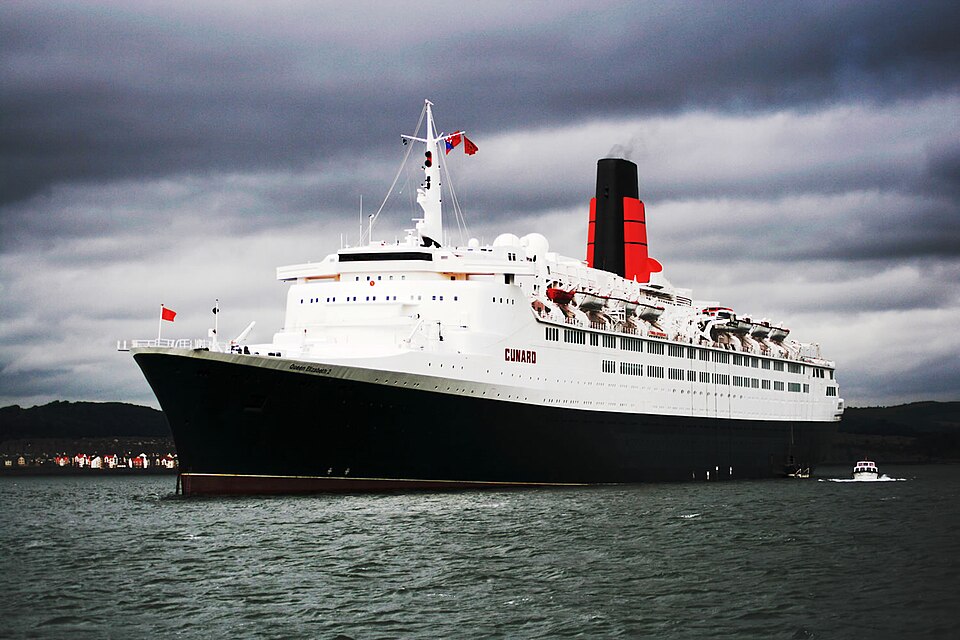
Even more distinctive was Queen Elizabeth 2. Entering service for Cunard in 1969, she already belonged to a different generation from the great Queens that had preceded her. Her design had been conceived with greater flexibility, and the ship built her career while maintaining a dual identity for many years. She continued to operate ocean crossings, but at the same time developed an increasingly important cruise operation, including long itineraries and world cruises. QE2 was therefore not simply a liner transformed into a cruise ship. She was a ship capable of permanently existing between two operational models.
Her history shows how, during this transitional period, the boundaries between categories were often less clear-cut than they may appear today. A liner could devote part of the year to crossings and another part to cruises, modifying the use of its spaces, the organization of service, and the composition of its passengers. Adaptability became a fundamental characteristic, especially for vessels designed during the years when the cruise industry was acquiring an identity of its own.
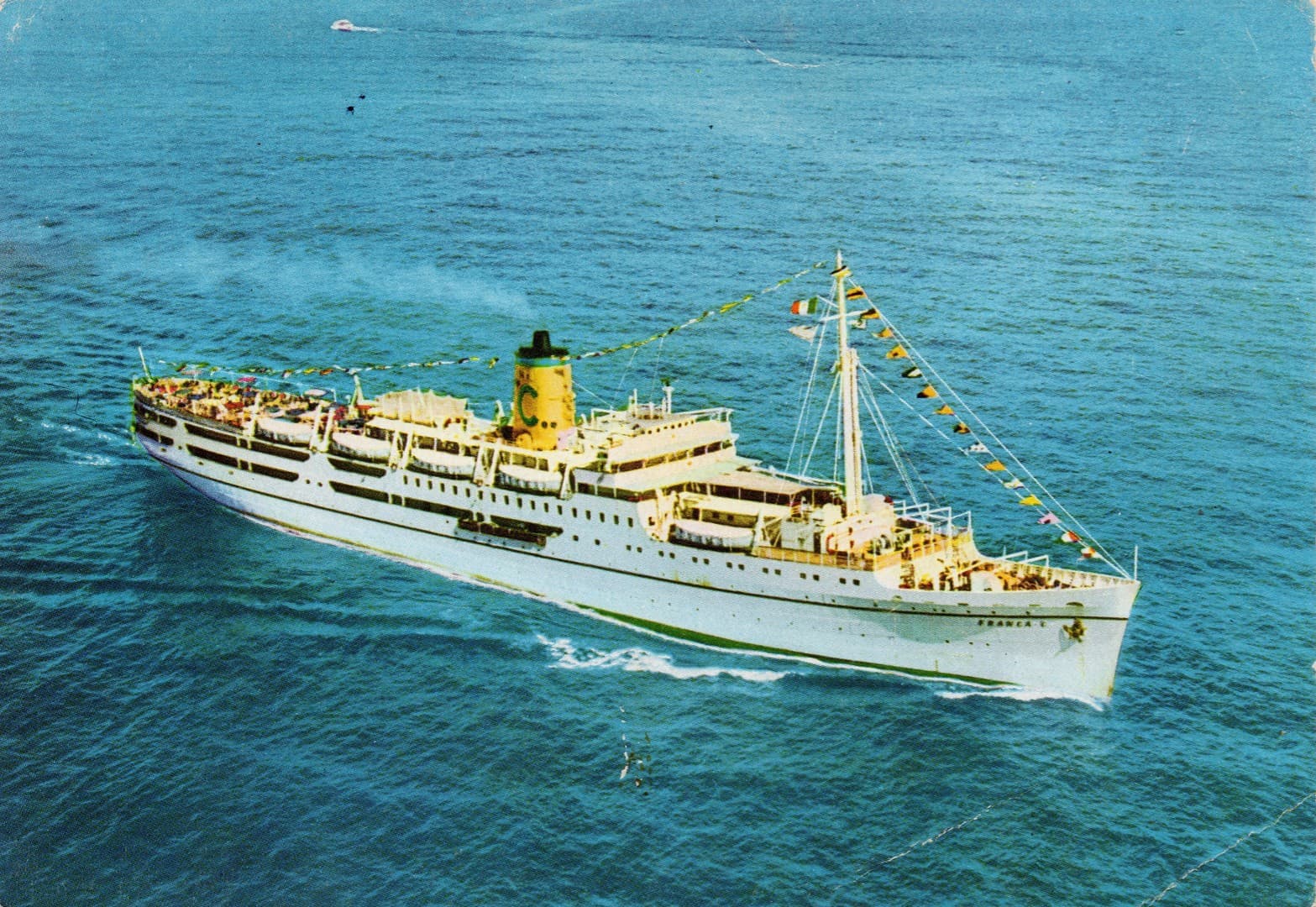
Italian history also offers important examples. Costa had developed a significant presence in post-war passenger services between Europe and Latin America, but gradually began using some of its vessels for cruising as well. Franca C. was assigned permanently to cruises as early as the late 1950s, while other ships in the fleet began operating seasonal tourism programs. The transition therefore did not take place through a single decision, but through a gradual process in which liner services and cruises continued to coexist.
Eugenio C., which entered service in 1966 and was built in Monfalcone, fully belonged to this period. She was a large Italian passenger ship initially associated with connections to South America, but her career unfolded during a phase in which the cruise market was assuming an increasingly important role. Over the years, the Costa fleet was progressively oriented toward this sector, ultimately transforming the profile of the company completely. In Italy too, cruising therefore emerged through a long period of overlap between different ships, routes, and service models.
Behind all these transformations lay a complex technical and design problem. A ship built for liner service possessed characteristics that were difficult to modify completely. The hull structure, the position of the machinery, the arrangement of the decks, and many of the internal routes were determined by the original design. Even the most extensive modifications could not completely eliminate these constraints. Conversion therefore required a balance between what could be transformed and what necessarily had to remain.
One of the most important aspects concerned passenger flows. The old divisions between classes had often resulted in separate restaurants, segregated lounges, different entrances, and routes that prevented passengers from moving freely throughout the ship. In the new model, these elements became less functional. Cruising tended toward greater sharing of spaces and required areas that could be easily accessed by a much larger number of people. Eliminating the separations could mean removing panels and doors, but in other cases it involved more substantial modifications to the interior layout.
Outdoor spaces represented another fundamental difference. Traditional liners often had magnificent covered promenades and open decks, but their arrangement was not necessarily designed for a life on board based on swimming pools, sun decks, and outdoor activities. The new function made it necessary to enlarge or convert these areas. Norway once again provides the clearest example, but the problem affected many other vessels adapted for cruising.
Cabins also reflected two different concepts. On old liners, a significant proportion of accommodations could be interior, relatively small, or equipped simply with a porthole. Many had been designed according to very different levels of comfort and categories. Cruising progressively required greater uniformity, while still maintaining various types of accommodation. Over time, the cabin would become an increasingly important component of the product, but for many converted ships the existing structure represented a limitation that was difficult to overcome.
Dining arrangements also had to be reconsidered. Large liners often had imposing and elegant dining rooms, but their organization was closely linked to classes and service shifts. With cruising, these spaces could be retained, modified, or repurposed, but the way passengers experienced them changed completely. Lounges, ballrooms, and reception areas likewise took on new functions. Some retained their original character, while others were transformed into more informal entertainment venues.
It was precisely this overlap that made converted ships so distinctive. On board Norway, Rotterdam, Canberra, or other vessels of the same generation, it was possible to recognize elements clearly belonging to their previous lives. A large lounge retained proportions created for liner service, a monumental staircase recalled the age of separate classes, and a long promenade preserved the character of an ocean liner. The modifications introduced swimming pools, bars, new services, and a different organization, but they could not—and often did not even seek to—completely erase what the ship had once been.
As cruising became established as an autonomous industry, this solution gradually became less necessary. New vessels could be designed from the outset for an exclusively leisure-oriented function. Cabins, outdoor decks, restaurants, entertainment areas, passenger flows, and systems could all be defined around the needs of a vacation, without having to adapt structures created for other purposes. The cruise ship thus ceased to be a derivative of the liner and became an autonomous design category.
The generation of large converted ships slowly began to disappear, but some enjoyed exceptionally long careers. Canberra remained in service until 1997, Rotterdam left Holland America in the same year, Queen Elizabeth 2 continued sailing with Cunard until 2008, and Norway operated until 2003, more than forty years after entering service as France. The length of these careers helped make these ships living witnesses to a transformation that had affected passenger shipping as a whole.
Their appeal derives precisely from the impossibility of assigning them completely to a single era. Beneath Norway's lido deck, France continued to exist. Behind Rotterdam's cruise life remained the great Dutch liner of 1959. Canberra retained the forms of the ship built for long-distance services to Australia, while QE2 continued to embody simultaneously the prestige of the ocean crossing and the freedom of cruise itineraries. They were ships that had learned a new trade without forgetting the one that came before.
Modern cruise ships are born with a complete understanding of their purpose. Every deck, every cabin, every restaurant, and every outdoor space is designed in relation to an experience that has already been defined. The large converted vessels of the twentieth century, by contrast, belonged to a more complex world. They had to change along with the market, adapt structures created for other purposes, and reinvent their operational lives without being able to completely abandon their origins. It is precisely this second existence, built upon the first without erasing it, that made France and Norway, Rotterdam, Canberra, Queen Elizabeth 2, and many other ships of the same period some of the most fascinating figures in the history of passenger shipping.
Gabriele Bassi