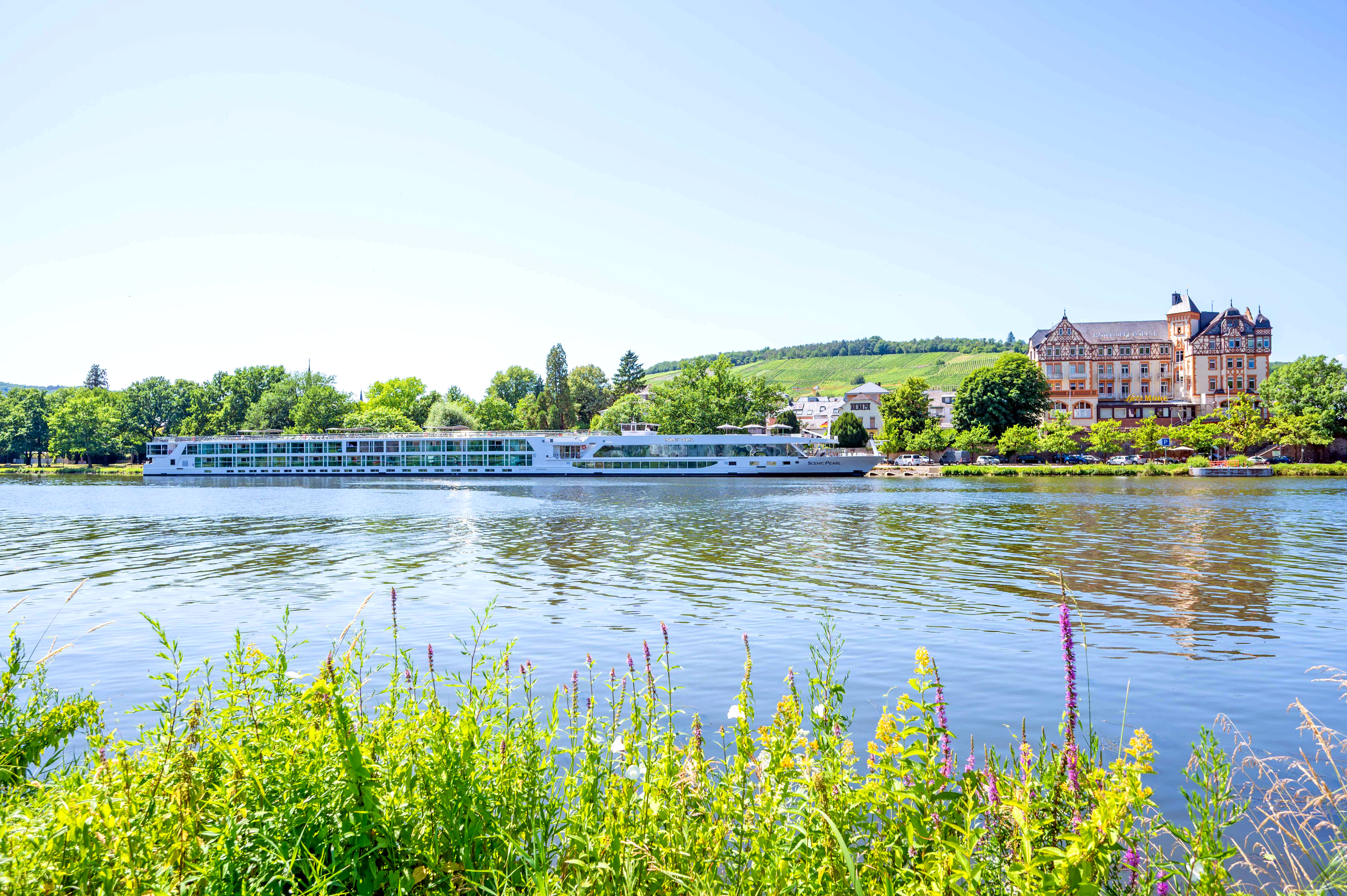
From Amsterdam to Basel, Scenic River Cruises offers a richly rewarding 14-night journey through the Netherlands, Belgium, Germany, France and Switzerland, combining long scenic sailings, all-inclusive ease, generous excursions and a polished onboard experience.
Scenic River Cruises calls its river vessels “Space-Ships,” and while the phrase may sound futuristic, the real pleasure of this journey lies in something far more timeless: the ability to travel through Europe slowly, comfortably and almost effortlessly. On this itinerary, the ship follows a wide arc from Amsterdam through the Rhine and Moselle river systems before reaching Basel, allowing guests to experience not only celebrated cities but also the smaller towns, wine villages, castles, vineyards and river landscapes that give European river cruising its deepest appeal.
This is not a cruise that treats the river as a corridor between destinations. Here, the river becomes the destination. Scenic spends enough time sailing by daylight that guests can watch Europe reveal itself in long, cinematic stretches: half-timbered villages, steep vineyard slopes, church towers, castles, cobbled lanes, flower boxes and bends in the river that seem to deliver one postcard after another. The pace is leisurely, but never dull. Over two weeks, the journey accumulates texture, context and pleasure.
For travelers accustomed to shorter river itineraries, the 14-night length makes a considerable difference. Rather than a sampler, the cruise feels like an immersion. There is time to settle into the ship, understand the rhythm of the rivers, and let the scenery itself become one of the principal pleasures of the voyage.
Scenic Pearl and the Luxury of Ease
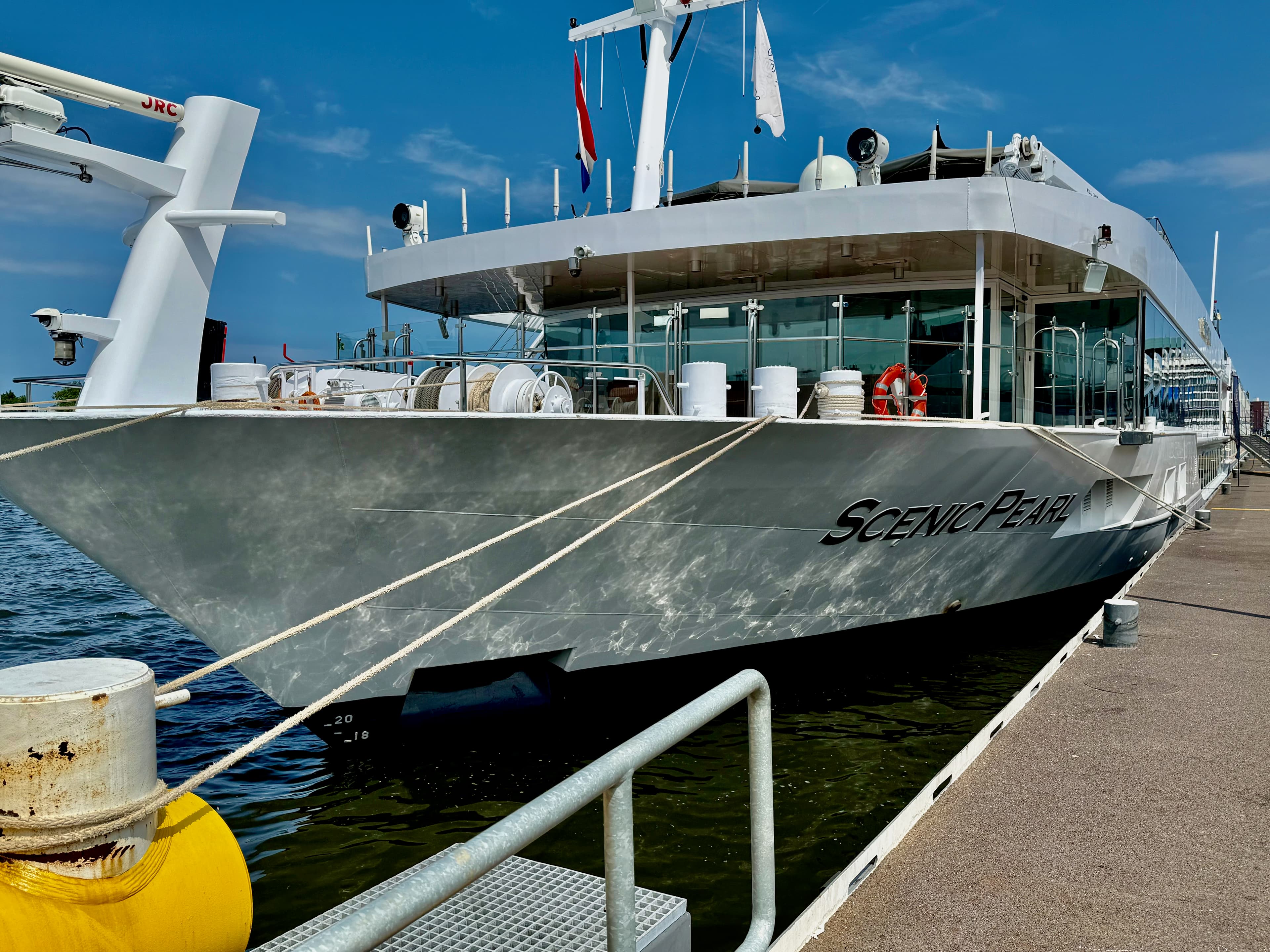
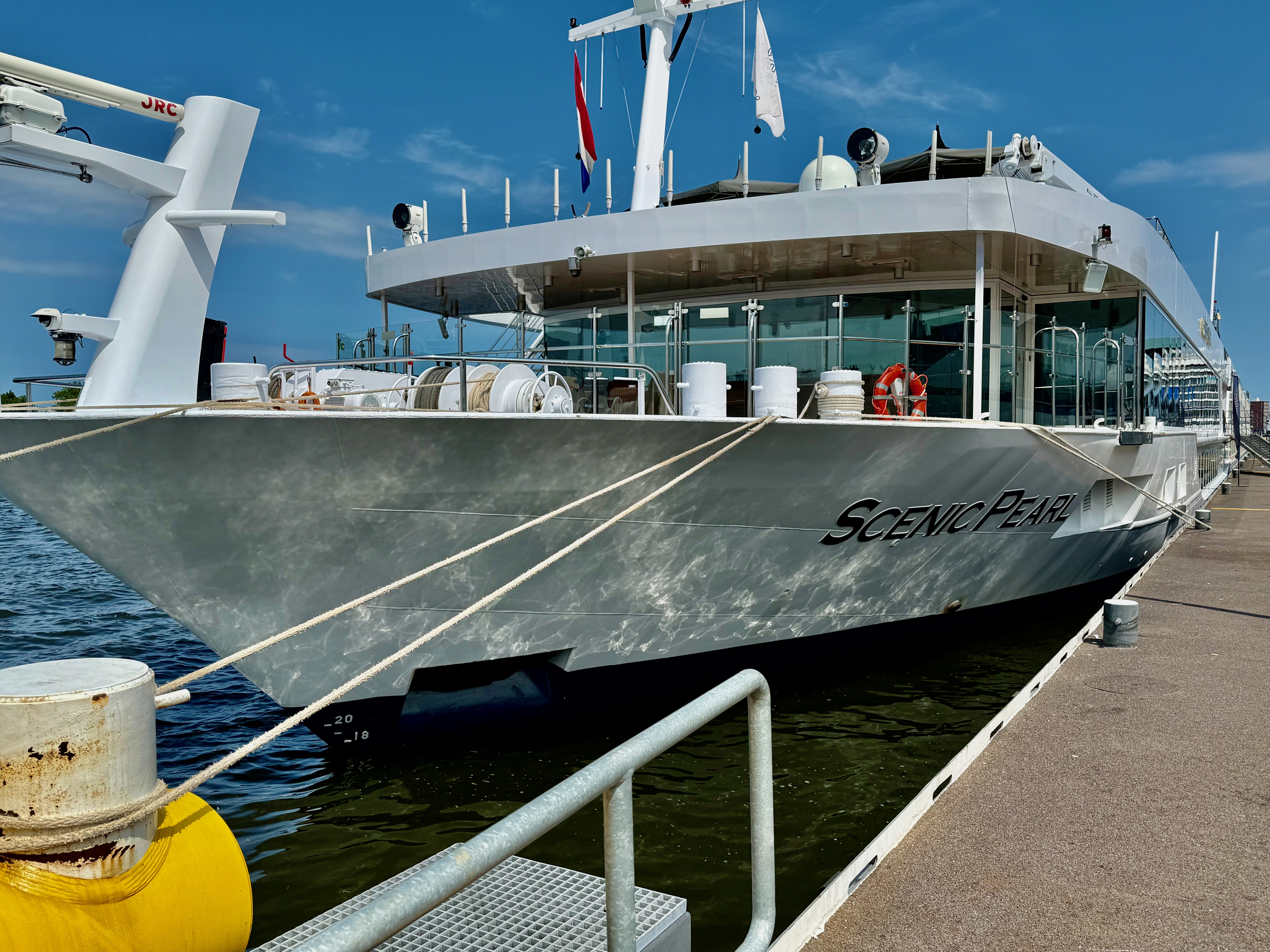
The ship I sailed on was Scenic Pearl. It is a comfortable, stylish river vessel whose greatest strength may be how easy she makes everything feel. Scenic’s all-inclusive model covers drinks, gratuities, excursions, Wi-Fi, transfers and a wide range of onboard amenities, removing many of the small frictions that can intrude on a holiday. Once aboard, guests are not constantly reaching for a key card or signing for every drink. The atmosphere is relaxed, generous and quietly efficient.
The ship’s interiors, designed by Karen Moroney, are calm and contemporary, with pale ash cabinetry, dark accents and public spaces that feel elegant without being overwrought. Cabins are well planned, with good storage, comfortable beds, excellent showers and Scenic’s signature drop-down window system, which turns the balcony seating area into an open-air-style terrace at the touch of a button.
On a voyage so rich in river scenery, that connection to the landscape is essential. The cabin window is a genuine pleasure, particularly in the morning, when the ship may be gliding past a town, vineyard or church tower before the day’s first coffee. Still, the finest viewing platform is often the Sun Deck. When weather cooperates, it becomes the ship’s great outdoor salon: a place for reading, photographing, conversation, a glass of wine, or the simple pleasure of watching the riverbanks unfold.
The public spaces aboard Scenic Pearl support a relaxed rhythm. The lounge functions as the social heart of the ship, while the dining rooms, café and outdoor areas give guests enough variety to prevent the experience from feeling confined. This matters on a 14-night sailing. A river ship must be intimate without feeling small, sociable without feeling forced, and Scenic Pearl manages that balance well.
The passenger mix on this sailing was notably international, with a strong Australian presence along with Canadians, Americans, Britons, Spaniards and New Zealanders. The result was an easy, companionable atmosphere, less formal than traditional ocean luxury but still very civilized. Scenic’s version of luxury is not ceremony for its own sake. It is comfort, inclusion, access and ease.
Service is central to that impression. The crew aboard Scenic Pearl worked with warmth and efficiency, and the best of them brought personality as well as professionalism to the experience. On the Sun Deck, servers Voyla, Ari and Malin helped turn scenic sailing into a daily pleasure. Behind the scenes, Indonesian Putro Nugroho helped lead the large housekeeping and hospitality team—the essential, often invisible engine of any successful river cruise. His good humor, stamina and obvious pride in the work were reminders that luxury on a river ship depends as much on human consistency as it does on design.
That may be one of Scenic Pearl’s strongest qualities. The ship does not overwhelm with spectacle. Instead, it creates a sense that things have been thought through. Drinks are included. Excursions are included. Tips are included. Transfers are included. Even forgotten necessities can be quietly supplied. On one previous Scenic experience, a missing toothbrush appeared as if by magic, which may sound like a small detail until one remembers that hospitality is very often measured in small details.
5 Dining Experiences aboard Scenic Pearl
Cuisine is a major part of Scenic’s identity, and Scenic Pearl offers more dining variety than one might expect aboard a river vessel of this size. There are five dining venues or experiences: Crystal Dining, the ship’s main restaurant; the more casual River Café; the intimate Portobellos; the degustation-style Table La Rive; and Riverview Terrace, the open-air venue used when weather permits.
That range is important on a two-week itinerary. Dining cannot simply be pleasant; it must remain interesting. Scenic Pearl’s culinary program succeeds by varying the mood as well as the menu. Breakfast and lunch can be relaxed and informal, while dinner in Crystal Dining provides the main evening gathering point. Portobellos and Table La Rive add a more intimate, special-occasion feeling, and Riverview Terrace offers the great river-cruise luxury of eating outside while Europe passes by.
The kitchen is overseen by Executive Chef Dzhaparov, who previously worked with Viking and Amadeus and joined Scenic in 2020. He manages a compact but energetic team of ten cooks and two dishwashers, largely Indonesian and Serbian, producing a broad range of dishes from a galley far smaller than most guests would imagine. That is one of the quiet marvels of river cruising: the culinary ambition is often ocean-going, while the workspace is emphatically not.
Chef Dzhaparov’s own favorite dishes include borscht and beef stroganoff, and it is precisely those personal details that make a ship’s kitchen feel more alive. On a European river itinerary, menus must satisfy an international passenger list while also reflecting the regions through which the ship is traveling. Scenic Pearl handled that balance well. Meals were generous, varied and attractively presented, with enough regional influence to connect the dining room to the journey ashore.
Wine also plays an important role, especially on an itinerary that moves through some of Europe’s most storied wine landscapes. Scenic offered multiple opportunities to taste and understand the regions visited, from the wines of Alsace to the vineyards near Heidelberg and the steep slopes along the river valleys. For guests who enjoy wine, four shore excursions added another layer to the culinary experience aboard.
Scenic’s all-inclusive approach also changes the dining atmosphere. Wine, cocktails, spirits and soft drinks are included, so guests are not constantly calculating what to order or whether to accept a refill. The result is a more relaxed and convivial experience. The pleasure is not in excess, but in ease.
From Antwerp to Colmar: The Surprises Ashore
A strong river itinerary depends not only on famous names but on the surprises between them. Scenic’s Amsterdam-to-Basel journey delivered both. Amsterdam provided the classic embarkation point: canals, narrow houses, bridges, bicycles and that unmistakable Dutch mixture of order and eccentricity. But one of the early revelations of the cruise came soon after, in Antwerp.
Antwerp is not always the first city travelers associate with a Rhine and Moselle sailing, which may be why it made such a strong impression. Its grand square, ornate guild houses and magnificent Cathedral of Our Lady gave the call architectural weight, while the city itself felt lively, elegant and unexpectedly moving. On the day of the visit, wedding couples appeared one after another at City Hall, turning the square into a civic stage set. Inside the cathedral, the great Rubens paintings offered another kind of theater entirely. Antwerp was a reminder that the best itineraries are not always defined by the most predictable highlights.
Dordrecht, one of the oldest cities in the Netherlands, offered a quieter but equally valuable experience. Its historic center, canals and merchant-town atmosphere gave a sense of Dutch life beyond Amsterdam. Arnhem brought a choice between wartime history and Dutch village life. The reconstructed village and gardens, even in the rain, provided a vivid look at rural traditions, architecture and domestic detail.
Düsseldorf offered a more urban contrast, with a private museum experience that reflected Scenic’s ability to create moments of access. As the ship continued toward the Moselle, the visual character of the itinerary changed. The riverbanks narrowed, vineyards climbed the slopes and villages appeared with an almost theatrical charm. This is one of the great stretches of European river cruising, where half-timbered houses, cobbled lanes, flower boxes and church towers seem to have been arranged for maximum effect.
Trier brought the deep past into focus. As Germany’s oldest city, it carries the weight of Roman history alongside later religious and civic monuments. Scenic’s special evening event there, a classical performance in one of the city’s historic sacred spaces, added atmosphere and a sense of occasion. These private “Scenic Enrich” experiences are among the brand’s distinguishing features. At their best, they lift an itinerary from sightseeing into memory.
Rüdesheim provided a different sort of pleasure. The musical instrument museum, the funicular ride to the Niederwald Monument and the surrounding vineyards all belong to the classic Rhine experience. On this particular visit, the presence of a major Harley-Davidson gathering added an unexpected note of modern exuberance. River cruising often produces such juxtapositions: medieval streets and motorcycles, Gothic churches and café terraces, Roman ruins and contemporary life moving all around them.
In Strasbourg, guests could choose between exploring the city itself or following the Alsace Wine Route. The wine excursion revealed one of Europe’s most distinctive regions, where French and German influences meet in architecture, cuisine, language and wine. Vineyards, stork nests, half-timbered villages, Rieslings, rosés and Crémants gave the day a strong regional identity. Alsace has a particular charm, at once orderly and whimsical, and it proved especially well-suited to Scenic’s excursion style.
Heidelberg offered another choice, with some guests visiting the famous university city while others explored nearby wine country. That flexibility is important. On a cruise with many repeat travelers, not everyone wants the standard city tour. Scenic’s excursion program allowed guests to shape the voyage according to their interests, whether history, wine, architecture, food or landscape.
Colmar, near the end of the itinerary, made a particularly memorable final impression. With its canals, covered market, boutiques, painted façades and elaborate wrought-iron hanging shop signs, it is a city that rewards close looking. Some destinations impress through scale; Colmar seduces through detail. A painted sign, a bakery window, a canal reflection or a loaf of brioche raisin bread can become as memorable as a monument.
That, ultimately, was the strength of the itinerary. It moved easily between grandeur and intimacy. There were cathedrals, castles, museums, Roman ruins and great wine regions, but there were also morning markets, quiet streets, small shops, local specialties and unexpected human scenes. The cruise did not depend on one spectacular destination. Its richness came from accumulation.
By the time the journey reached Basel, the voyage had become more than a sequence of port calls. It had acquired rhythm. The ship, the crew, the dining, the excursions and the rivers themselves had worked together to create a complete experience.
For travelers seeking a European river cruise that combines comfort, culture, scenery, food, wine and ease, Scenic offers a compelling choice. Scenic Pearl is polished without being showy, the service is warm, the dining is varied, and the all-inclusive model genuinely enhances the holiday. Most importantly, the itinerary gives Europe room to breathe.
There are faster ways to travel from Amsterdam to Basel. There may be few more pleasurable ones. With Scenic, the river is not simply the route. It is the reason for going.
Monte Mathews