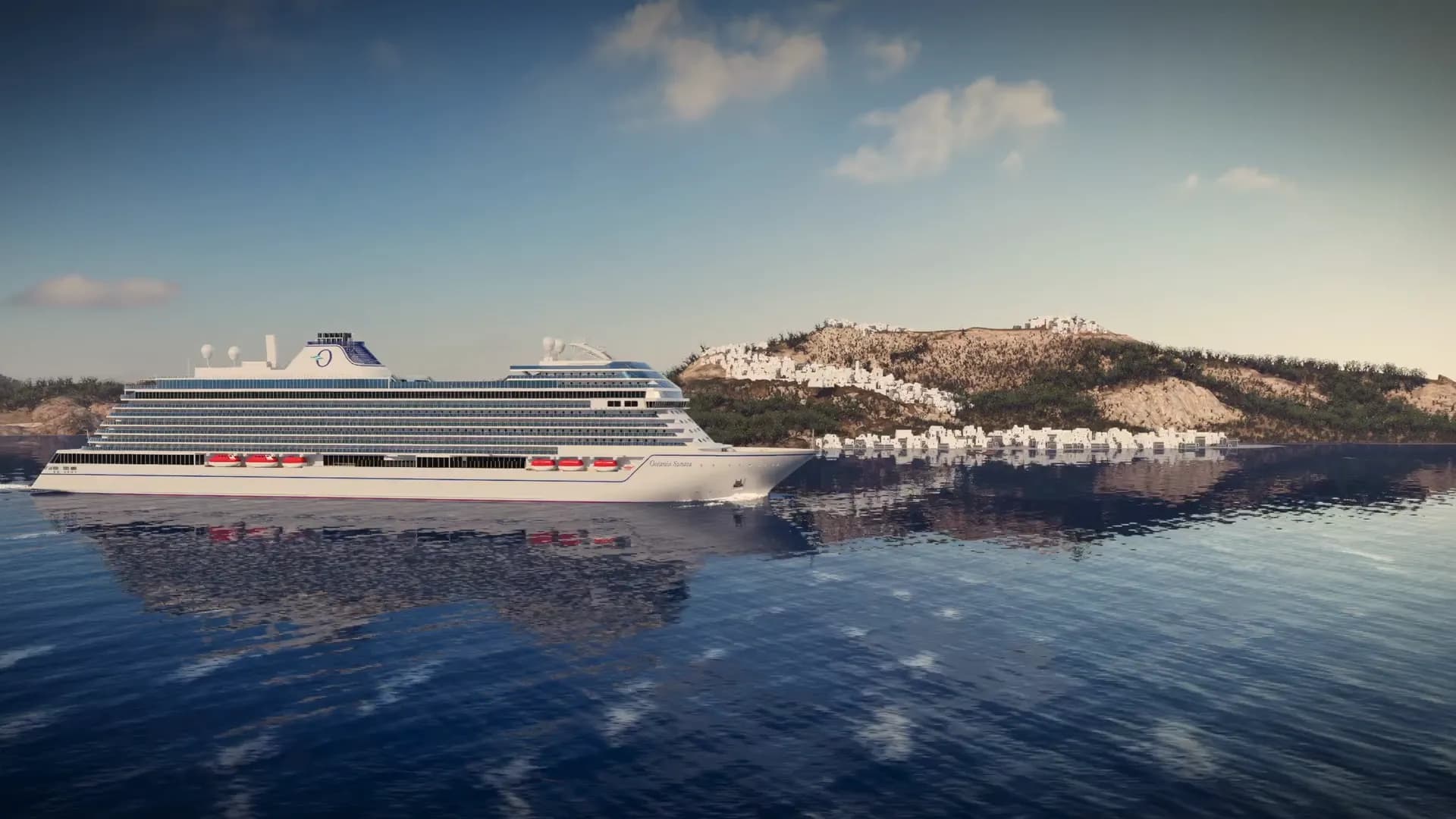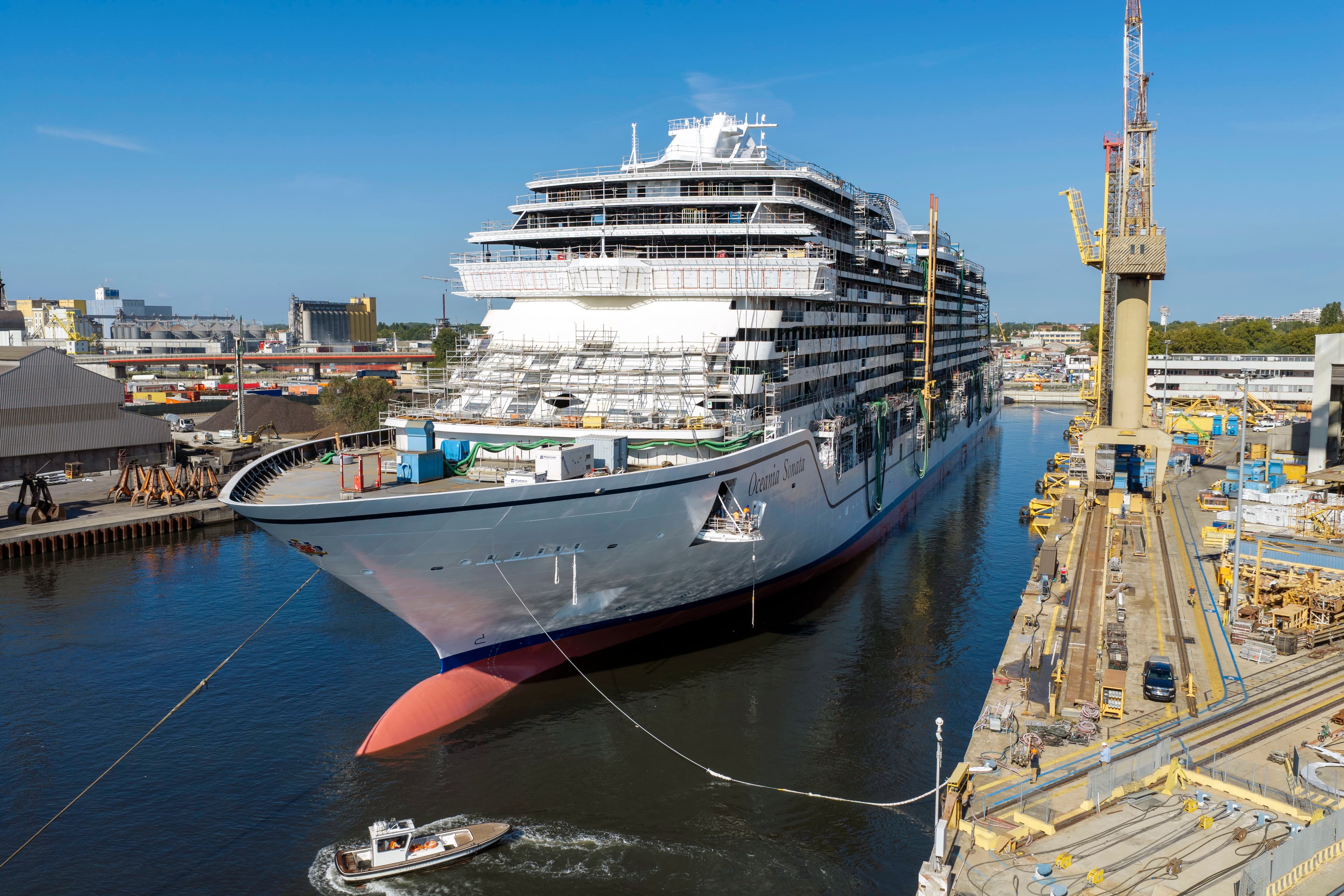
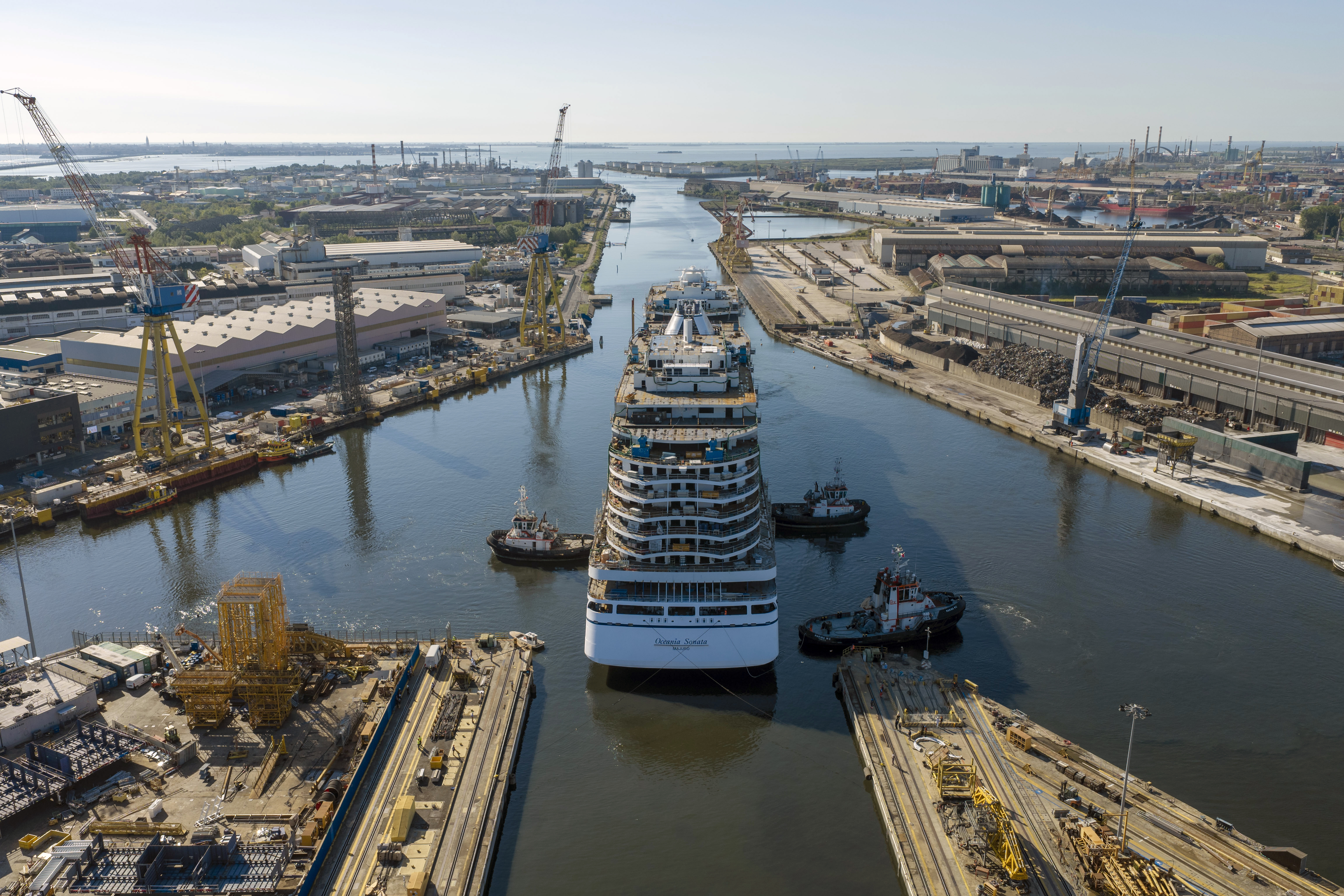
Oceania Cruises has reached one of the most visible milestones in the construction of Oceania Sonata, with the vessel floated out at Fincantieri’s Marghera shipyard in Italy ahead of her planned debut in August 2027.
The float-out marks the point at which the ship leaves dry dock and moves to the fitting-out berth, where attention now shifts to the completion of interiors, technical spaces and onboard venues. For Oceania Cruises, the milestone carries particular weight because Oceania Sonata is not simply another addition to the fleet, but the first representative of an entirely new class that will shape the company’s growth for the next decade. The ship is the first of five Sonata Class vessels currently planned, with Oceania Arietta due to follow in 2029 and three additional ships scheduled for delivery in 2032, 2035 and 2037.
The series therefore represents a long-term fleet-development strategy rather than a one-off expansion, gradually introducing a new generation of Oceania ships while preserving the relatively small-ship positioning around which the brand has built its identity. At approximately 86,000 gross tons, Oceania Sonata will be nearly 30 percent larger than Oceania Allura, but the increase in capacity will be comparatively modest. The ship will feature 695 rooms and suites, only around 90 more guest accommodations than Allura, allowing much of the additional volume to be translated into more generous public areas and larger residential spaces rather than simply higher passenger density.
That approach is particularly significant for a brand whose positioning depends on combining a more intimate onboard environment with a strong focus on destination immersion. Oceania Sonata is intended to remain firmly within that philosophy, but with more space available for suites, lounges, restaurants and other public areas. One-third of all accommodations will be suites, and the new ship will introduce several changes at the upper end of the accommodation offering. Four Owner’s Suites will feature two bedrooms, a first for Oceania Cruises, while two entirely new suite categories will make their debut. The Horizon Suites will offer more than 600 square feet of space, with separate living and sleeping areas, walk-through closets and oversized verandas, while the new Penthouse Deluxe Suites, at 488 square feet, will sit between existing suite categories and are designed around a more residential layout, including expansive floor-to-ceiling sliding doors opening toward the sea.
The development of the accommodation mix illustrates how Oceania is using the increase in ship size: rather than pursuing a major increase in passenger count, the Sonata Class is being positioned around higher space ratios and a greater proportion of premium accommodations, reinforcing the line’s move further into the upper end of the small-ship luxury segment. Cuisine will remain another central element of the product. Oceania Sonata will feature 13 dining venues, including two concepts new to the brand, La Table par Maîtres Cuisiniers de France and Nikkei Kitchen, alongside established Oceania restaurants including Jacques, Red Ginger, Polo Grill and Toscana, as well as The Grand Dining Room. The expanded dining offer continues a strategy that has long differentiated Oceania from many competitors of similar size, using the number and variety of restaurants as a core part of the onboard proposition rather than treating them as secondary amenities.
The float-out ceremony also underlined the continuity of the relationship between Oceania Cruises and Fincantieri. Representing the cruise line was Paolo Novarino, Senior Director, Project Owner, alongside representatives of the shipyard and project teams. The partnership between the two companies stretches back nearly two decades: Fincantieri delivered Oceania Marina in 2011 and Oceania Riviera in 2012, followed more recently by Oceania Vista in 2023 and Oceania Allura in 2025. Oceania Sonata now extends that relationship into a new generation of vessels. Jason Montague, Chief Luxury Officer of Oceania Cruises, described the float-out as a defining step both for the ship and for the evolution of the brand. With the exterior structure substantially complete, the next construction phase will increasingly reveal how the Sonata Class differs in practice from the Vista Class vessels that immediately preceded it. That comparison will be especially interesting from an industry perspective.
The 86,000-gross-ton platform is considerably larger, yet Oceania has chosen not to convert that growth proportionally into additional cabins. The result points toward a broader trend across the upper-premium and luxury cruise sectors, where new tonnage is increasingly being used to create more space per guest, larger suites and a greater variety of dining and public venues instead of maximising berth counts.
The company has already outlined an inaugural season designed to demonstrate the geographical flexibility of the new platform. Between August 2027 and April 2028, Oceania Sonata is scheduled to visit more than 90 destinations across Europe, the Caribbean, the Panama Canal region, Mexico, Central America and South America. Her maiden voyage, Mediterranean Collage, departs Rome on August 7, 2027 for a 14-day sailing to Trieste, with calls in Italy, Malta, Greece, Montenegro and Croatia. The detailed routing includes Salerno, Catania and Valletta before an extensive Greek section taking in Katakolon, Heraklion, Paros, Athens, Mykonos, Argostoli and Corfu, followed by Bar, Split and Zadar before arrival in Trieste. The inaugural program continues with a strong Eastern Mediterranean component, including Greeks & Byzantines, a seven-day sailing from Athens to Istanbul departing October 14, with calls at Paros, Heraklion, Rhodes, Patmos and Izmir before an overnight stay in Istanbul. After the European season, the ship will move toward the Americas. Panama Canal Coastlines, departing Los Angeles on January 6, 2028, is a 16-day sailing to Miami combining calls in Mexico, Guatemala and Costa Rica with a daylight transit of the Panama Canal, followed by Cartagena and George Town. A subsequent Caribbean program includes roundtrip Miami voyages such as Tropical Coves in March 2028, while the broader maiden deployment also features less obvious ports including Koper, Sarandë, Palamós, Zihuatanejo-Ixtapa and Puerto Quetzal, alongside overnight stays in destinations such as Istanbul, Livorno and Bordeaux.
The itineraries are important, but the more consequential story is the platform itself. Oceania Sonata marks the beginning of a fleet cycle that will extend through 2037 and potentially reshape the size and composition of Oceania Cruises over time. With five ships planned in the class, the company is effectively committing to a larger physical platform while trying to preserve the attributes that have traditionally defined the brand: relatively low passenger density, culinary depth and destination-heavy deployment. That balance will be closely watched. Growth in ship size can create operational efficiencies and support a broader range of onboard amenities, but it can also alter the sense of intimacy on which smaller luxury and upper-premium brands depend. Oceania’s decision to add substantial tonnage without a corresponding rise in guest accommodations suggests that the company is attempting to use scale primarily to improve the product rather than simply to increase capacity.
The ship’s adults-only environment, expanded public spaces, larger suite inventory and 13 dining venues all support that interpretation. If the concept performs as intended, Sonata Class could give Oceania greater flexibility to compete simultaneously on space, cuisine and itinerary design while remaining distinct from the much larger vessels entering service elsewhere in the cruise industry. For now, the float-out brings that strategy one step closer to reality, as the technical shell of Oceania Sonata moves into the fitting-out phase and begins the transition from new platform to finished ship ahead of her August 2027 debut.
Gabriele Bassi