
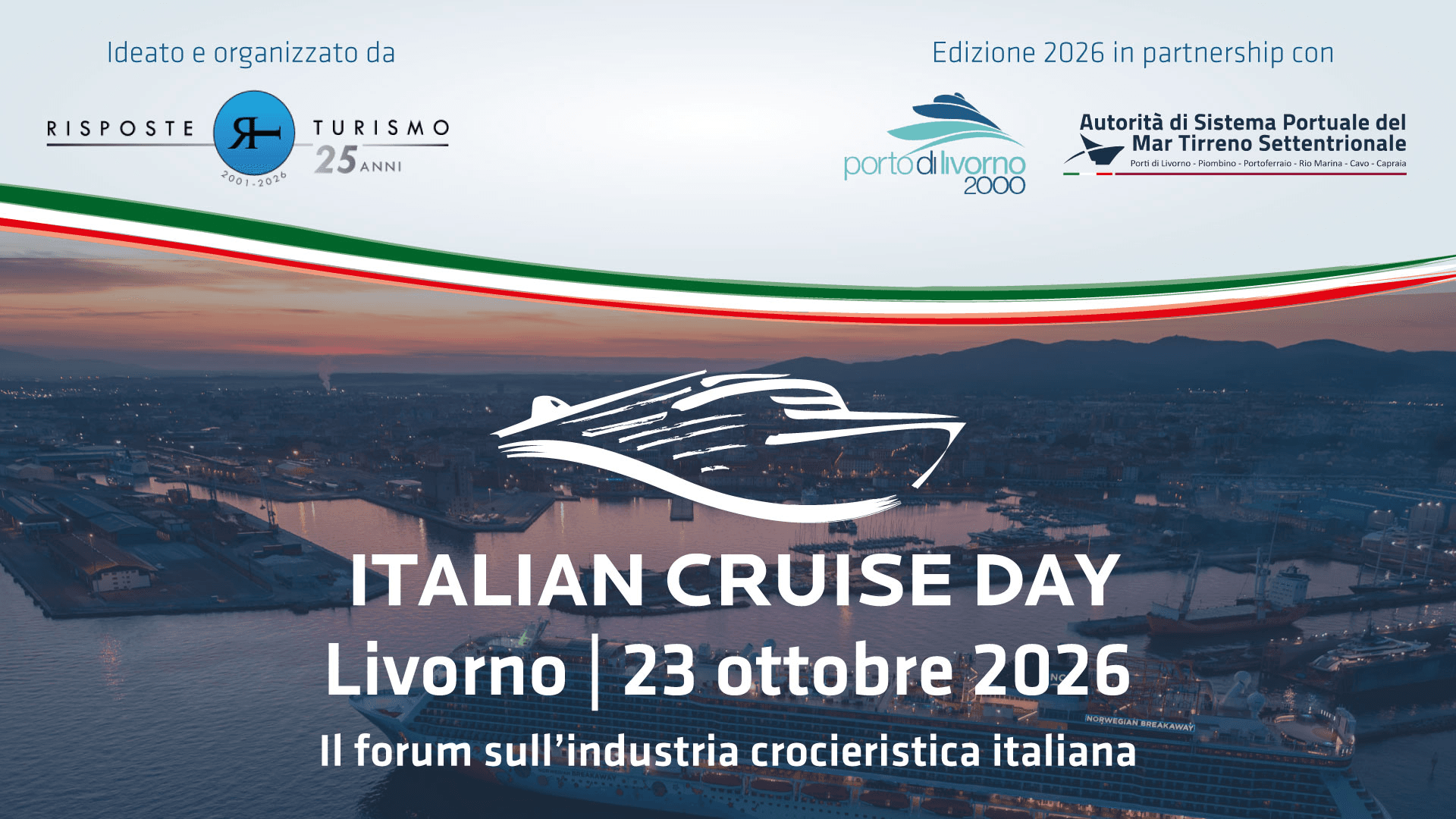
Italy’s cruise sector is preparing for a growing 2027, with new records expected at several ports and a major investment programme aimed at strengthening port infrastructure.
The forecasts were presented on 23 October in Livorno, during Italian Cruise Day 2026, by Francesco di Cesare, President of Risposte Turismo, as part of the latest edition of Italian Cruise Watch, the report analysing the performance and outlook of Italy’s national cruise sector.
Among the key expected results is the further consolidation of Civitavecchia’s leading position, with 3.8 million passenger movements forecast. Nine Italian ports are also preparing to surpass their previous all-time records, while investments planned by ports across the country for the 2027–2029 period amount to more than €1.05 billion in total.
According to Francesco di Cesare, the figures point to a solid and evolving sector, capable of achieving new records and extending its presence to emerging destinations. However, traffic growth requires port infrastructure and services to be upgraded so that ports can meet the needs of cruise lines and passengers.
The more than €1.05 billion in investments planned for the 2027–2029 period are aimed precisely in this direction: more modern terminals, berths suitable for the latest-generation ships, and greater attention to environmental sustainability. As the President of Risposte Turismo emphasised, the challenge also concerns destinations and their ability to manage passenger flows, ensuring a positive experience for visitors while maximising the economic benefits for local areas.
The choice of Livorno as the host city for the 2026 edition provided an important opportunity to discuss the port’s role and the outlook for the Northern Tyrrhenian region. Davide Gariglio, President of the Port Network Authority of the Northern Tyrrhenian Sea, highlighted the strategic value of cruising for the port system and the local economy, stressing the importance of strengthening cooperation among institutions, port operators, local administrations and tourism businesses.
For 2027, Livorno is expecting 425 cruise calls and between 820,000 and 830,000 passengers, according to estimates presented by Risposte Turismo. Matteo Savelli, President of Porto di Livorno 2000, emphasised the need to turn increasing passenger volumes into tangible opportunities for the local area through an integrated offering and balanced, sustainable development.
Livorno Mayor Luca Salvetti also highlighted the sector’s contribution to the city’s economy. According to the figures cited, 29% of cruise passengers disembarking at the port choose to explore the city independently. The economic impact generated by the sector is estimated at approximately €20 million per year, taking into account passenger and crew spending, as well as the services provided by cruise lines.
Discussions at Italian Cruise Day also focused on changes in the cruise offering and the market’s evolving needs. Tomaso Cognolato, President of Assiterminal, noted that 2027 could bring further growth not only for traditional cruise ports but also for emerging destinations, as cruise lines consider increasingly diverse itineraries and services in these locations.
The issues highlighted included adapting berths to accommodate ship dimensions, developing passenger reception facilities and making use of public-private partnership models. Cognolato also stressed the need for greater consistency in concession regulations and for port security tools and related requirements to be updated.
On the sustainability front, Nikos Mertzanidis, Executive Director of CLIA Europe, reiterated the shared responsibility of cruise lines, ports and destinations in managing the sector’s growth, both at sea and on shore. The evolution of the fleet and the increasing presence of smaller ships, also dedicated to themed cruises and alternative itineraries, require destinations to adapt their visitor offering accordingly.
Roberto Petri, President of Assoporti, highlighted the role of investment in infrastructure, innovation and sustainability in supporting the sector’s development. He also stressed the importance of translating traffic growth into value for local areas, employment and business opportunities.
The forecasts presented at Italian Cruise Day 2026 therefore point to a further phase of growth for Italy’s cruise sector, supported by significant investments and the gradual evolution of destinations. Exceeding all-time records at several ports and the expected increase in passenger numbers represent important opportunities, but also require planning that involves the entire cruise supply chain. The competitiveness of Italy’s national cruise sector will increasingly depend on its ability to combine adequate infrastructure, sustainability and cooperation with local communities, ensuring that growing traffic translates into tangible benefits for local communities and economies.
Gabriele Bassi