
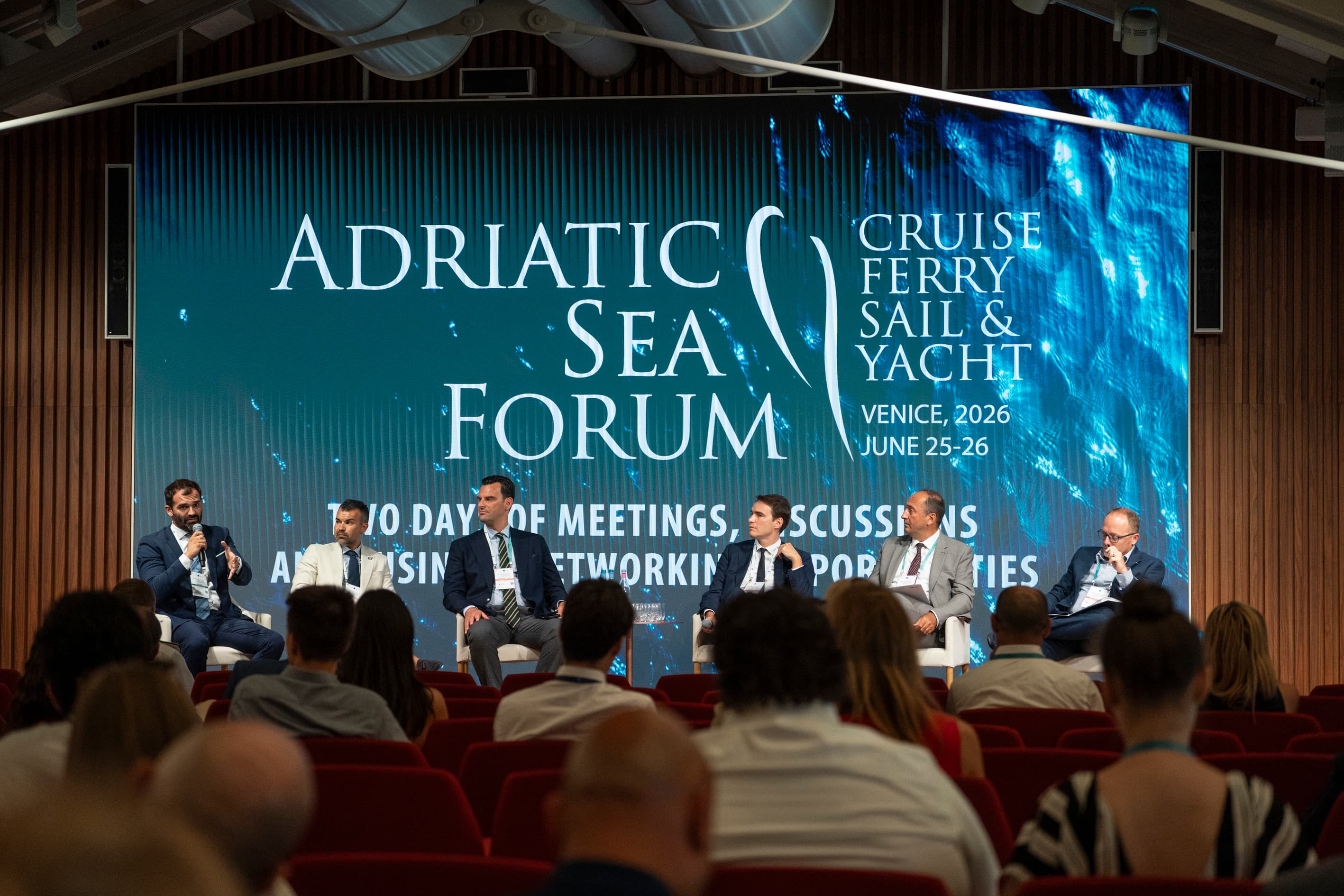
The Adriatic Sea Forum returned to Venice for its eighth edition, once again confirming its role as one of the leading events for discussion on the future of maritime tourism in the Adriatic region.
Organised in collaboration with the North Adriatic Sea Port Authority, with the support of main sponsor Bassani Group, sponsors Mastercard and Plus Marine, and with contributions from Generali Italia, Venezia Terminal Passeggeri, and Venice Yacht Pier, the event brought together industry professionals, institutions, and key stakeholders to analyse the developments, opportunities, and challenges of a sector that is becoming increasingly strategic for the tourism economy of the wider Adriatic area. Among the partners of the 2026 edition was also Cruising Journal, the Forum’s official media partner, which covered the main discussions and insights focused on the development of maritime tourism across the Adriatic region.
The 2026 edition provided the opportunity to present the new edition of the Adriatic Sea Tourism Report, the research report produced by Risposte Turismo that provides an overview of the current state of maritime tourism across the seven countries bordering the Adriatic Sea. The data collected outline a sector undergoing continuous transformation, supported by the expected growth of the cruise industry and maritime connections, the expansion of the yachting sector, and major infrastructure investments planned for the coming years.
The report, presented by Francesco di Cesare, President of Risposte Turismo, analyses the flows, scale, characteristics, and development trends of maritime tourism across the seven Adriatic countries, focusing on the three main segments of the sector: cruises, ferries, and yachting. The aim is to provide industry professionals with an up-to-date overview of the market and identify opportunities and critical issues in order to support the future development of a sector that continues to represent a strategic asset for the tourism economy of the region.
According to the estimates contained in the 2026 edition of the Adriatic Sea Tourism Report, maritime tourism in the Adriatic will continue its growth trajectory, driven by the positive outlook expected for both the cruise sector and maritime connections, as well as by the expansion of the yachting offering.
In detail, the cruise sector continues to confirm its positive trend. According to the Risposte Turismo report, the 35 Adriatic ports are expected to handle approximately 5.7 million cruise passengers in 2026, including embarkations, disembarkations, and transit passengers. This figure represents a 6% increase compared with 2025, while ship calls are expected to reach 4,000, corresponding to a 7.7% growth. The increase in volumes will be driven primarily by the eastern Adriatic coast and will allow the sector to move closer to pre-pandemic levels, although it will not yet reach the record figures recorded in 2019.
Compared with other Mediterranean macro-areas, however, the Adriatic remains the only region to have recorded a decline in cruise traffic between 2019 and 2025, with an 8% decrease, while other areas experienced significant growth: the Western Coastal Mediterranean recorded a 35% increase, while the Eastern Mediterranean grew by 83%.
According to Risposte Turismo researchers, the Adriatic’s slower recovery is mainly linked to the infrastructure gap and local regulations, which in some cases limit the ability of ports to accommodate larger vessels. Nevertheless, 2026 will represent a record year in terms of the number of ships calling at Adriatic ports, with approximately 4,000 ship calls compared with 3,700 in 2016. This result confirms the growing presence of medium and smaller-sized vessels, as well as a lower impact of homeporting activities compared with previous years.
At the national level, Italy will once again confirm its position as the leading Adriatic country in terms of cruise traffic, with more than 2.1 million cruise passengers expected by the end of 2026, representing 37.3% of the area’s total, and 1,075 ship calls. It will be followed by Croatia, with 1.61 million expected passengers, and Greece, which is expected to exceed the one-million-passenger threshold for the first time.
Among the countries showing the most significant growth, Albania stands out. Although it remains far from the record levels achieved in 2017, it will register the strongest increase compared with 2025, with a 15.9% rise in passenger movements and a 29.9% increase in ship calls.
Looking at individual ports, Corfu will confirm its position as the leading cruise port in the Adriatic for the seventh consecutive year, reaching the milestone of one million cruise passengers for the first time. The result represents an 11.8% increase compared with 2025, supported by more than 560 ship calls (+20.3%). Dubrovnik will remain in second place, with 675,000 expected passengers, up 8% compared with 2025. Kotor will move into third position, reaching 615,000 passengers, with a 6% increase. Completing the top five are Bari, with 559,000 expected passengers (+1.5% compared with 2025), and Venice, which according to Risposte Turismo’s estimates will record a 9.3% decline compared with 2025, reaching approximately 530,000 passenger movements.
Among the ports recording the strongest performances are Bar, in Montenegro, which is expected to reach around 130,000 passengers in 2026, representing a 78.5% increase compared with 2025, and Ravenna, which is projected to reach 390,000 passengers, with growth of 57.2%.
Regarding the ferry, hydrofoil, and catamaran sector, the outlook presented by the Adriatic Sea Tourism Report 2026 confirms a positive trend. According to Risposte Turismo’s estimates, the sector is expected to experience further growth in traffic volumes over the coming year, reaching 20.6 million passenger movements, with a 2.1% increase compared with 2025. In this segment as well, leadership remains firmly in the hands of the area’s main ports. Split will maintain the top position with more than 5.2 million passenger movements, up 2.5% compared with 2025. Igoumenitsa will rank second, exceeding 3.1 million passengers with a 3% increase, while Zadar will take third place with more than 2.7 million passengers, representing a 1.4% growth compared with 2025.
Commenting on the report’s findings, Francesco di Cesare, President of Risposte Turismo, highlighted how the dynamics of maritime tourism in the Adriatic demonstrate a healthy and resilient sector, supported by significant public and private investments and by tourism demand that continues to show strong interest in the region. According to the President, however, comparisons with other Mediterranean macro-regions and international markets remain essential to fully understand the Adriatic’s still considerable growth potential. Future development will need to take into account several factors, including the strategies adopted by individual countries in the area, the level of port infrastructure, visitor reception models, and the management of tourism flows.
Among the priorities for the future, the President of Risposte Turismo highlighted in particular the need to strengthen the relationship between coastal areas and inland territories, improving not only accessibility and mobility but also the ability to view the entire Adriatic macro-region as an integrated tourism destination, enhancing the diversity and richness of its attractions.
Regarding the yachting sector, the Adriatic continues to confirm its strategic role within maritime tourism, with an offering of facilities and services that is steadily expanding. According to the mapping carried out by Risposte Turismo for 2026, the area currently includes a total of 347 facilities, including marinas and tourist ports. Almost the entire offering, accounting for approximately 93% of the total, is concentrated between Italy and Croatia, which remain the two leading yachting markets in the Adriatic region, with 189 and 133 marinas respectively.
The report also highlights a total availability of 81,710 berths, representing a 1.3% increase compared with 2024. Once again, Italy and Croatia rank first, with 49,597 and 21,847 berths respectively, confirming the central role of these two countries within the region’s yachting infrastructure.
The outlook for yacht charter, both in the sailing and motorboat segments, is also particularly positive. The feedback collected by Risposte Turismo from industry operators points to an improving scenario compared with recent years, within a market that has progressively consolidated its structure. Current expectations are more favourable than those recorded in the comparison between 2024 and 2023, when contraction forecasts were more prevalent than growth expectations. However, confidence levels have not yet returned to those recorded ten years ago, when growth was anticipated by 89% of operators in the sailing segment and 50% of those in the motorboat segment. Among the different demand segments, the local market currently shows the greatest dynamism, both for sailing charter and motorboat charter.
Commenting on the yachting data, the President of Risposte Turismo emphasised that this sector represents a fundamental component of the Adriatic’s tourism future, considering the extensive coastline and the large number of mooring facilities available. According to the President, however, from a purely tourism perspective it is essential to distinguish between stationary and residential users and transit users, the latter representing the true driving force behind nautical tourism. These are visitors who use boats to undertake multi-day itineraries, stopping at different ports along their route.
According to the President of Risposte Turismo, future efforts should focus more strongly on this type of demand by increasing the spaces dedicated to transit users within marinas. Currently, this segment accounts for around 20% of total berths, although with significant differences between the various areas of the Adriatic. Ports along the eastern coast, for example, already allocate a larger share of their capacity to this type of visitor. Investing in new infrastructure and services for the yachting sector therefore remains a priority, but equally important will be attracting a growing number of international visitors interested in discovering the Adriatic through integrated nautical itineraries.
The Adriatic Sea Tourism Report 2026 also included an in-depth analysis of investments aimed at strengthening maritime tourism across the Adriatic region. According to the mapping carried out by Risposte Turismo researchers, a total of more than €843 million in investments has been planned for the two Adriatic coastlines during the 2027–2030 period, with the aim of enhancing infrastructure and services dedicated to cruising, ferry passenger traffic, and nautical tourism.
Of these resources, more than €573 million will be allocated to the development of the cruise sector and maritime connections, while €270 million will concern the yachting sector. In particular, approximately €230 million will be invested in the construction of seven new tourist ports, while a further €40 million will be dedicated to the expansion and redevelopment of existing port facilities.
Among the most significant projects planned along the Italian coastline are those focused on the modernisation and sustainability of port facilities. Shore power infrastructure is planned for the ports of Trieste and Monfalcone, while the Port of Trieste will also undergo extraordinary maintenance works on Molo Bersaglieri.
In Venice, the investment plan includes maintenance works on the Vittorio Emanuele Canal, with an investment of €32 million, maintenance dredging operations on the Malamocco–Marghera Canal, with a total value of €85 million, and the construction of two new cruise ship berths on the North Channel – North Bank at Porto Marghera, representing an investment of €72 million.
The future of maritime tourism in the Venice area was also addressed by Matteo Gasparato, President of the North Adriatic Sea Port Authority, who highlighted how the experience of Venice and Chioggia demonstrates the possibility of transforming maritime tourism from a phenomenon to be managed into an opportunity to be enhanced, through a model based on sustainability, respect for local territories, and the quality of relationships created. According to Gasparato, in recent years a process has begun to rethink the entire port system by redistributing traffic flows among multiple ports of call, investing in shore power infrastructure, and directing demand towards higher-value forms of tourism that are more attentive to local identities and cultural heritage. From this perspective, the sea is viewed as a space for connection and cooperation, also through European projects and cross-border initiatives capable of linking the two Adriatic shores through culture, innovation, and a shared maritime heritage.
Among the other significant projects planned along the Italian coastline are those in Ancona, where the construction of a new passenger terminal is scheduled, with an investment of €7.2 million and completion expected by 2027, as well as the Molo Clementino project, valued at €15 million. Moving further south along the Adriatic coast, the Apulian ports of Bari, Brindisi, and Termoli are planning total investments of more than €70 million to improve the quality of the cruise passenger experience through the redevelopment of existing terminals, the construction of a new cruise terminal at Sant’Apollinare quay in Brindisi, and the electrification of port infrastructure.
Regarding the yachting sector, Risposte Turismo has identified at least €100 million in investments dedicated to the development of new tourist ports in Italy. Among the main projects are the new Otranto Marina, with a planned investment of €70 million, and the new marina at Molo San Cataldo in Bari, for which an investment of €30 million is expected.
In Croatia, the city of Pula is set to develop a new passenger terminal by 2029, with an investment of €130 million, alongside the construction of a new outer breakwater, valued at €26.8 million. The Port of Split will invest more than €24 million in the Resnik-Divulje terminal and the expansion of San Pietro Pier, while Korčula will allocate more than €16 million (excluding taxes) for the construction of a new port. In Dubrovnik, the main project will be Bathovina II, worth €22 million, which includes the relocation of ferry traffic to an area outside the existing port, as well as repair works on the quay at Petka Pier. In Greece, meanwhile, the Port of Igoumenitsa will invest approximately €6.8 million by 2027 to implement a cold ironing system, enabling ships to connect to shore-side electricity while docked.
The yachting sector on the eastern Adriatic coast will also benefit from new investments. In Croatia, the opening of the new Šešula Marina is expected in 2027, with an estimated investment of €7 million, while the first phase of the Verudela Marina project is scheduled for 2029, with a value of €1.1 million. In Albania, two major luxury yachting projects are planned: Vlora Marina, which will be operated by D-Marin and is expected to be completed by 2027 with an investment value of €45 million, and Durrës Yachts Marina, whose first phase, estimated by Risposte Turismo at €28 million, is expected to be completed in 2028. Finally, in Greece, the opening of Lamda Corfu Marina is planned for 2029, a large-scale project with an estimated investment of around €50 million.
The eighth edition of the Adriatic Sea Forum placed the main issues surrounding the future of maritime tourism in the Adriatic region at the centre of discussion, exploring the challenges and opportunities that will shape the sector in the coming years. Among the topics addressed, particular attention was given to the effects of climate change and rising sea levels on tourism activities and maritime infrastructure, a phenomenon expected to impact both supply and demand across all segments of the sector, from recreational boating to large-scale cruise operations and ferry connections.
Considerable attention was also devoted to the strategic role of ferries as not only a means of connecting territories but also as instruments capable of fostering economic cooperation, exchanges, and greater integration of the Adriatic as a unified tourism destination. Discussions highlighted how maritime routes can contribute to strengthening mobility within the Adriatic basin, supporting the growth of tourist and passenger flows, and increasing the region’s appeal in international markets.
A further focus was dedicated to nautical tourism and its actual contribution to the Adriatic coastal economy. The discussion highlighted the need to distinguish between the local and residential user base and the purely tourism-driven segment, represented by transit boaters who use vessels for multi-day itineraries with stops in different ports along their route. This second segment was identified as one of the sector’s main development opportunities, given the remaining potential for growth in increasing the share of tourist users within marinas and enhancing the ability of Adriatic ports to attract new international demand flows.
During the Adriatic Sea Forum, the fourth Call for Proposals on the capitalisation of the Interreg Italy–Croatia Programme was also presented. The initiative is dedicated to the transfer and enhancement of solutions already developed through European cooperation projects, with a particular focus on sustainable tourism.
For more than ten years, the Interreg Italy–Croatia Programme has supported cross-border cooperation between the territories located on the two shores of the Adriatic, funding more than 90 projects during the 2014–2020 period and over 120 projects under the current 2021–2027 programming period, across several strategic areas including sustainable tourism and multimodal maritime transport. The new Call, developed in coordination with the Mediterranean Multi-Programme Mechanism (MMM) of the Interreg Mediterranean Programme, aims to promote the transfer and adaptation of proven best practices, extending their impact beyond the individual territories where they were originally developed.
The opportunities offered by the Call were presented during the first day of the Forum by Silvia Comiati, Head of the Managing Authority of the Interreg Italy–Croatia Programme, who outlined the main features of the initiative and the strategic framework in which it operates. The Call has a budget allocation of nearly €6 million from the European Regional Development Fund (ERDF) and will remain open until 15 September 2026, providing interested stakeholders with the opportunity to submit new projects focused on sustainability and territorial cooperation.
The Forum also dedicated attention to European programmes and cross-border initiatives aimed at promoting sustainability, enhancing natural and cultural heritage, and developing a shared tourism offering among the countries bordering the Adriatic. The objective is to strengthen cooperation and highlight the diverse identities and assets of the wider Adriatic macro-region.
During the event, Simonida Kordić, Montenegro’s Minister of Tourism, also took part in the discussion, emphasising that the Adriatic represents far more than a shared sea: it is a common identity and an opportunity for sustainable growth for seven countries. According to Kordić, strengthening cooperation, particularly in nautical tourism, will make it possible to create a recognisable, well-connected, environmentally conscious macro-destination capable of offering a high-quality Mediterranean experience throughout the year.
Along the same lines, Alessandra Priante, President of ENIT, highlighted how the Adriatic is one of the Mediterranean’s richest seas in terms of history, identity, and beauty. According to Priante, coastal and maritime tourism represents the key opportunity through which the seven countries can build a shared vision of sustainable and balanced development: not simply a destination to be promoted, but a region to be managed through a common strategy, data-driven approaches, cooperation, and the ability to transform its diversity into an integrated tourism system.
During the Forum, further attention was dedicated to the themes of connectivity, competitiveness, and the economic value generated by maritime tourism for Adriatic territories. The second day opened with the presentation of the results of the European CROSSCONNECT project – “Cross-border Coordinated Sea-Land Approach Interconnecting Ports of the Adriatic Sea with Airports and Urban Areas,” funded by the Interreg Italy–Croatia Programme. The session provided an overview of the activities developed and the four new pilot intermodal connections created within the project. Discussions also explored how operators and stakeholders in the region can leverage these results to improve integration between ports, airports, and urban areas, strengthening overall mobility across the macro-region.
Among the other topics addressed, the Forum focused on the growing gap between the Adriatic and other Mediterranean areas in the cruise sector, analysing the reasons why the region is struggling to recover previous traffic levels and identifying possible strategies to enhance its competitiveness. The discussion, introduced and moderated by Gabriele Bassi, Chief Editor of Cruising Journal, brought together representatives from cruise companies, shipping agents, and ports, focusing on the key factors for sector development, possible improvement measures, and the conditions required to reverse the current trend.
A further session examined the economic value of maritime tourism for Adriatic countries, with a focus on the sector’s impact in terms of tourism expenditure, supply chains involved, employment, and the development of coastal economies. The discussion highlighted the importance of improving the ability to measure and enhance the overall impact of the sector, particularly in light of new investments and future growth opportunities for local territories.
The 2026 edition of the Forum concluded with a discussion dedicated to Adriatic cities and the evolving needs of maritime destinations, through a dialogue with the mayors of three representative cities from the region. At the heart of the debate was the need to find a balance between the growth of tourism flows, the quality of life of local communities, and the evolution of coastal destinations within an ever-changing tourism landscape.
The Adriatic Sea Forum 2026 confirmed the strategic role of maritime tourism in the future of the Adriatic region, identifying cooperation between territories, sustainability, and innovation as the key drivers for the sector’s future development.
Gabriele Bassi