
Egypt is undertaking an ambitious transformation of its transport system, with the aim of consolidating the country’s role as a regional hub for maritime transport, logistics and transit trade. The strategy pursued by the Ministry of Transport goes beyond the development of individual ports, focusing instead on the creation of an integrated network connecting maritime infrastructure, logistics corridors, production areas and the country’s main economic and tourism destinations.
One of the key elements of this process is the expansion and modernization of port infrastructure. Five new commercial ports have been established, bringing the total number of Egyptian commercial ports to 19. At the same time, port areas have grown from 40 million square metres in 2014 to approximately 75 million square metres today, with the target of reaching 100 million square metres by 2030.
Maritime infrastructure has also been significantly upgraded. A total of 35 kilometres of breakwaters have been constructed, bringing the overall length to approximately 50 kilometres, while the marine tugboat fleet has been expanded and modernized, with a target of reaching 80 vessels with bollard pull capacities ranging from 70 to 90 tons. Navigation channels and port infrastructure have also been developed to accommodate the world’s largest vessels, with depths ranging from 18 to 25 metres.
Supporting this transformation is an increasing level of cooperation with major international port operators and shipping companies. The Ministry has established a series of strategic partnerships aimed at strengthening Egypt’s integration into international maritime transport networks and increasing transit trade.
Among the key agreements are the partnership with Hutchison Ports for Berth 100 at Dekheila Port, the collaboration with A.P. Moller – Maersk at East Port Said, and the partnership between CMA CGM and the Egyptian Marine Ports Company for the Tahya Misr Terminal at Alexandria Port. At Sokhna, the Multi-Purpose Terminal is operated by DP World, while the Red Sea Container Terminal involves a consortium comprising Hutchison, CMA Terminals, CMA CGM and COSCO. At the same port, Noatum is involved in the Ro-Ro and cruise terminals.
The network also includes the Tahya Misr 1 Container Terminal at Damietta Port, developed with Eurogate and Hapag-Lloyd, the Container Terminal at Abu Qir, involving Hutchison and Evergreen, and the Safaga 2 Multi-Purpose Terminal, developed with Abu Dhabi Ports Group.
From Infrastructure to Integrated Logistics Corridors
The Ministry’s approach is based on a clear principle: transport should not be viewed as an end in itself, but as a catalyst for comprehensive economic development. For this reason, Egypt is progressively moving from individual infrastructure projects towards the development of integrated logistics corridors designed to connect production, consumption and export centres.
The main corridors include the Sokhna–Alexandria, Safaga–Qena–Abu Tartour, Tanta–Mansoura–Damietta, Al-Arish–Taba, Cairo–Alexandria, Gargoub–Salloum, Cairo–Aswan–Abu Simbel and Berenice–Aswan–East Oweinat–Al-Kufra corridors.
This approach allows the country’s port system to be viewed not as a collection of independent facilities, but as an integrated network capable of supporting goods throughout their entire journey, from production to international markets.
Major Port Projects
At Alexandria Port, the Tahya Misr Multi-Purpose Terminal is one of the most significant developments, with a 2.5-kilometre berth, an area of 560,000 square metres and an estimated annual capacity of between 12 and 15 million tons. The project also includes the Grain and Silos Terminal 85/3, designed to handle vessels carrying up to 70,000 tons, as well as three road links connecting the port to the El Taamir Axis.
At Dekheila Port, the Tahya Misr 2 Multi-Purpose Terminal features a 1,680-metre berth with a depth of 18 metres. Its hinterland includes 840,000 square metres for investors and 423,000 square metres of port hinterland.
Damietta Port represents another strategic node. Developments include a multi-purpose terminal with a 680-metre berth and the Tahya Misr 1 Container Terminal, featuring a two-kilometre berth and a capacity of 3.5 million TEUs. The programme also includes breakwater works and a Grain and Silos Terminal with an 850-metre berth and a 270,000-square-metre storage yard.
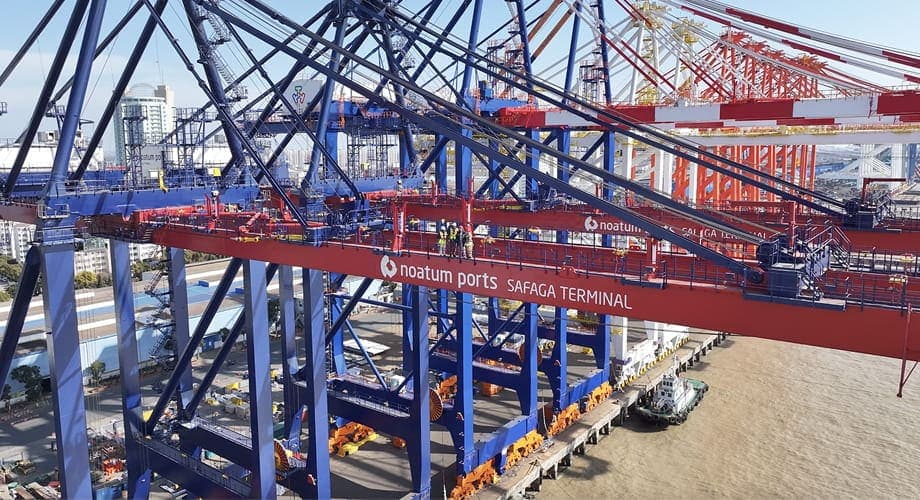
On the Red Sea, development projects are focused in particular on Nuweiba, Safaga and Hurghada, while the Safaga 2 Multi-Purpose Terminal covers 776,000 square metres, with a 1,100-metre berth and a depth of 17 metres. The Safaga navigation channel is also being dredged to reach a depth of 19 metres. At Sokhna, meanwhile, the port has reached a depth of 19 metres and has been recognized by Guinness World Records as the deepest man-made port built on land.
Private-sector participation represents another key pillar of the strategy. Numerous investment opportunities have been identified across Egypt’s main ports. At Alexandria, these include the development and operation of El Max Port and the operation of two logistics zones, while at Damietta opportunities include the management and operation of the Tahya Misr 2 Multi-Purpose Terminal and the Grain and Silos Terminal.
Further opportunities involve multi-purpose terminals at Safaga, El Arish, Abu Qir and East Port Said, as well as the construction and operation of terminals at Taba Port.
A Transport Network Extending Beyond the Ports
The transformation of Egypt’s transport system also encompasses the country’s road network. Some 7,500 kilometres of new roads have been constructed, while a further 10,000 kilometres of existing roads have been developed. In addition, 35 new Nile bridges and axes have been constructed, bringing the total to 73, while the nationwide number of bridges and tunnels has reached 2,500.
This is complemented by the development of 41,000 kilometres of local roads under the first phase of the presidential Decent Life (Hayat Karima) initiative.
An important role will also be played by the high-speed electric rail network, designed not only for passenger transportation but also as a strategic infrastructure system connecting seaports with industrial zones, agricultural production areas with export gateways and new urban communities. Its integration with ports, dry ports and logistics zones will further strengthen multimodal transport.
This infrastructure network is particularly important for the tourism sector, connecting some of Egypt’s major destinations. From the Red Sea diving destinations around Hurghada to the Pyramids of Giza, and from Abydos and Luxor to Aswan and Abu Simbel, the objective is to improve connectivity between the country’s different tourism hubs. The network also encompasses destinations of significant cultural and religious importance, such as the Monastery of Al-Muharraq in Assiut, contributing to a more integrated mobility system linking ports, airports, railways and roads.
Digital Transformation and Sustainability
Modernization also extends to services. A significant example is the Yacht Tourism Platform, introduced to simplify yacht entry and exit procedures. Processing times have been reduced from approximately 30 days to just 30 minutes, enhancing Egypt’s competitiveness as a yacht tourism destination.
At the same time, the Ministry’s strategy places strong emphasis on environmental sustainability, with the aim of reducing carbon emissions and pollution in line with international standards, promoting electrification and reducing dependence on conventional fossil fuels. The development of greener and more sustainable ports is also part of this broader vision.
An Integrated Vision
Taken together, the projects completed and currently under development outline a strategy that goes far beyond simply increasing port capacity. Egypt is building an integrated network of maritime, road, rail and logistics infrastructure, supported by international partnerships and growing private-sector participation.
The country’s geographical position, at the crossroads of the Mediterranean, Red Sea, Africa, the Middle East and Asia, makes this strategy particularly significant. Through new terminals, logistics corridors, multimodal connections, digital transformation and investments in sustainability, Egypt aims not only to become a transit point for goods, but an integrated maritime and logistics hub capable of supporting trade, industry, tourism and long-term economic development.
Giorgia Lombardo